
Kitchen Cabinet Refacing in Oakville — Sprayed Boxes, Not Stick-On Veneer
We check the boxes before anything else. If they are sound, you get new doors and drawer fronts, and the boxes themselves are sprayed in 2K polyurethane — not wrapped in stick-on veneer.
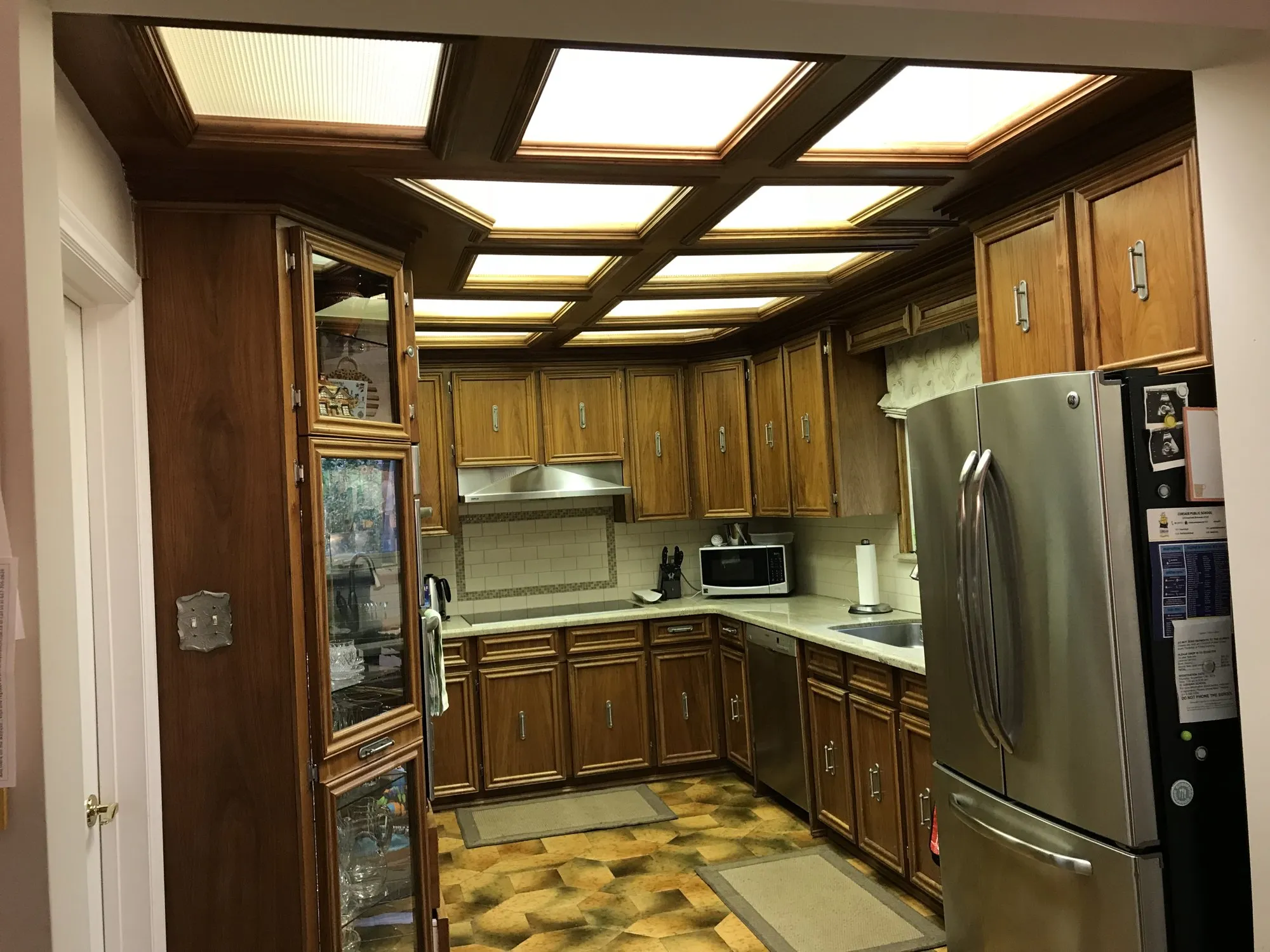 Before
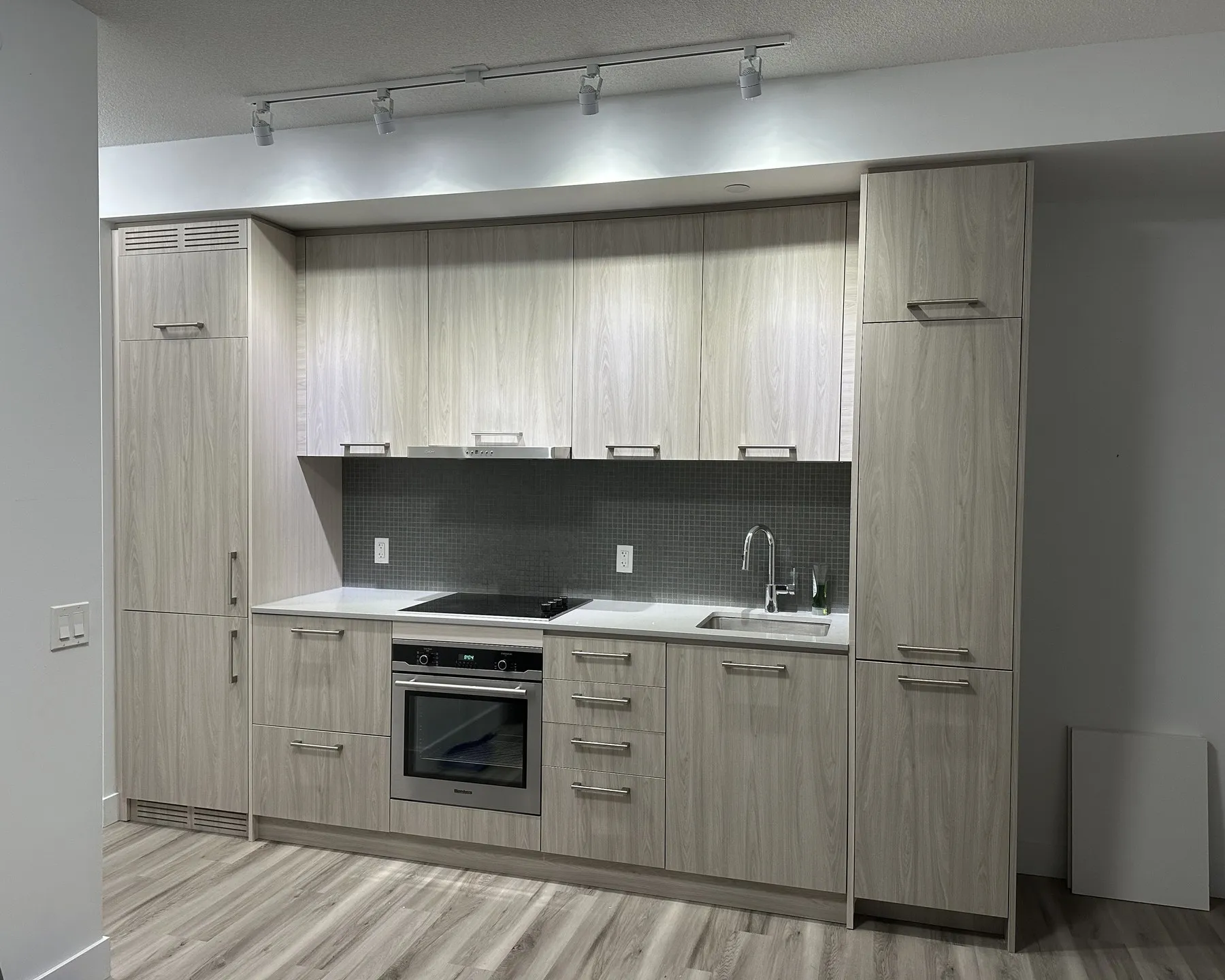
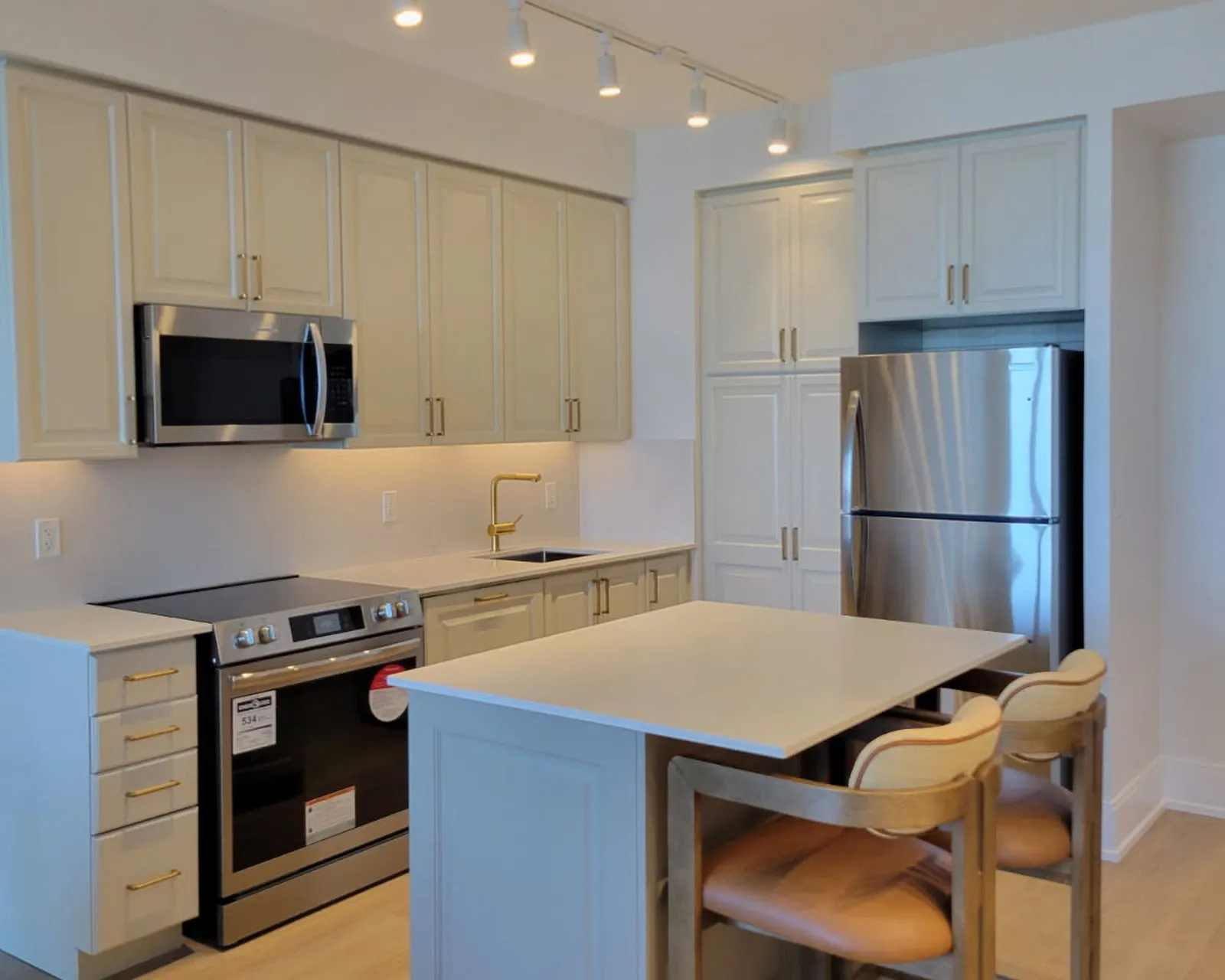
 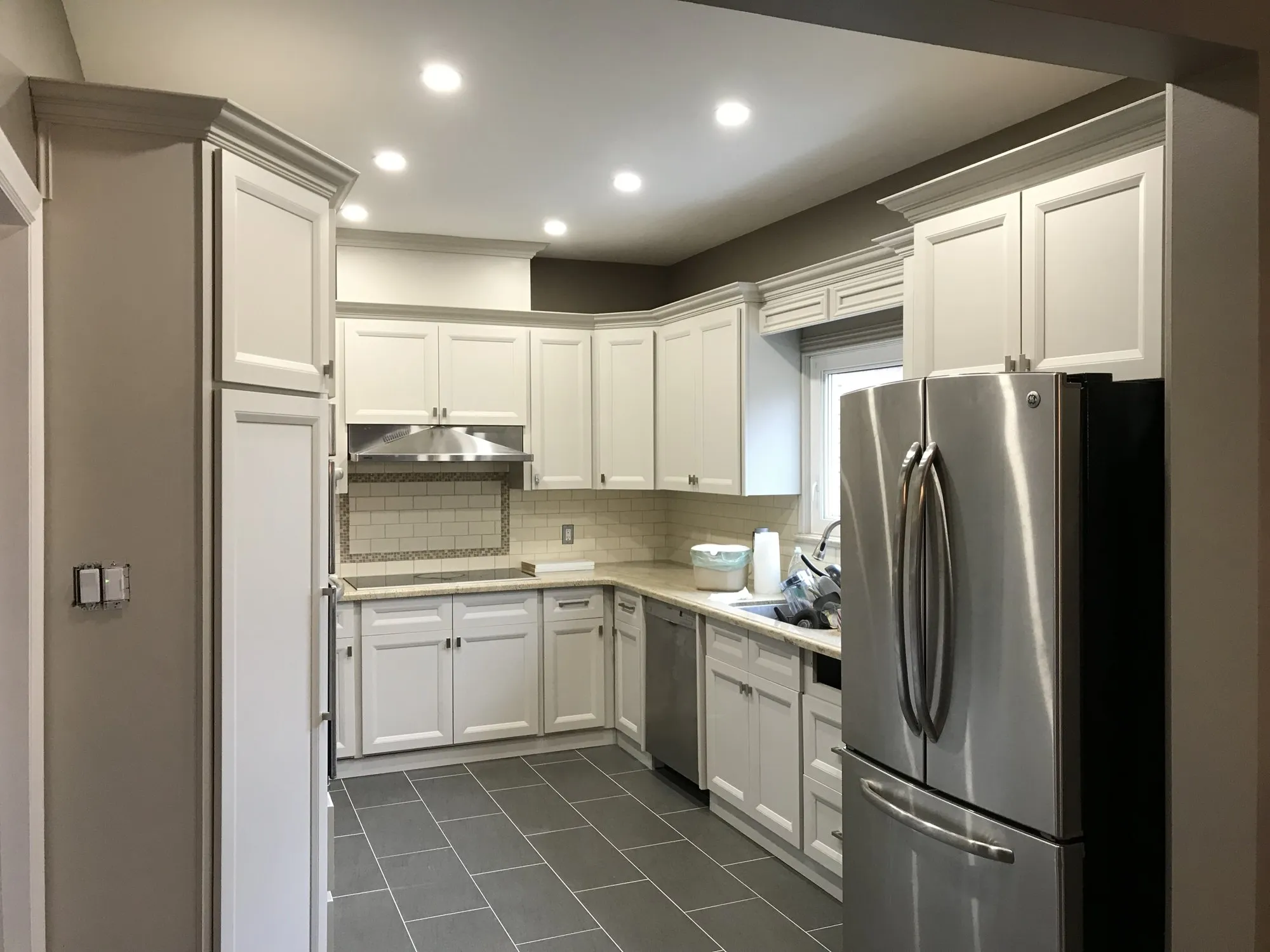 After
After 5 days
The kitchen is out of action, not weeks
100+
Kitchens completed
25 years
In the trade, and here since 2013
5.0
Rated on Google
How Cabinet Refacing Works and What It Replaces
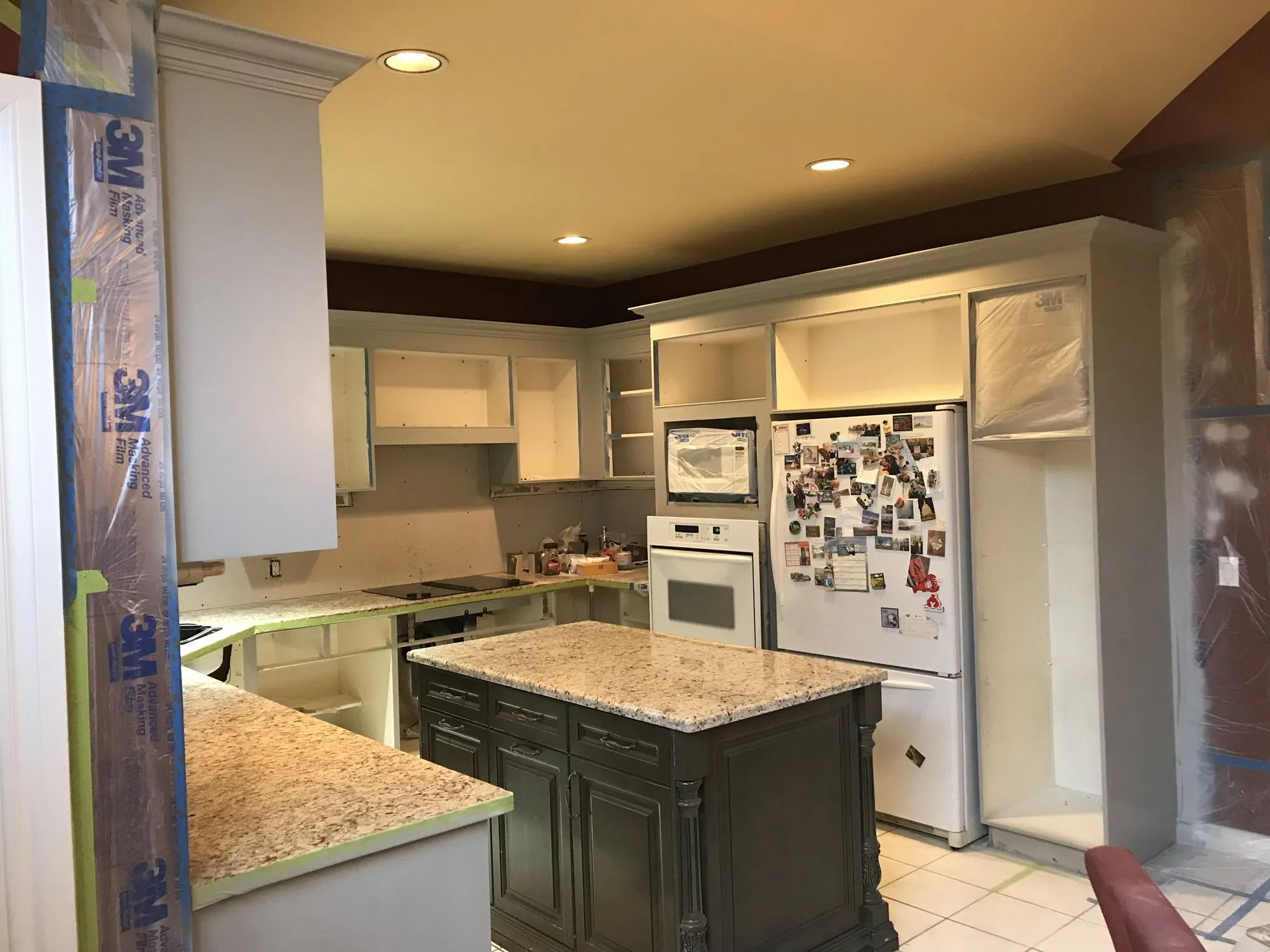
Cabinet refacing is usually described as new doors on old boxes. That is half of it. The other half is what happens to the boxes themselves, and it is the half that decides whether the finished kitchen reads as rebuilt or as patched.
What stays and what changes
Cabinet refacing keeps your existing cabinet boxes in place. Those boxes are the structural backbone of your kitchen. If they are square, solid and properly mounted to the wall, there is no reason to rip them out. What changes is everything you see and touch.
We replace every door and drawer front with brand new ones, made to your measurements. They arrive from the door maker already sprayed in 2K, in the colour we specify — solid wood if you want the grain to show through the colour, waterproof MDF if you want a painted finish that will not move with the seasons. The visible faces of your cabinet boxes are then sprayed in place with the same 2K polyurethane, so the whole kitchen is one finish rather than two.
Sprayed boxes, not stick-on veneer
This is the part that separates us from most refacing companies. The usual approach is a stick-on veneer film over the boxes, which limits you to the colours the film comes in and can lift at corners and edges over time. Veneer also cannot be repaired — a damaged section has to be replaced. A sprayed box can be any colour you like, has no seams, and can be touched up. Your old hinges can stay if they are working fine, but most people take the soft-close upgrade once they have felt the difference.
What gets replaced:
- All cabinet doors and drawer fronts — made to your exact measurements
- Every visible cabinet box surface — sprayed with 2K polyurethane, in any colour you choose
- Hardware like handles and drawer pulls if you want a fresh look
- Hinges, when upgrading to soft-close
What else can go on the same quote
Because the same crew does the carpentry as well as the finishing, the things that are awkward to bolt onto a refacing job elsewhere are ordinary add-ons here — crown moulding across the tops, new drawer boxes with soft-close runners where the old ones stick, a shelf arrangement changed, a countertop coordinated to land in the same week. Each one is a separate line on the quote, so you can see what it adds rather than being handed a single number.
What stays is everything structural — the cabinet boxes, the countertop, the plumbing, the electrical. That is why you lose the kitchen for five days rather than the three to six weeks a full tear-out demands — even though the project as a whole runs four to five weeks, because your doors are made to measure before we start.
Why you keep the kitchen while it happens
Whether your boxes are worth keeping is a question about the boxes, not about the decade the kitchen went in. Plenty of old cabinetry is better built than plenty of new cabinetry. What we look for is the material, whether it has stayed dry, and whether the boxes are still square and firmly fixed — and we look before recommending anything.
And because nothing gets demolished, there is no month of takeout and no washing dishes in the bathtub. For the four weeks your doors are being made, the kitchen works exactly as it does today — no crew, no dust, nothing started. The week we are in the house is the disruptive one, and we ask you to be elsewhere for the two or three days we spend spraying. The containment keeps the solvent out of the rest of the house; it does not make the kitchen a pleasant place to sit.
When Refacing Is Not the Right Fix for Your Cabinets
Sometimes we look at a kitchen and know straight away that refacing will not solve the problem. It is not what people want to hear, and saying it early saves them money.
When the boxes themselves have gone
Where the cabinet boxes are falling apart, refacing is a waste. Particle board swollen from years of water under the sink, or boxes that have pulled away from the wall because the mounting hardware failed. New doors on a crumbling frame will not last — they look good for a few months and then the same problems return. That is a case for new cabinet boxes built from scratch.
When the layout is the problem
Layout is the other one. Refacing keeps your cabinets exactly where they are, so if the problem is the flow — an island you want to add, a fridge you want moved, a wall you want opened up — refacing cannot help. When somebody asks about refacing and then mentions moving things around, we steer them towards a full kitchen design conversation instead.
The clearest signs refacing is not your best path:
- Cabinet boxes show water damage, soft spots, or visible mould
- Shelves sag badly even when empty
- You want to change your kitchen's footprint or add more storage
- Boxes have separated from the wall or each other
The mistake we see more often
The opposite mistake is the more common one. A few scratches, sticky drawers or outdated hinges do not mean the boxes are bad. We see this every week in older Oakville neighbourhoods like Bronte — dated doors in front of boxes with decades of life left in them. They need new faces, nothing more. Which of the two you have is a question about your boxes rather than the year the kitchen went in, and it is why we look before recommending anything.
Photographs settle which category your kitchen falls into in most cases. Wide shots of each run of cabinet, and we will tell you straight whether refacing makes sense or whether you would be better off going a different route — no appointment, no pressure either way, and nothing spent finding out.
What Happens During a Cabinet Refacing Project
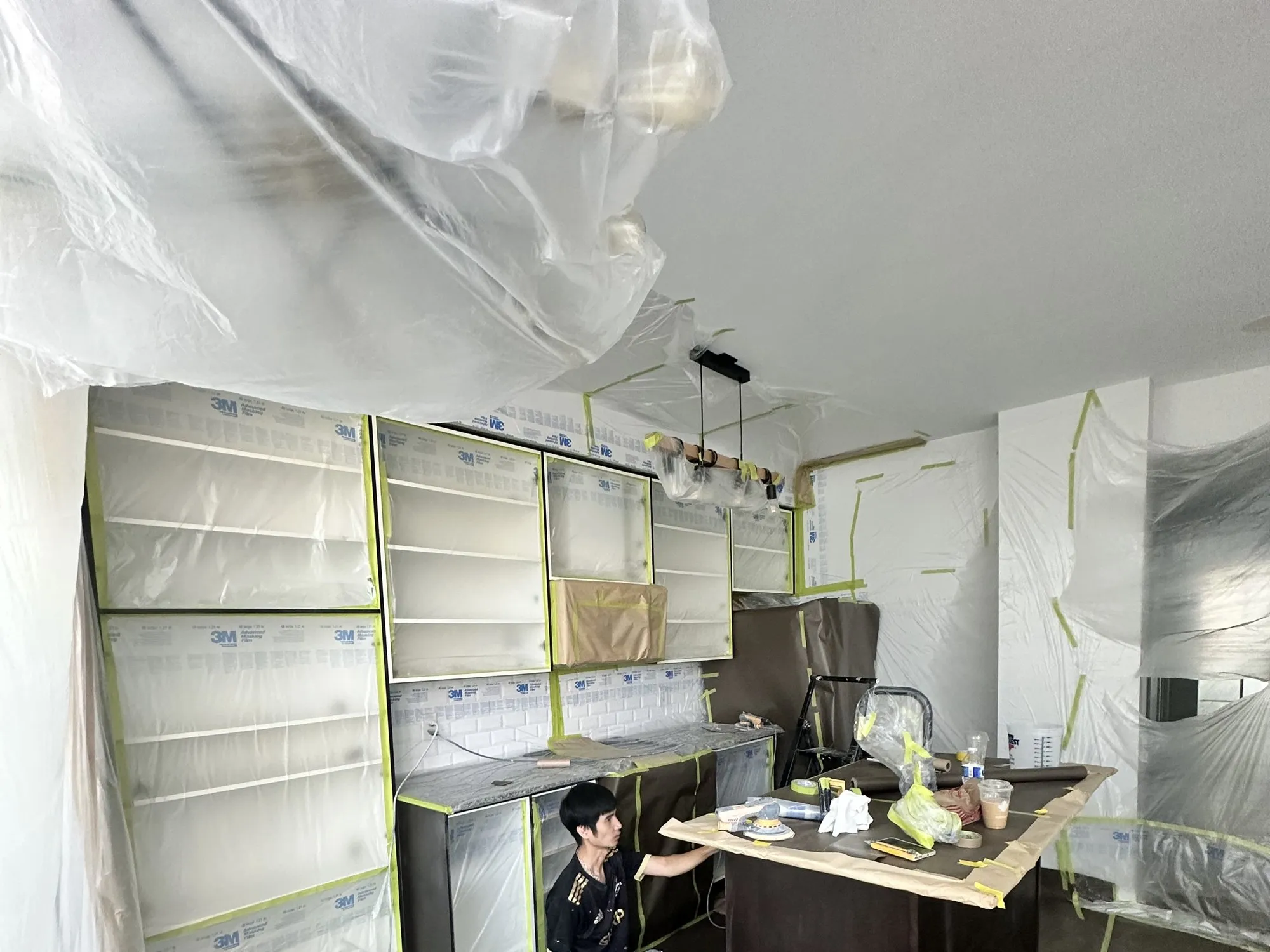
People picture weeks of chaos — dust everywhere, no kitchen, takeout for a month. That is not how this runs.
A refacing project has two halves, and only one of them happens in your house.
The four weeks nothing happens at home
The first is manufacturing. Once we have measured every opening and you have chosen the door style, material and colour, your doors and drawer fronts are made to those exact measurements. That takes about four weeks, and nothing changes at home while it happens — your kitchen works exactly as it did before.
The five days in your house
The second half is the installation week, and that is the five days people mean when they talk about a five-day kitchen:
- Day one: removal and containment. Old doors and drawer fronts come off. We build the containment — zipper walls and sheeting sealing the kitchen off from the rest of the house — mask the appliances and counters, and set up filtration and ventilation.
- Days two and three: preparing the boxes. Every box is degreased with our own solvent formula, which lifts the wax and polish that a water-based cleaner leaves behind, then sanded. Any filler repairs happen here. Prep is what decides whether a finish lasts.
- Days four and five: spraying. Tinted primer first, then sanded, then two topcoats of 2K polyurethane with a cure between each. The primer is tinted to your colour, so a future chip does not flash white.
- Final day: installation and walkthrough. Your new doors and drawer fronts go on, hardware is fitted and every door and drawer is adjusted. Then we go through every cabinet with you before anything is signed off.
Four to five weeks, then, from the first visit to the walkthrough, of which five days are the ones you notice.
Quieter than people expect
The process is quieter than a full tear-out, which surprises people. There is no demolition. No drywall repair. No plumbing or electrical disruption, because nothing is disconnected and nothing comes out. You lose the use of the kitchen for the installation week, but the kitchen itself stays intact throughout, and it goes back into service the day we finish — the 2K is cured by the walkthrough, so you can load the cupboards that evening.
Many of our clients in Oakville's older Bronte Village homes choose refacing because the boxes behind those dated doors turned out to be sound — they needed a fresh face, not a skip.
And because we use professional 2K solvent-based polyurethane finishing systems, the same materials used by high-end furniture manufacturers, every surface cures hard and stays that way. To find out what it would cost on your kitchen, send photographs — the written quote comes back inside 24 hours, and it is a quote rather than an estimate, because the figure we send is the figure you pay.
Cabinet Refacing for Oakville's Established Kitchens
Most kitchens we work in across Oakville have the same thing wrong with them. The boxes are sound. The layout works. But the doors look tired, the finish has yellowed, and the whole room feels ten years behind the rest of the house.
That is the kitchen refacing was designed for.
Sound boxes behind dated doors
Homes in neighbourhoods like Old Oakville and Bronte often turn out to have cabinetry that is still perfectly square and sturdy behind the doors. Ripping those out makes no sense. The bones are good. What needs to change is everything you see and touch: the door fronts, drawer faces, exposed end panels, and the finish that ties it all together. Refacing keeps those strong boxes in place and gives you a completely different kitchen, with five days the only ones you are without it.
We see the same reaction every week. Somebody stands in their kitchen, looks at the raised-panel oak doors, and assumes the only fix is a $30,000 gut renovation. It is not. Cabinet refacing replaces the visible surfaces while your plumbing, countertops and layout stay exactly where they are. No demolition dust settling on everything you own, and no weeks of takeout.
Why the booth matters
Your new doors arrive sprayed with professional 2K solvent-based polyurethane, and we spray your boxes on site in the same colour and the same system — doors and boxes finished in the same system and the same colour. A refacing company that cannot spray the boxes cannot do that, which is the reason they reach for veneer. It is the same coating system used by high-end furniture manufacturers. It cures harder than water-based alternatives, resists moisture and grease, and will not yellow over time the way your old finish did.
What actually bothers people
What bothers people about their kitchen is almost never the cabinet boxes. It is the colour, the style of the doors, the cheap hinges that do not close properly. Refacing addresses all three. You can move to a shaker profile, switch to a modern slab door, add soft-close hinges and change the hardware, without a single wall coming down.
Sound structure behind outdated surfaces is the problem refacing was designed to solve. Where that is what you have, there is no reason to pay for a tear-out to fix it.
The real choice
Refacing or full replacement: where the money and the weeks actually go
This is the question most people arrive with, and the answer below is the one we give on the phone before anybody has committed to anything.
| Aspect | Refacing your boxes | Full cabinet replacement |
|---|---|---|
| What it costs | Most kitchens land between $8,000 and $15,000, depending on size and materials — like for like, a saving of roughly $17,000 to $25,000. | Typically starts around $25,000 and commonly runs $30,000 to $40,000 once trades, countertops and finishing are counted. |
| Your cabinet boxes | Stay where they are. If they are square, solid and dry, there is nothing to fix. | Come out. Every box, every shelf, into a skip — sound or not. |
| Time without a kitchen | Five days. The doors are made off site over about four weeks while your kitchen carries on. | Three to six weeks, and the room is a construction zone for all of it. |
| Walls, plumbing, electrical | Untouched, because nothing is disconnected and nothing comes out. | Walls often need patching, and plumbing and electrical sometimes need adjusting. |
| What changes | Every surface you look at and touch — doors, drawer fronts, end panels, the finish. | The same, plus the boxes behind them and the layout if you want it. |
| When it is the right call | The boxes are sound and it is the doors, the colour or the hinges that have aged. | The boxes are warped or water-damaged, or the layout itself is the problem. |
Refacing may not be the job you need
Plenty of people arrive asking about refacing and book painting instead. If the doors themselves are sound and well made and it is only the colour that has aged, replacing them is money spent on the one part that was not wrong. That is an easier call to make with both jobs side by side, which is what how refacing and painting compare on the same kitchen sets out — along with the countertop and cabinetry work that sometimes turns out to be the actual problem.
Recent work
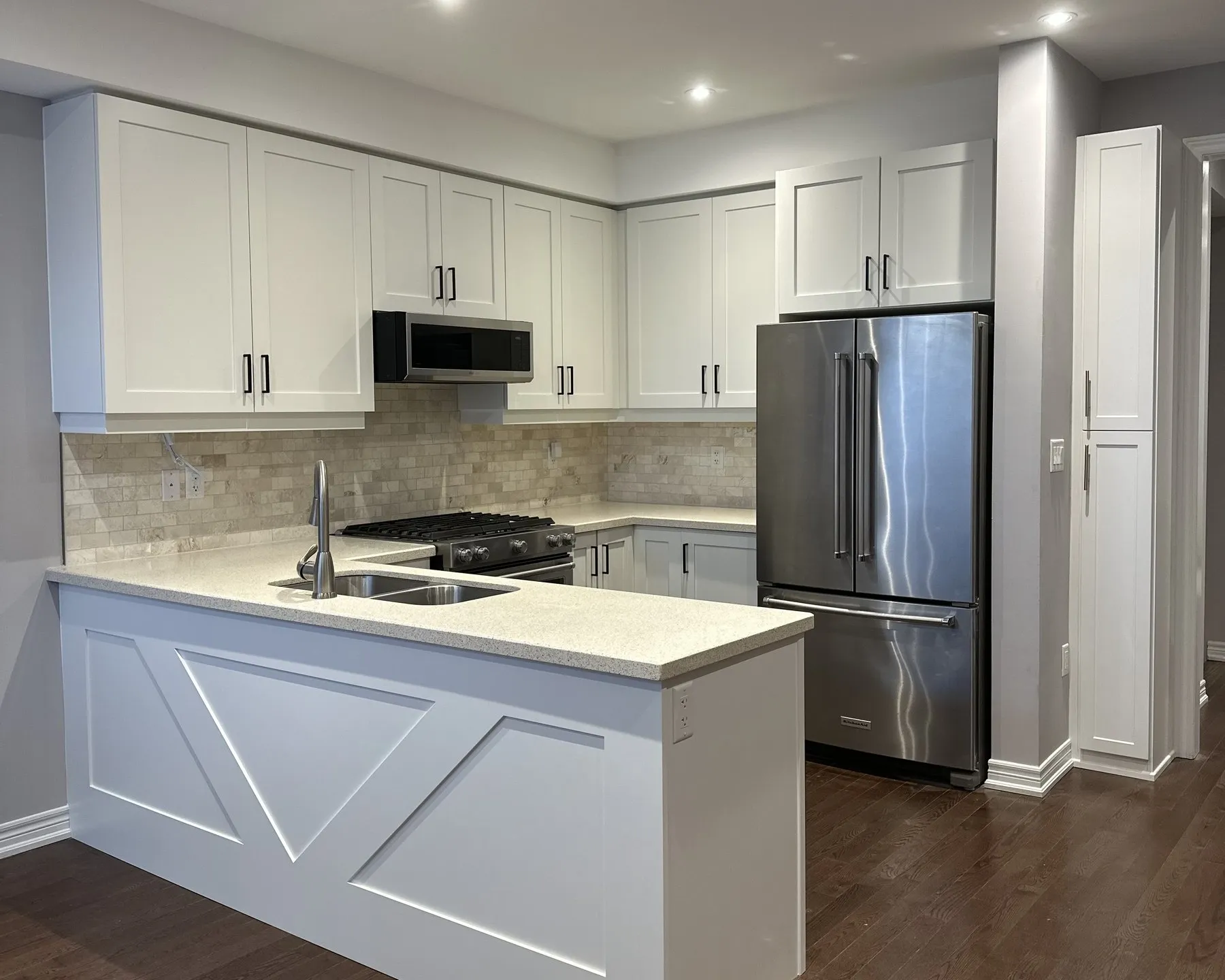
Kitchen cabinet refacing in Oakville, before and after
Same boxes, same layout, one installation week apart.
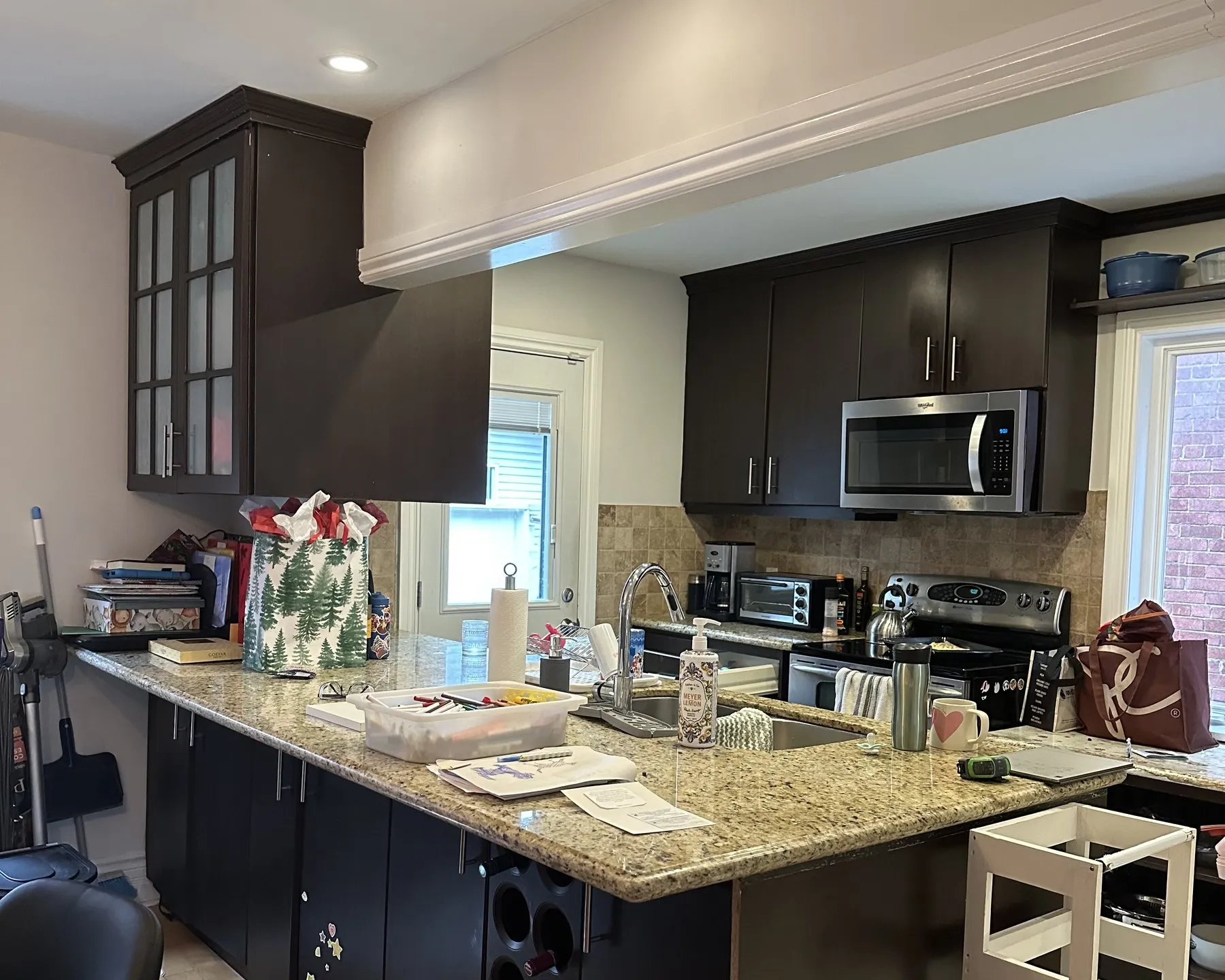 Before
 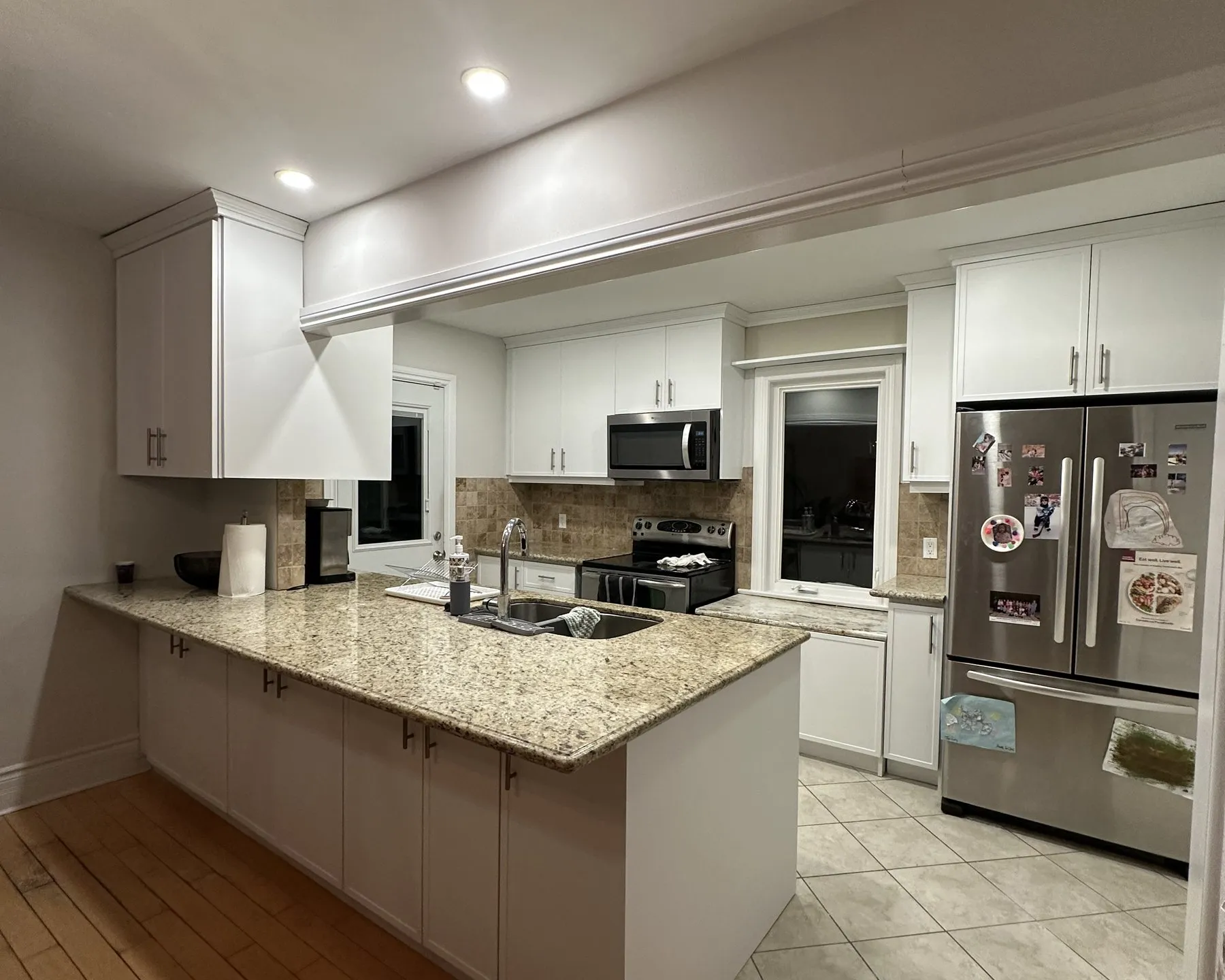 After
After 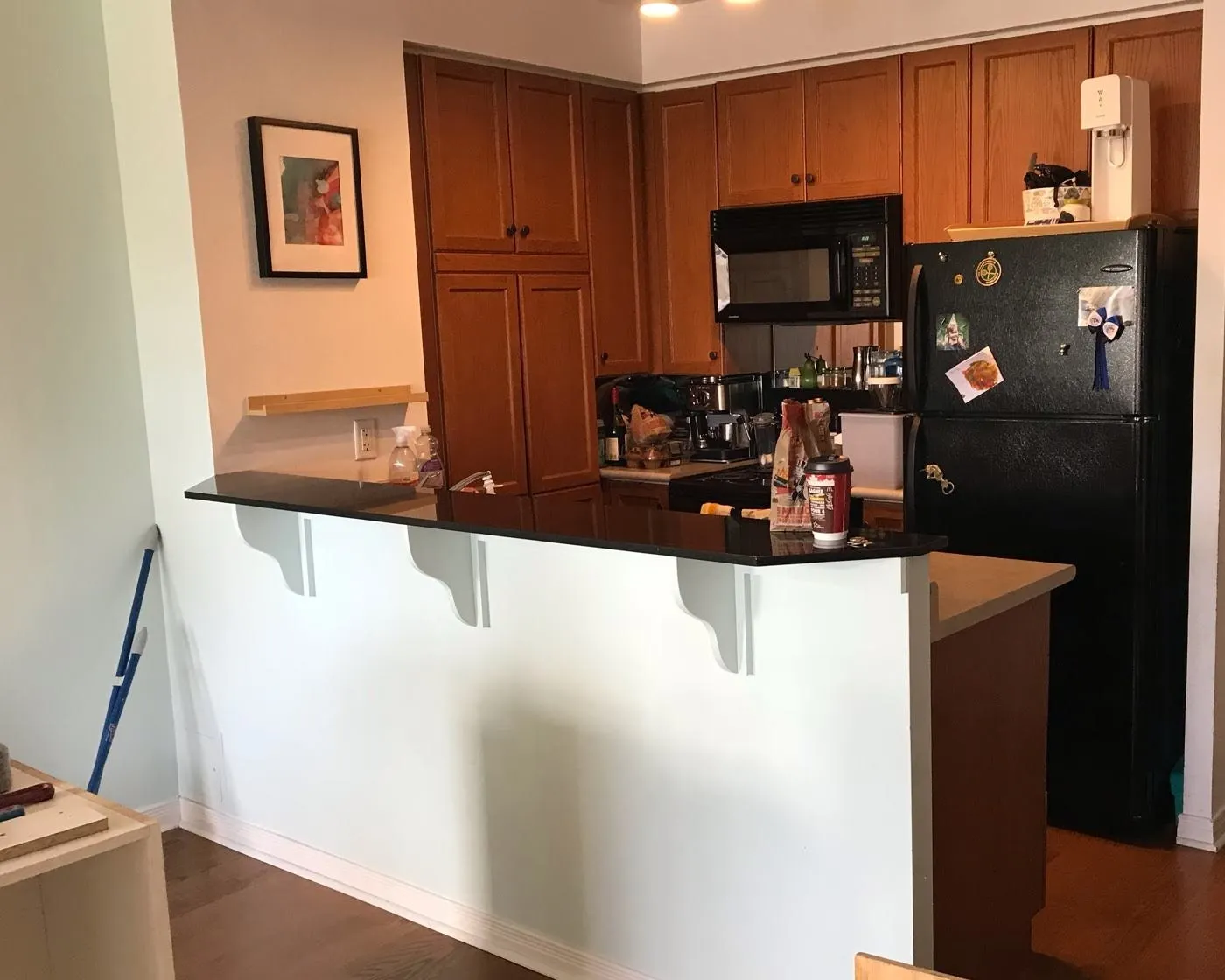 Before
 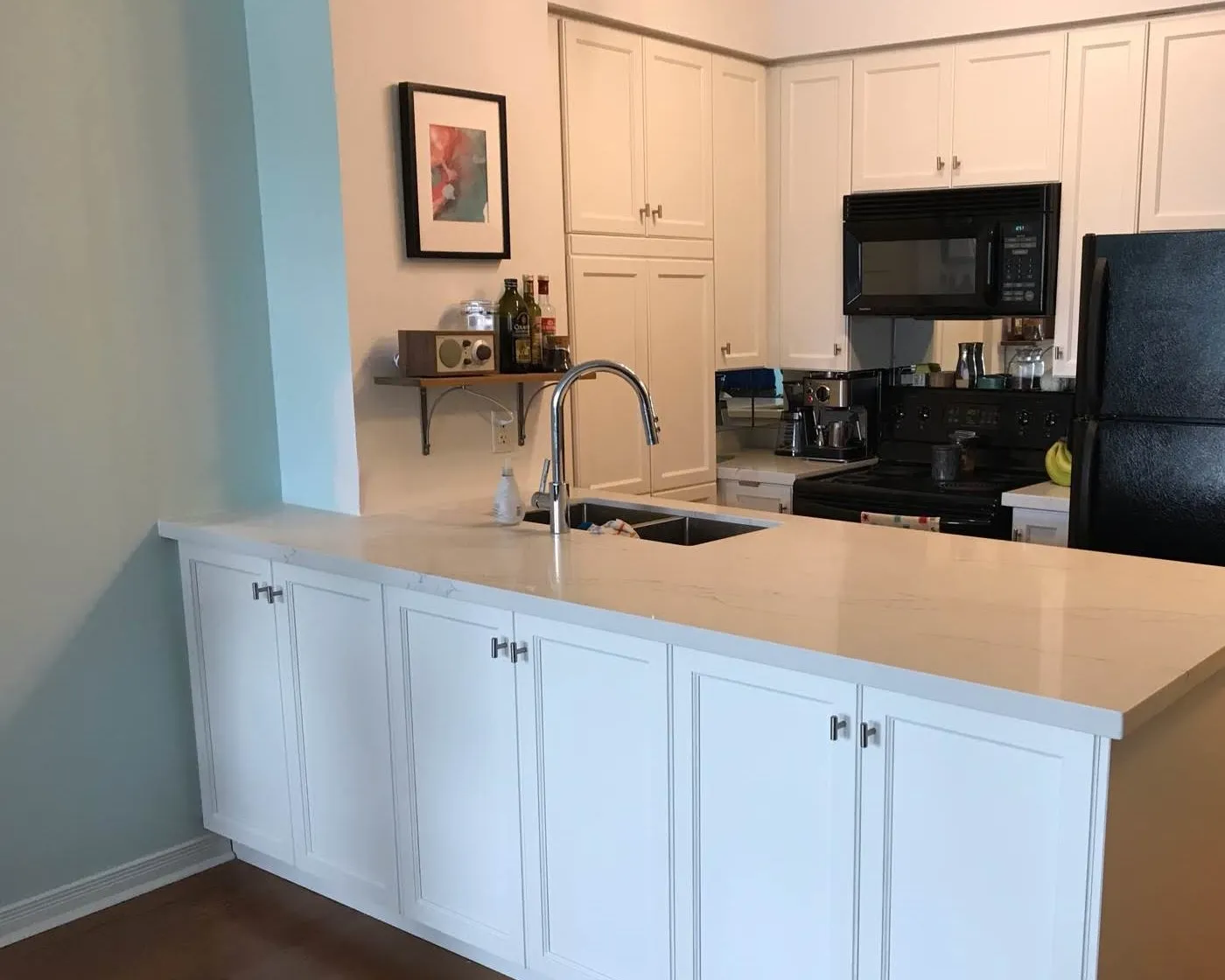 After
After 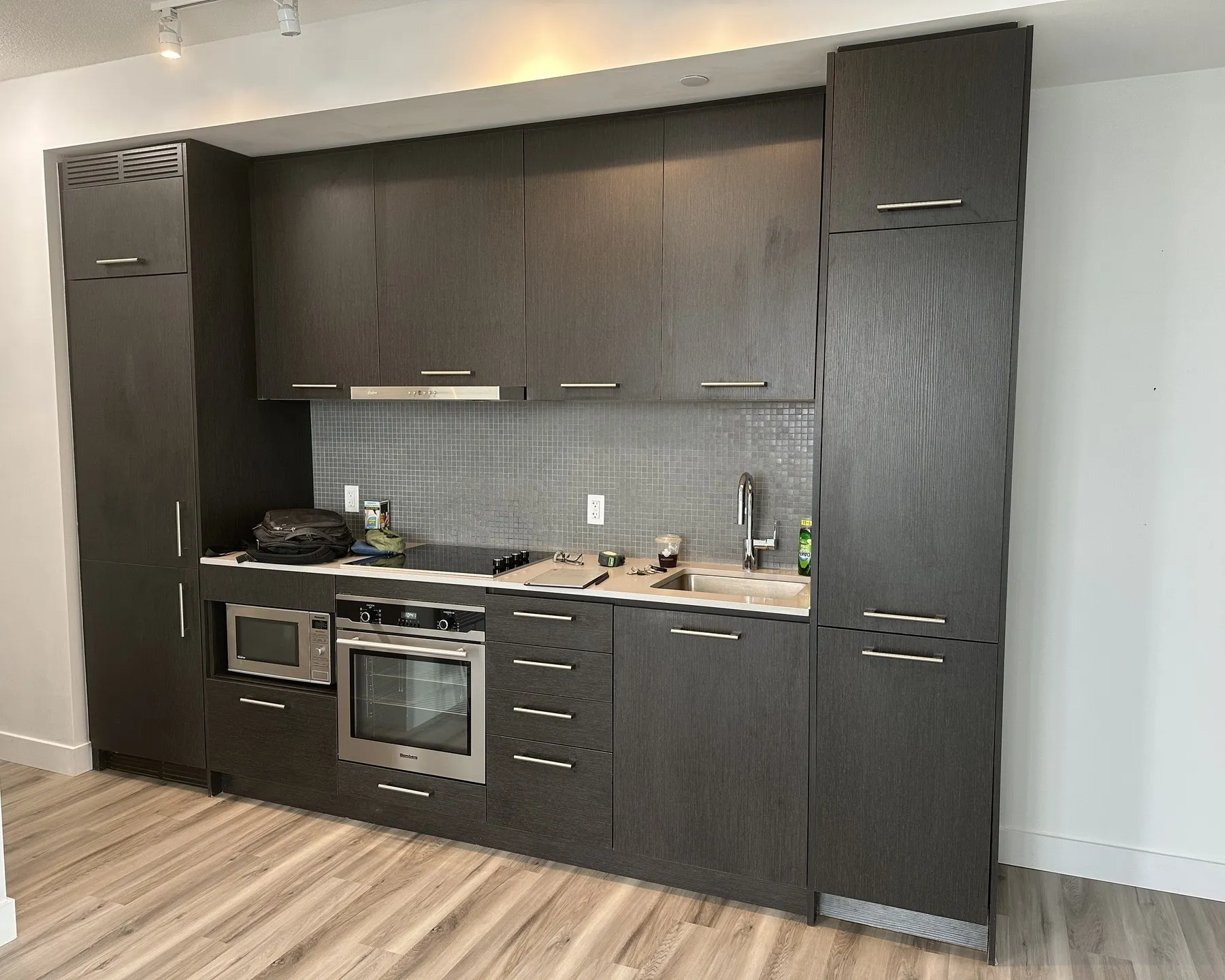 Before
  After
After 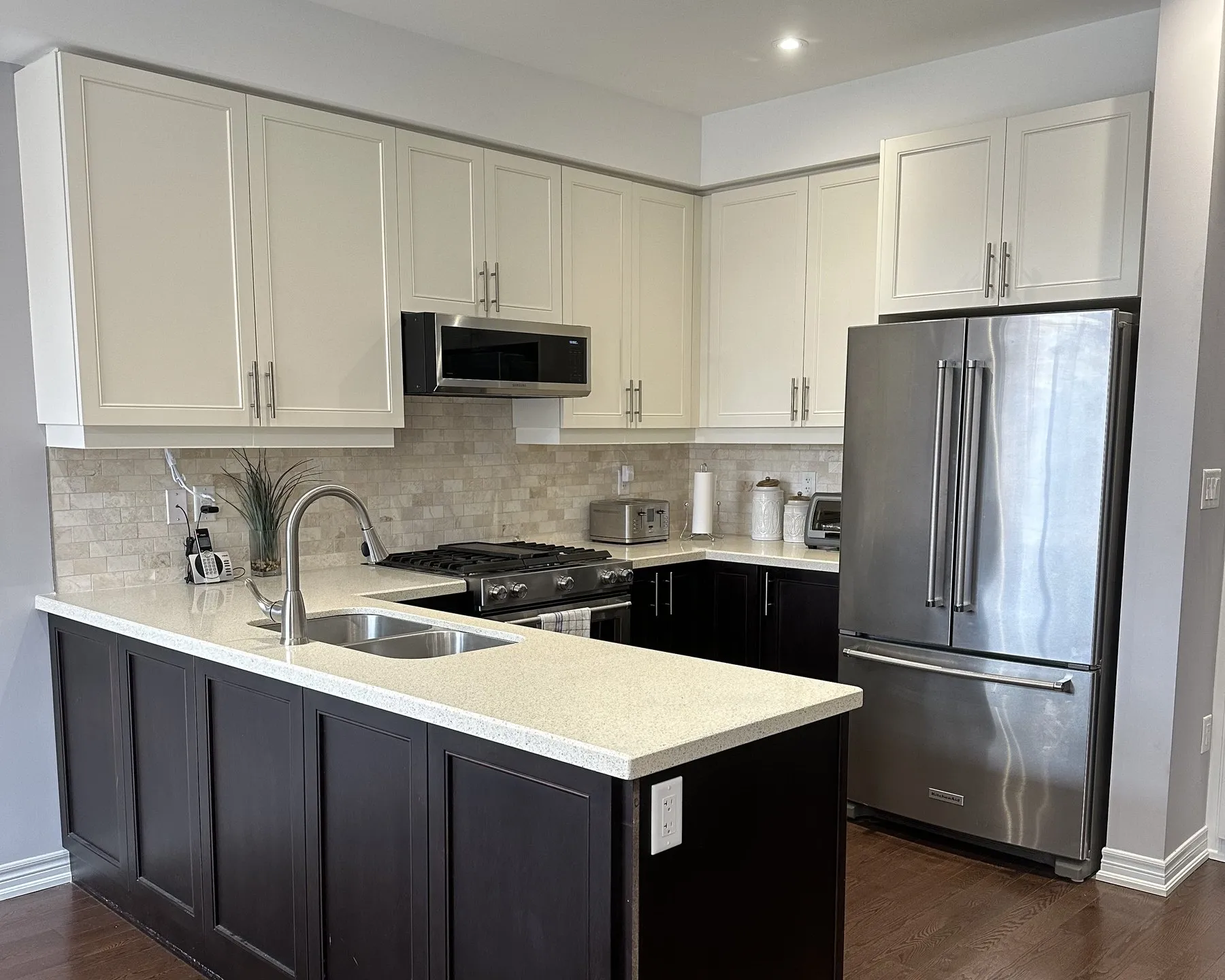 Before
  After Before After
 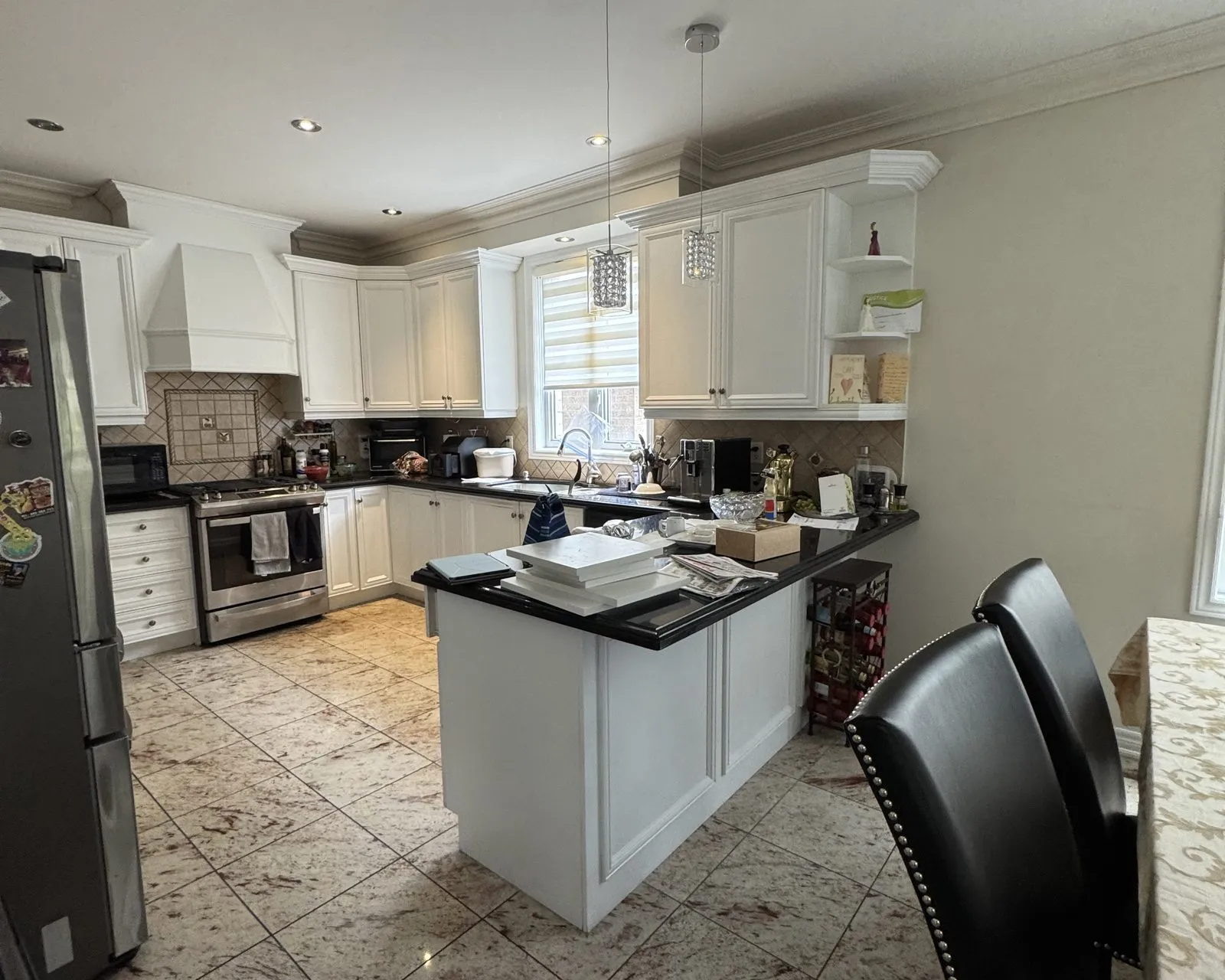 Before
 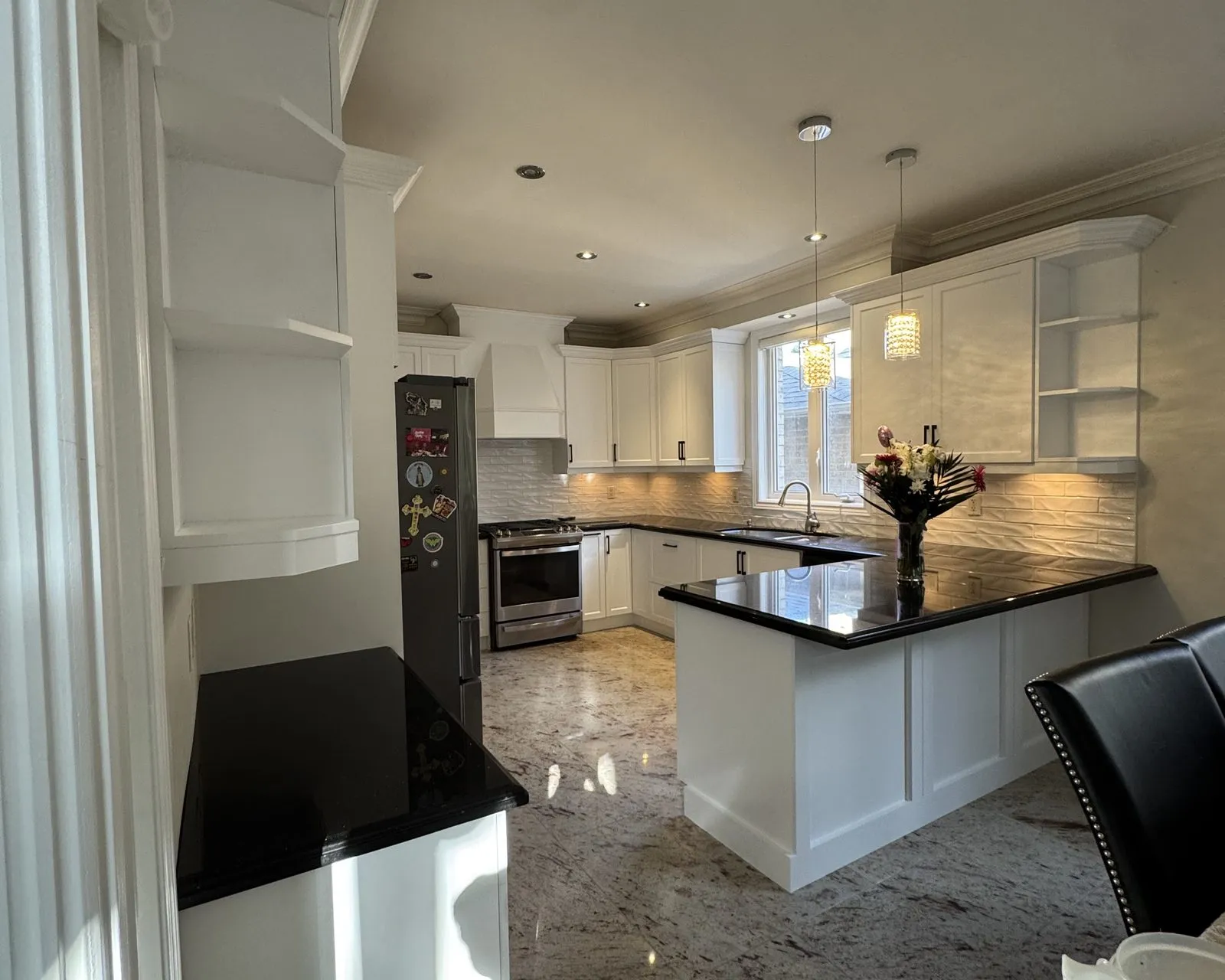 After
After 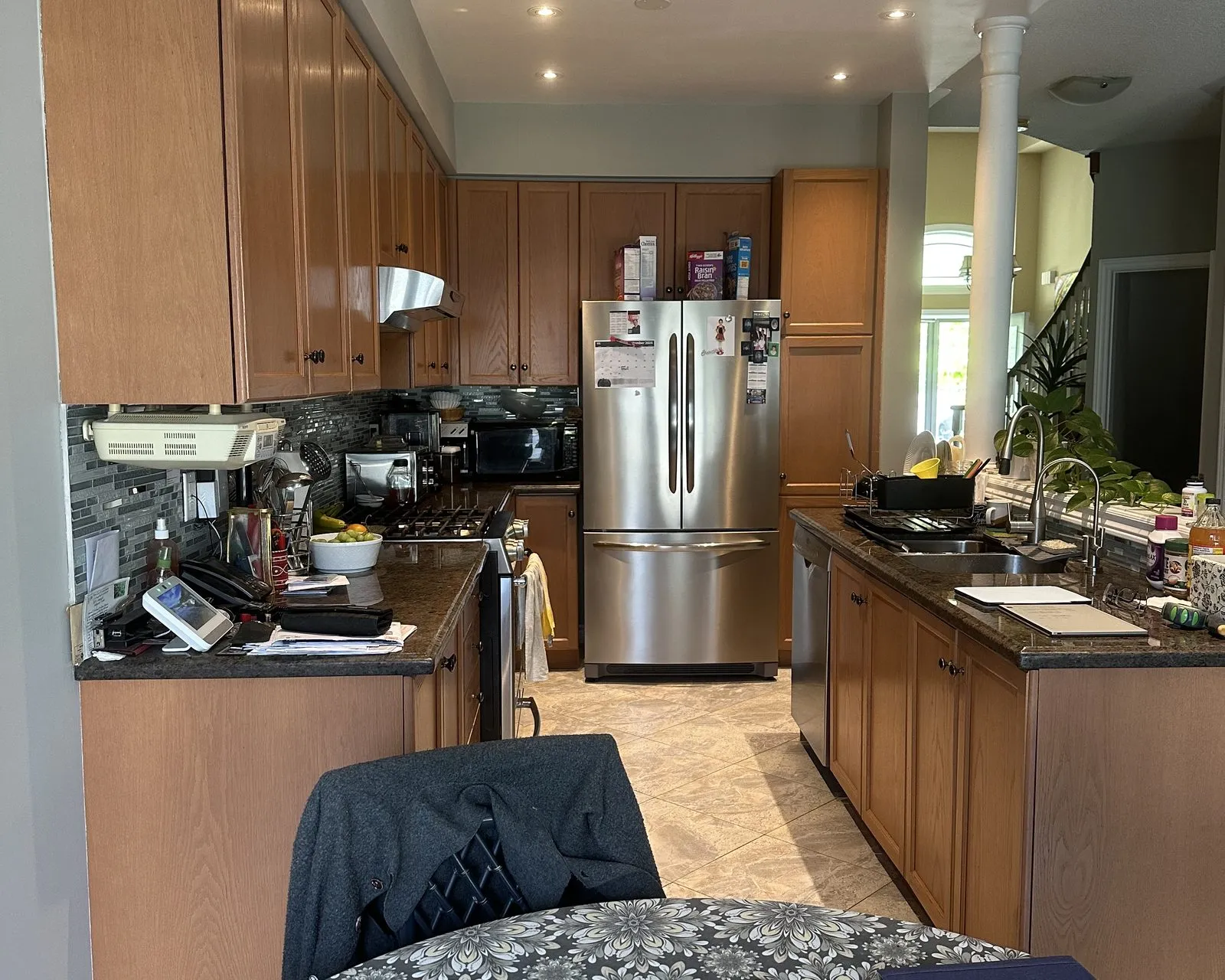 Before
 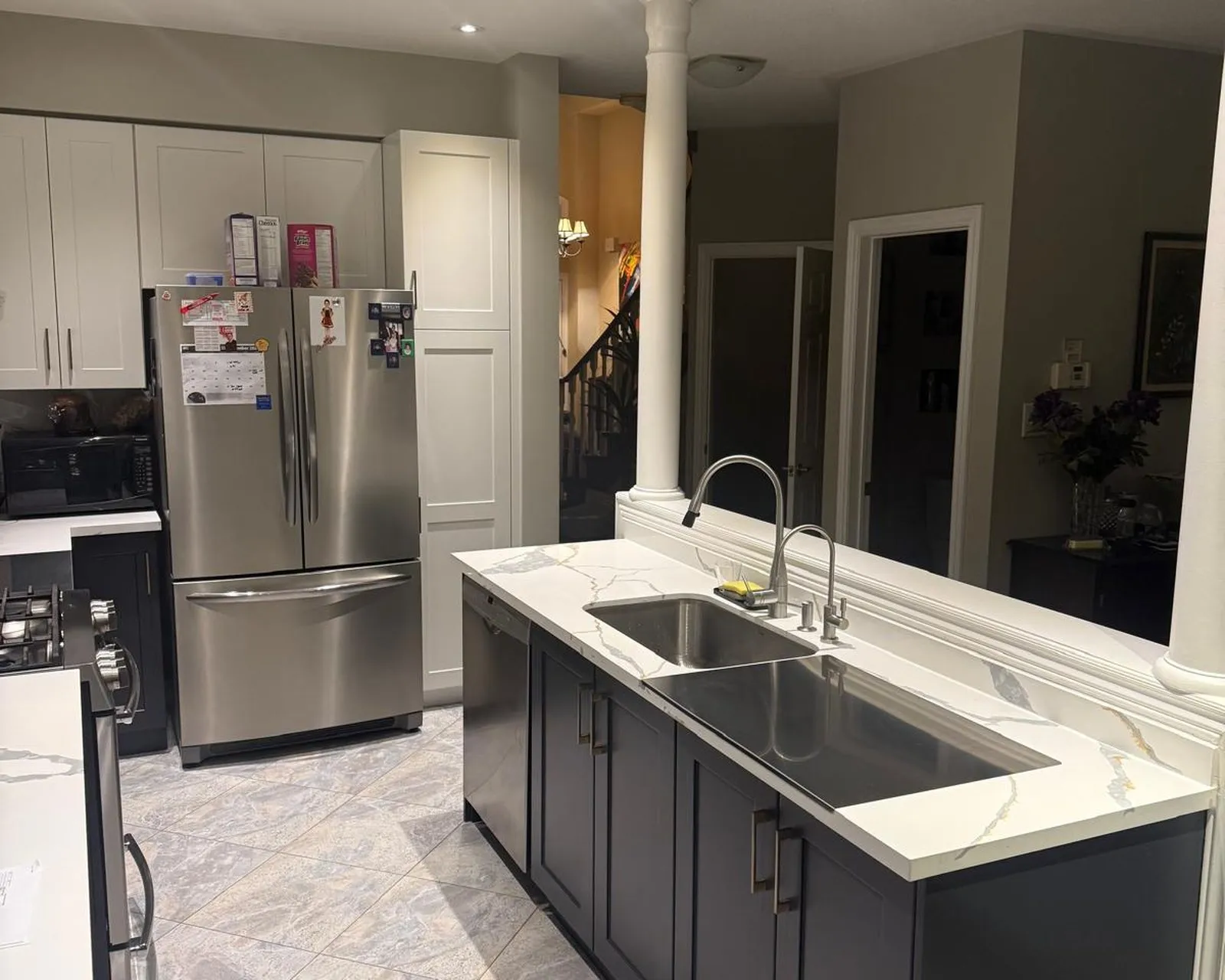 After
After 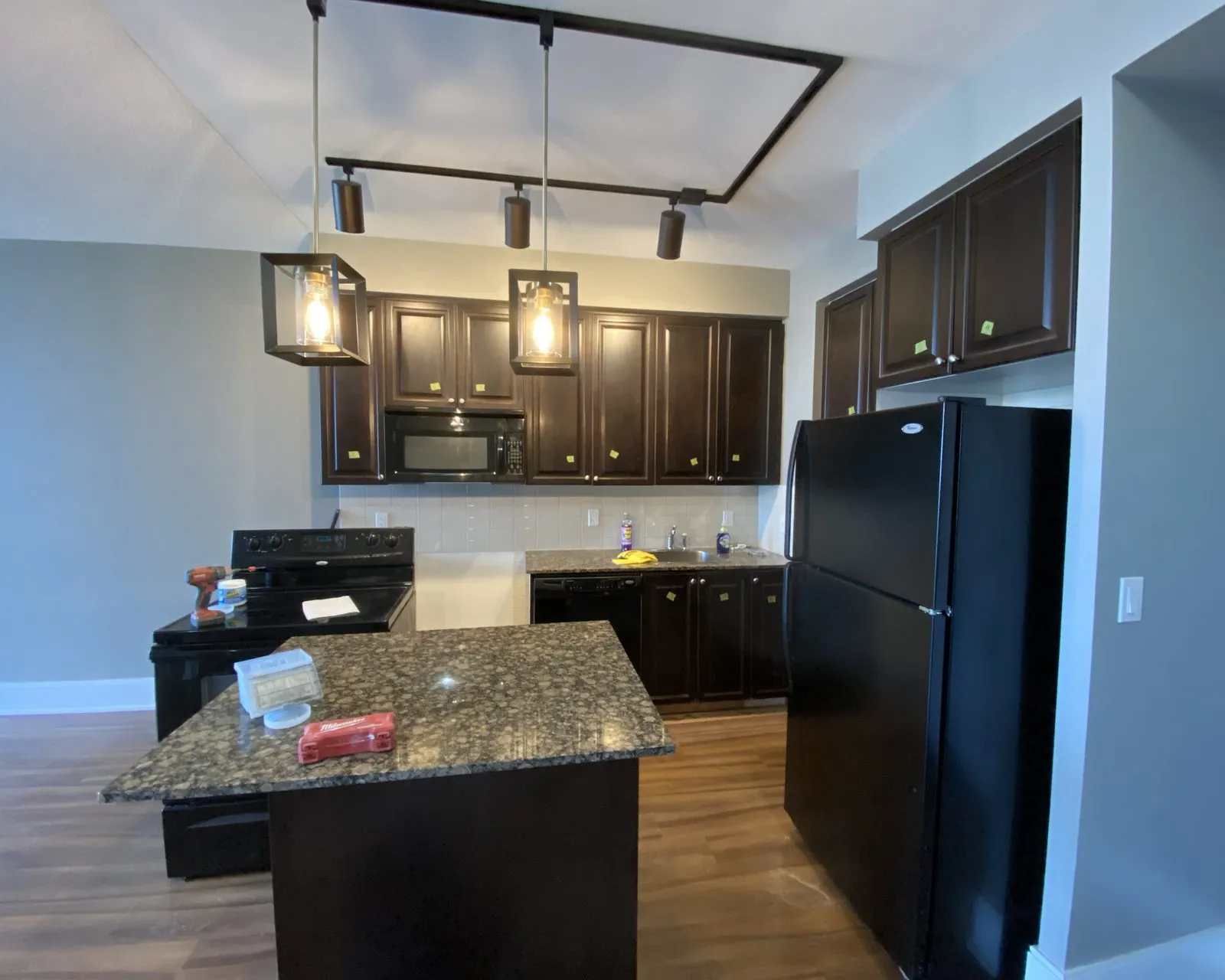 Before
  After
After Kitchen Cabinet Refacing Cost in Oakville
Refacing lands around half the cost of tearing the kitchen out and replacing it, and the saving comes from labour and disposal as much as from materials. Nothing is demolished, no trades wait on each other, and there is no skip.
The quote is built in three layers, and the reason to show them separately is so you can take one out. The count covers every door and drawer front, each of which is measured, made, finished and hung. The days cover the on-site week at a day rate, which follows from how many boxes there are and how awkward the layout is to work around. The material runs from painted MDF at one end to rift-cut hardwood with a custom stain at the other.
Two details specific to refacing move the price more than people expect. Boxes are sprayed in 2K polyurethane rather than wrapped in stick-on veneer, so their condition affects the prep hours directly. And where old handle holes do not fall under the new hardware, they are filled properly — solid wood dowels where the new hole lands close to the old one.
Doors and drawer fronts on waterproof MDF carry a fifteen-year warranty. The finish and workmanship carry five.
Book it
Find out what refacing your kitchen costs
Send wide photographs of each run of cabinet and the written quote comes back inside 24 hours. If your boxes are not worth keeping, we will tell you that instead.
Questions
Common questions about kitchen cabinet refacing in Oakville
- What makes a refaced kitchen look cheap?
Seams where the boxes were wrapped in film instead of sprayed, brush marks on doors viewed from a foot away, and a sheen on the fronts that does not match the frames. None of it shows on the day the work finishes — it shows in year three. We set out the details that give a cheap job away and how to spot them in a quote before you sign one.
- Can I reface my kitchen cabinets myself?
Parts of it, genuinely — removing doors, sanding, fitting hardware. The finish is the part that is not, because a catalysed 2K coating needs ventilation and a controlled space a kitchen does not have. We set out which parts of the job are actually doable at home, including where home attempts usually fail.
- Which cabinets cannot be refaced?
Boxes that have failed — swollen at the base from a slow leak, soft particle board, joints working loose — and surfaces that will not hold a finish, chiefly thermofoil where the film has begun to lift. We set out the kitchens that rule themselves out and how we check before quoting.
- Do the countertops have to come off?
No. The boxes stay fixed and the counters sit on the boxes, so nothing is lifted, disconnected or re-sealed — and the plumbing and walls are untouched for the same reason. We explain why nothing structural is disturbed, including the one case where they do come off by choice.
- How much does cabinet refacing cost in Oakville?
Most Oakville kitchens land between $8,000 and $15,000, and where yours falls depends on the number of doors and drawer fronts rather than the floor area of the room. Hardware, millwork and counters are quoted as their own lines. We set out how a refacing quote is actually built in full, including why two kitchens of the same size can quote differently.
- Is it cheaper to reface or replace kitchen cabinets?
Substantially cheaper to reface — roughly $17,000 to $25,000 less like for like, and five days without a kitchen instead of three to six weeks. Replacement is the right call when the boxes have failed or the layout is the problem. We compare the two options side by side on money, time and disruption.
- How long does cabinet refacing last?
Fifteen to twenty years on the doors and the finish in a normal household, because on the surfaces you touch it is new cabinetry. The 2K polyurethane is catalysed rather than air-dried, so it does not yellow. We explain what actually determines how long a refaced kitchen lasts and what shortens it.
- What material should my new doors be?
For a painted door, MDF — it does not move with humidity the way timber does, so a painted finish will not craze at the joints. Solid hardwood is the answer where you want visible grain. We set out which door materials suit which kitchens, including the substrate we will not spray.
- What actually happens during the refacing week?
Containment goes up first, then the doors come off, then two days of degreasing, sanding and spraying, then the new fronts go on and every door is adjusted. We ask you to be out for the spraying days. We set out the whole process from photograph to finished kitchen day by day.
- What are the downsides of cabinet refacing?
It cannot move anything, and it cannot rescue a box that has failed. Your layout and cabinet positions stay exactly as they are, so a kitchen that annoys you to cook in will still annoy you afterwards — and a box swollen under a leaking sink needs replacing rather than a new front. We set out the four kitchens we turn away every year in full, including the case where refacing would work and painting reaches the same result for less.
- How soon can you start my cabinet refacing project?
- Faster than you would expect, because it starts with photographs rather than an appointment — a written price inside 24 hours, and we do not revise it later. Once you have chosen a door style and colour we measure every opening, and your doors are made to those measurements, which takes about four weeks — nothing changes in your kitchen during that time. The installation week itself is five days. Four to five weeks end to end, with the kitchen out of action for five of those days.
- What happens when your crew arrives to start refacing my kitchen?
- Our crew seals the kitchen off before anything else — zipper walls and sheeting between it and the rest of the house, appliances and counters masked, filtration and ventilation running. Then we remove your old doors and drawer fronts, and degrease and sand the cabinet boxes ready for spraying. Your plumbing and wiring are never touched, because the boxes never come out. What you do lose is the kitchen for the five days, and the house for the two or three of them we spend spraying — the finish is solvent-based and the containment is not a substitute for air.
- Are older Oakville cabinet boxes, like those in Bronte or River Oaks homes, strong enough for refacing?
- Often, yes — but it is not something anyone can tell you from the postcode. Age is a poor guide — what matters is the material the boxes are made from and whether they have stayed dry and square. So we check them rather than guess. If they pass, new doors and freshly sprayed boxes give you a completely fresh kitchen without tearing anything out. If they do not, we will say so.
- How do I know if my kitchen is a good fit for refacing instead of full replacement?
- Your kitchen is a good fit if the cabinet boxes are square, dry, and solidly attached to the wall, even if the doors look dated. Scratches, sticky drawers, and old hinges do not mean the boxes are bad. Refacing is not the right move if boxes show water damage, mould, or sagging shelves, or if you want to change your kitchen's layout. Wide photographs of each run of cabinet usually show us which of those you have, and we will tell you before you have spent anything.
- Can I still use my kitchen while the refacing work is happening?
- For the four weeks your doors are being made, yes — nothing in your kitchen has changed yet. The installation week is different. You lose the kitchen for those five days, and we ask you to be out of the house for the two or three when we are spraying, because 2K polyurethane is solvent-based. Most people plan a short trip around it. Compared with a full replacement, where the kitchen is a building site for weeks, it is a short interruption you can put a date on.
- Can I upgrade to soft-close hinges when I reface my cabinets?
- Yes, and it is the add-on we quote most often. Your existing hinges can stay if they still work well — they are hidden, and there is no sense replacing what is not worn. But most people take the upgrade once they have felt the difference. It happens alongside your new doors and drawer fronts, so it adds no time to the installation week.
- What warranty comes with a refaced kitchen?
- Five years on our own work — the finish, the hinges and the installation, including the cabinet boxes we spray in your house. Waterproof MDF doors and drawer fronts carry fifteen, on the paint and on the panel itself, because that material does not warp or swell and the 2K bonds to it exceptionally well. Most refacing companies offer one to three years on anything.
- Can I see what a new colour would look like before committing?
Yes. Refacing changes the doors and the colour at once, which is a lot to picture from a sample, so you can generate a preview of your existing kitchen in the new colour from a single photograph first. It shows the colour and the finish honestly while your counters, backsplash and floor stay exactly as they are, which is what refacing actually does to a room.
Ready to find out if your boxes are worth keeping?
Send wide photographs of each run of cabinet and you will have a written price inside 24 hours, which we do not revise afterwards. If refacing is the wrong call for your kitchen, we will tell you that instead of quoting you for it.
Free in-home consultation · no obligation
Refaced. Repainted. Refinished.