
Kitchen Cabinet Refinishing in Oakville — For People Who Want to See the Wood
Refinishing is for people who want to see the wood. The old finish comes off completely, the timber is stained to the tone you choose, and clear 2K goes over the top.
5 years
Warranty on the finish and the work
100+
Kitchens completed
25 years
In the trade, and here since 2013
5.0
Rated on Google
What refinishing actually is
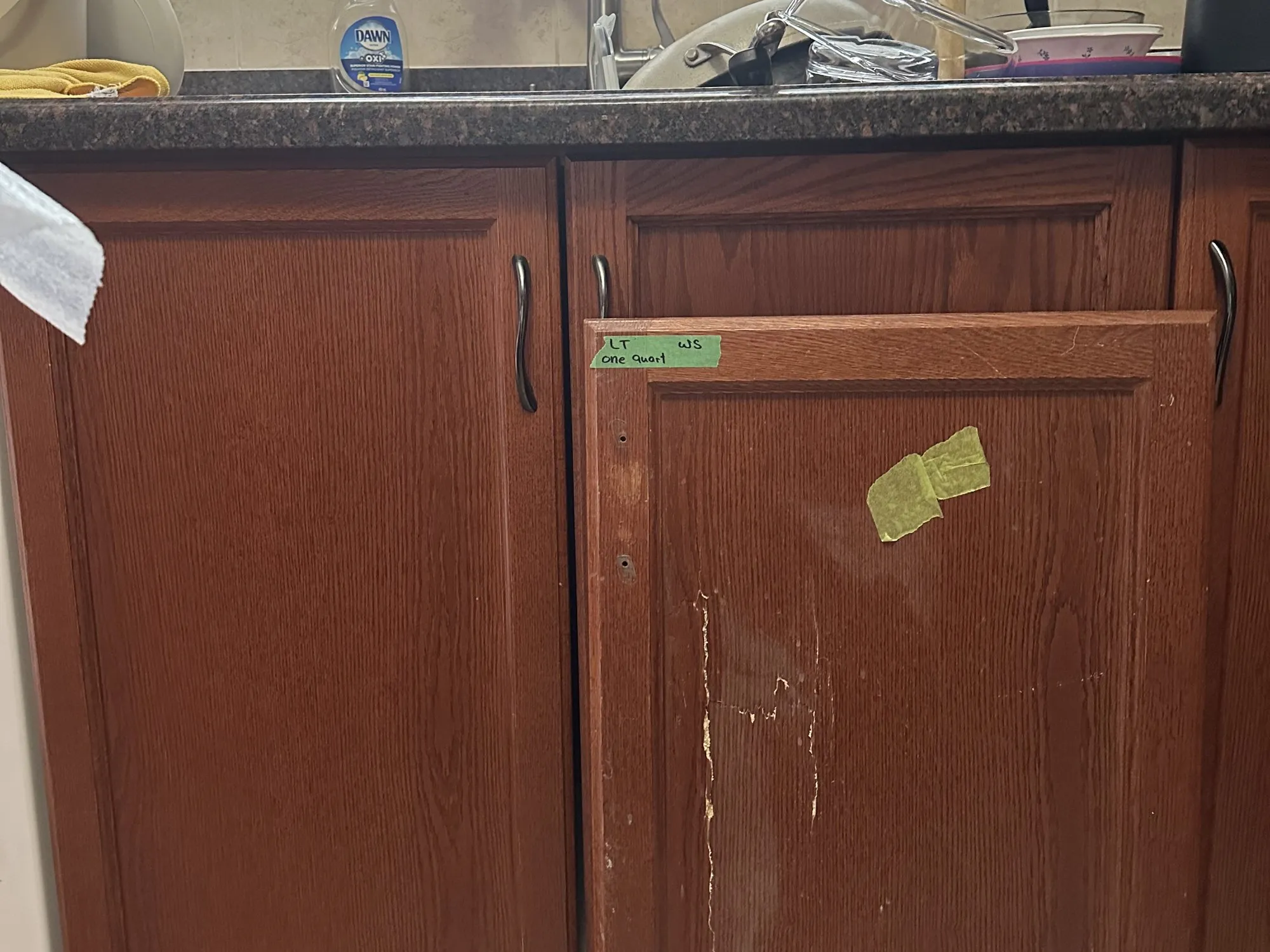
Refinishing is for people who want to see the wood.
That sentence does most of the work of this page, because it is the thing most often misunderstood. Refinishing is not a repaint with extra steps and it is not a recoat over what is already there. The existing finish comes off completely, back to bare timber. The wood is sanded smooth, stained to the tone you have chosen, and then sealed under clear 2K polyurethane — the same catalysed system we spray on painted cabinets, without the pigment in it.
What you get back is the grain, in a different tone, protected by a coating as hard as anything we put on a painted door.
The kitchens it suits
It suits a kitchen where the timber is worth looking at and the finish has failed rather than the wood. That usually looks like one of these:
- Solid oak, maple or cherry that has yellowed under an old lacquer
- A tone that was fashionable when the kitchen went in and reads as dated now
- Sun-faded runs beside a window, or water marks around the sink
- A clear coat that has gone cloudy and sticky with age
It does not suit somebody who wants a colour. If what you picture is a soft white kitchen or a deep navy island, that is painting, and painting will do it better and for less.
Why it costs more than painting
This is the part of the conversation that decides most projects, so it is worth being direct about it. Refinishing costs around half again what painting the same kitchen costs, and sometimes more than that. It also takes about twice as long — five to seven weeks against two and a half to three, and one to two of those weeks without a usable kitchen rather than five days.
Where the stripping has to happen
The reason is stripping, and specifically where the stripping has to happen. Painting preparation is degreasing and sanding — thorough, but quick by comparison. Refinishing preparation is chemical stripping back to bare wood.
The doors can be stripped at our shop. The cabinet boxes are screwed to your walls, so they have to be stripped in place, in your kitchen, with multiple applications of a chemical stripper and careful handling throughout. It is slow, it is awkward around corners and profiles, and there is no shortcut that does not show later.
There is more sanding afterwards than a painting job needs, because the surface has to be uniform enough for stain to take evenly. And staining is a higher-skill application than spraying colour: timber absorbs unevenly, blotching is a real risk on maple in particular, and the margin for correcting a bad result is much smaller than with paint.
The cost that does not show up front
The last cost is a hidden one. Paint covers imperfections. Stain reveals them. So the standard of the underlying repair work has to be considerably higher, and any filler used has to be chosen and placed knowing it will be visible.
We say all of this before quoting rather than after, and it is the reason refinishing is a small part of what we do. Most people who ask about it choose the painted finish once both numbers are in front of them, and that is a perfectly good outcome — it just should not be a surprise arrived at halfway through.
When we will not do it
There are kitchens where refinishing is the wrong answer, and we would rather refuse the work than take money for a result neither of us will be happy with. Three things rule it out:
- Thin veneer — sanding can go through it, and that cannot be undone
- Particle board and similar engineered substrates — they will not take stain predictably
- Mismatched timber underneath — invisible under paint, obvious under stain
Thin veneer
A veneered door can be refinished, but only if there is enough material to sand without going through it — and going through veneer cannot be repaired, only replaced. Where the veneer is already worn at an edge or a corner, that is usually the answer already.
Particle board and engineered substrates
Particle board and similar engineered substrates do not accept stain in any predictable way. They take it unevenly, the exposed edges drink it, and the result looks like what it is. Those kitchens can be painted very successfully, because paint sits on the surface rather than soaking into it.
Mismatched timber underneath
Some kitchens were built with a good face and cheaper material where it would never be seen. Others have been repaired over the years with whatever was to hand. None of that matters under paint. All of it shows under stain.
What we suggest instead
Where we turn refinishing down, there is usually a better route rather than no route. Painting the existing doors is one. New solid wood doors, refinished or stained to the tone you wanted in the first place, is the other — you get the wood you were after on timber that will actually take it.
How the work runs
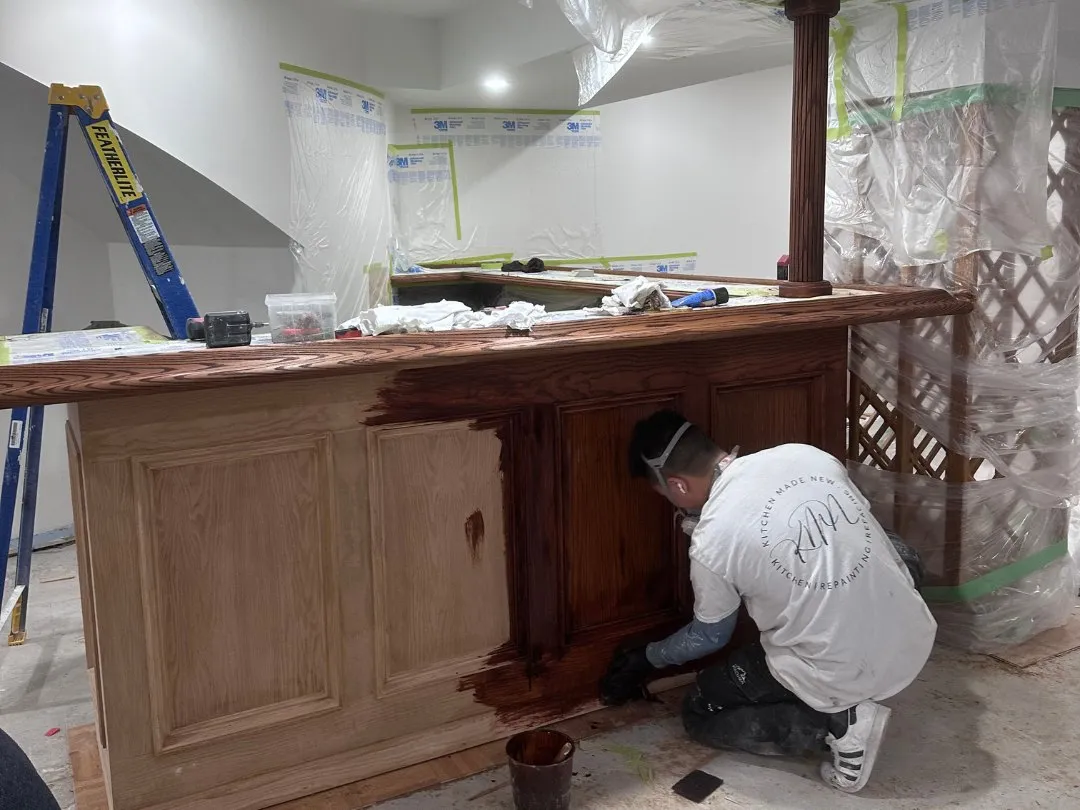
The shape is the same as a painting project — what can come off goes to the booth, what cannot is done in your house — and every stage of it takes longer, because of the stripping.
What comes off, and what stays
Doors, drawer fronts and any removable panels come off first and are labelled so every piece returns to the opening it came from. Those are stripped, sanded, stained and clear-coated at our shop, where the conditions are controlled and the dust is not. They are away for four to five weeks rather than the fortnight a repaint needs, and during that time nothing happens at your house at all — the kitchen carries on with open shelving where the doors were.
The cabinet boxes stay where they are. Containment goes up — sheeting and zipper walls sealing the kitchen from the rest of the house, masking over the counters and appliances, filtration running — and then the boxes are stripped in place.
That takes one to two weeks, against five days for the equivalent stage of a painting job, and it is the stretch where you genuinely lose the kitchen. Stripping in somebody's house is the slowest thing we do, and there is no version of it that is quicker without being worse.
Stain, then the clear coats
Once the boxes are back to bare timber and sanded, the stain goes on, and then the clear 2K over it in coats with proper cure time between them. We ask you to be out of the house for the days we are spraying, because the clear coat is solvent-based exactly like the pigmented version, and containment keeps it out of the rest of the house without making the kitchen somewhere you would want to sit.
Then the doors come back, get hung and adjusted, and we go through every cabinet with you before anything is signed off. The finish is cured by that point rather than merely dry, so the kitchen goes straight back into normal use.
The work carries the same five-year warranty on the finish and the workmanship as everything else we do.
Deciding between refinishing, painting and new doors
Three questions settle it in most kitchens.
Do you want wood or colour?
If the answer is colour, stop here — painting is cheaper, faster and better suited, and no amount of stain gets you to a soft white. If the answer is wood, refinishing is the only one of the three that gets you there on the doors you already own.
Is the timber worth showing?
Solid oak, maple or cherry in sound condition, yes. Thin veneer, particle board, or a kitchen assembled from several different materials, probably not — and that is a question about your cabinets rather than your budget.
Is the door style right?
Refinishing keeps the profile exactly as it is. If a raised panel is what you dislike, no finish changes that, and new doors are the honest answer. That is refacing, and it comes with the option of having the new doors stained rather than painted, which is often what somebody asking about refinishing actually wanted.
The three services overlap enough that people arrive asking for one and leave booking another. We would rather have that conversation before a quote than after a deposit.
The choice most people are actually making
Refinishing or painting — the same doors, two different jobs
Almost everyone who asks about refinishing is weighing it against paint. This is the comparison we give on the phone, before anybody has committed to anything.
| Aspect | Refinishing | Painting |
|---|---|---|
| What you end up looking at | The grain, in a new tone, under a clear coat. | A colour. The timber is covered completely. |
| Preparation | Chemically stripped back to bare timber, then sanded. | Degreased and sanded. Nothing is stripped. |
| Where the slow part happens | The boxes are stripped in your kitchen — they are screwed to your walls. | The doors go to the booth. The boxes are degreased and sprayed in a few days. |
| Start to finish | Five to seven weeks. | Two and a half to three weeks. |
| Without a usable kitchen | One to two weeks, while the boxes are stripped and finished. | About five days. |
| Cost | Around half again what painting the same kitchen costs, sometimes more. | The baseline. You are buying labour and finish, not stripping. |
| What it hides | Nothing. Filler, repairs and mismatched timber all show under stain. | A great deal. Paint sits on the surface and covers what is under it. |
| Suits a kitchen where | The timber is solid and worth showing, and the finish has failed. | The doors are sound and only the colour has aged. |
Most people who ask about refinishing end up painting
This is the smallest of the three services we offer, and the reason is price rather than quality. Stripping a kitchen back to bare timber is slow, and it happens in your house rather than in a shop, so it costs half again as much as painting the same kitchen and sometimes more. Once people see the two quotes beside each other, most choose paint. Understanding why a stained finish costs more than a painted one is worth doing before you fall in love with either, and the page above this one sets all three services against each other.
Recent work
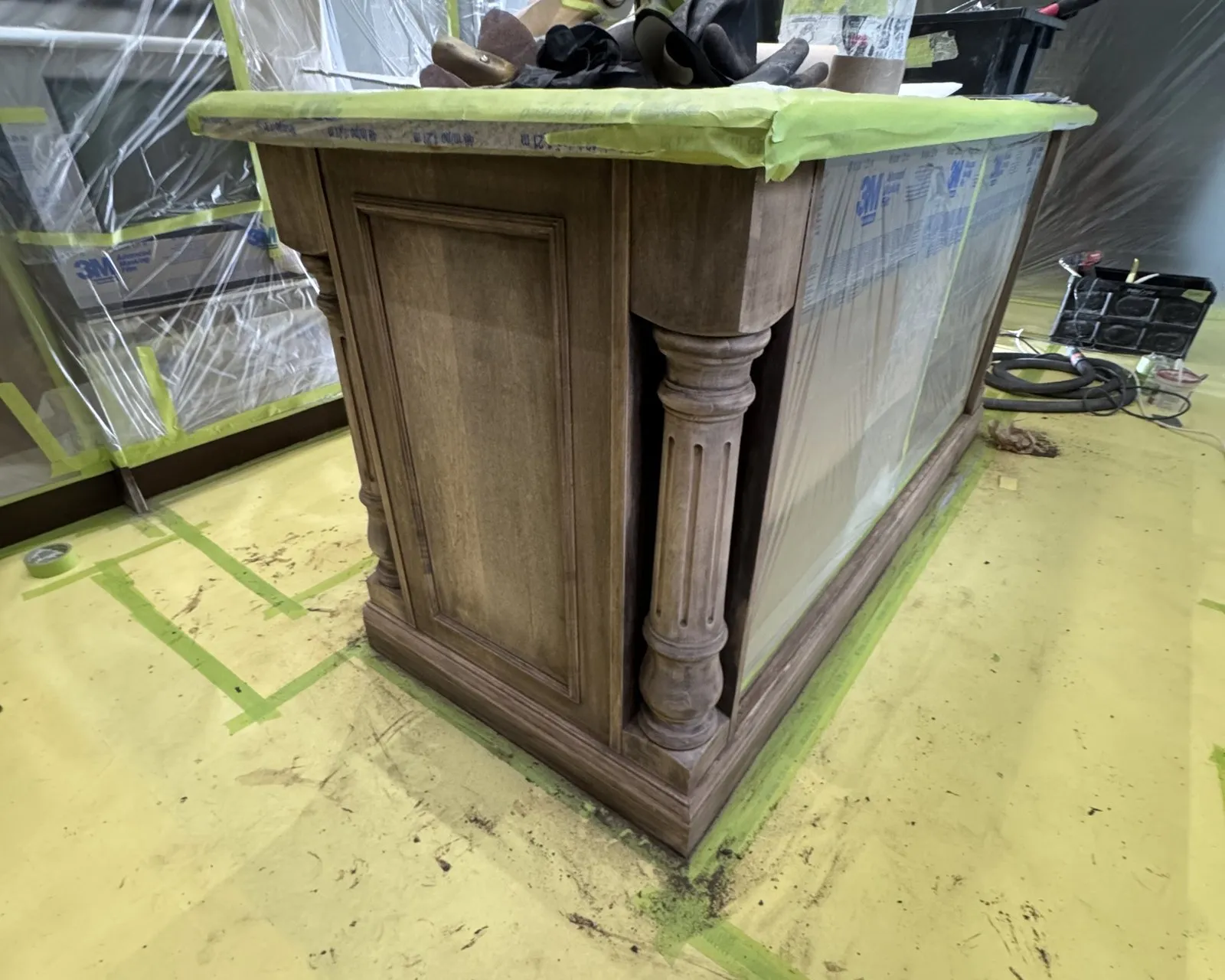
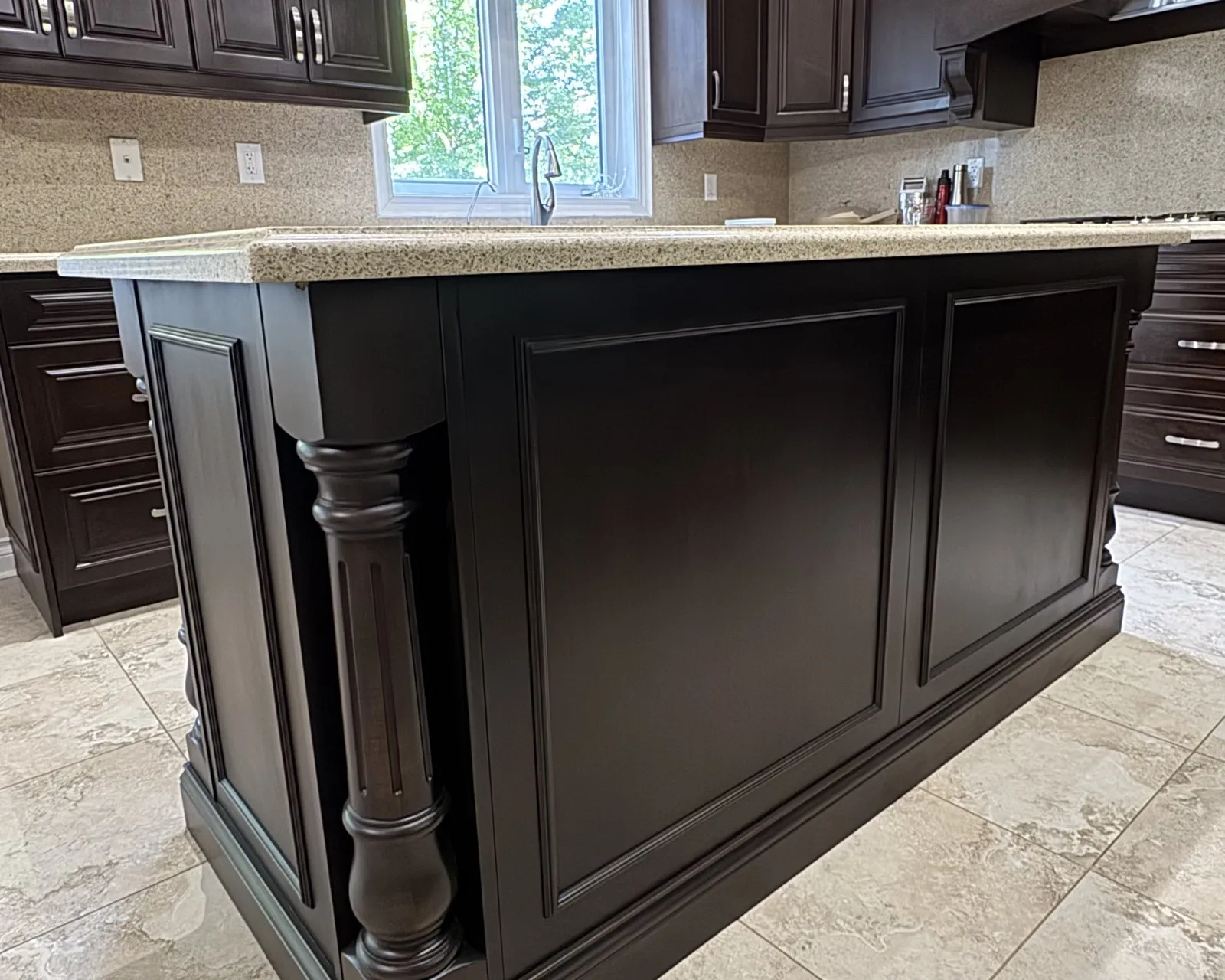
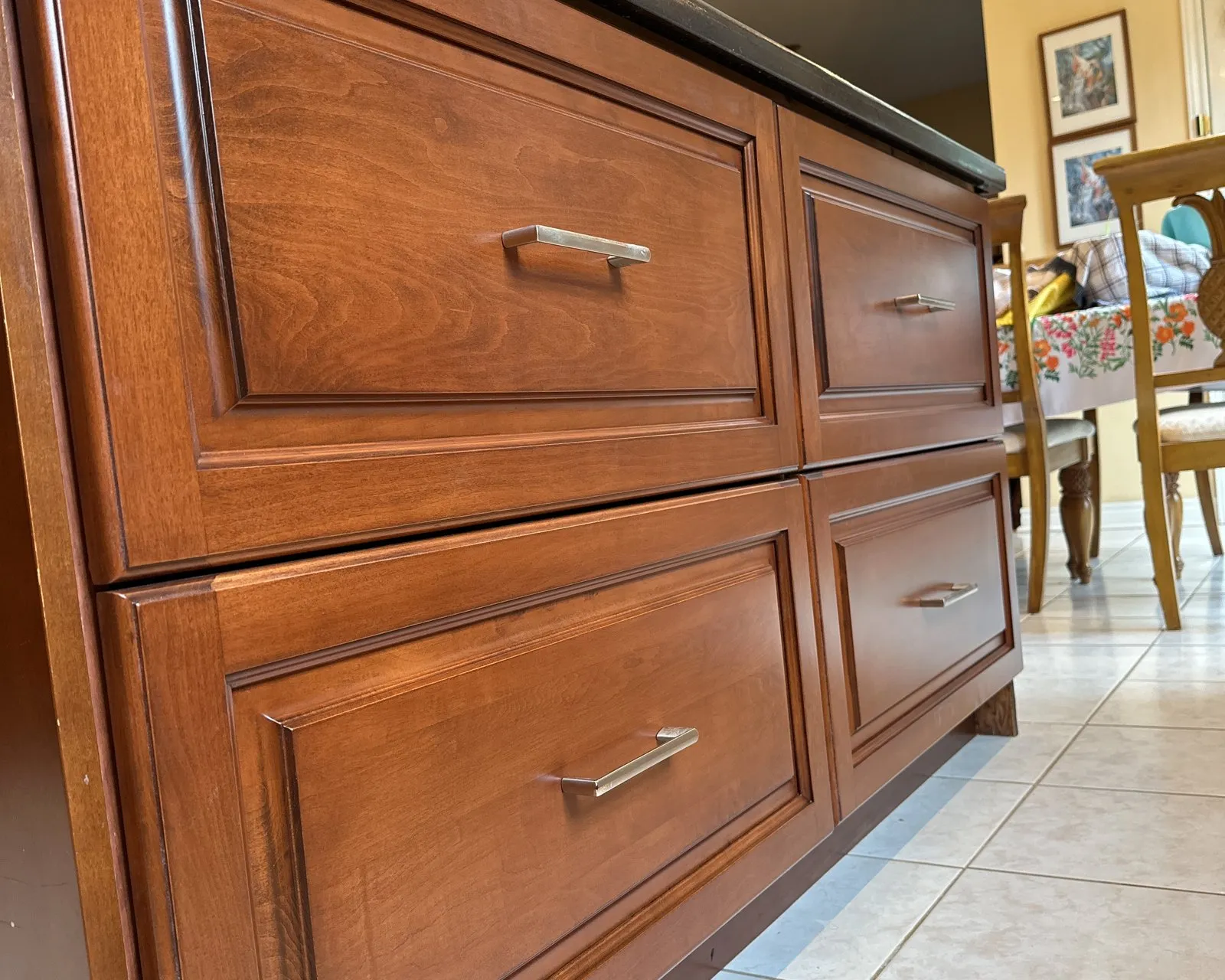
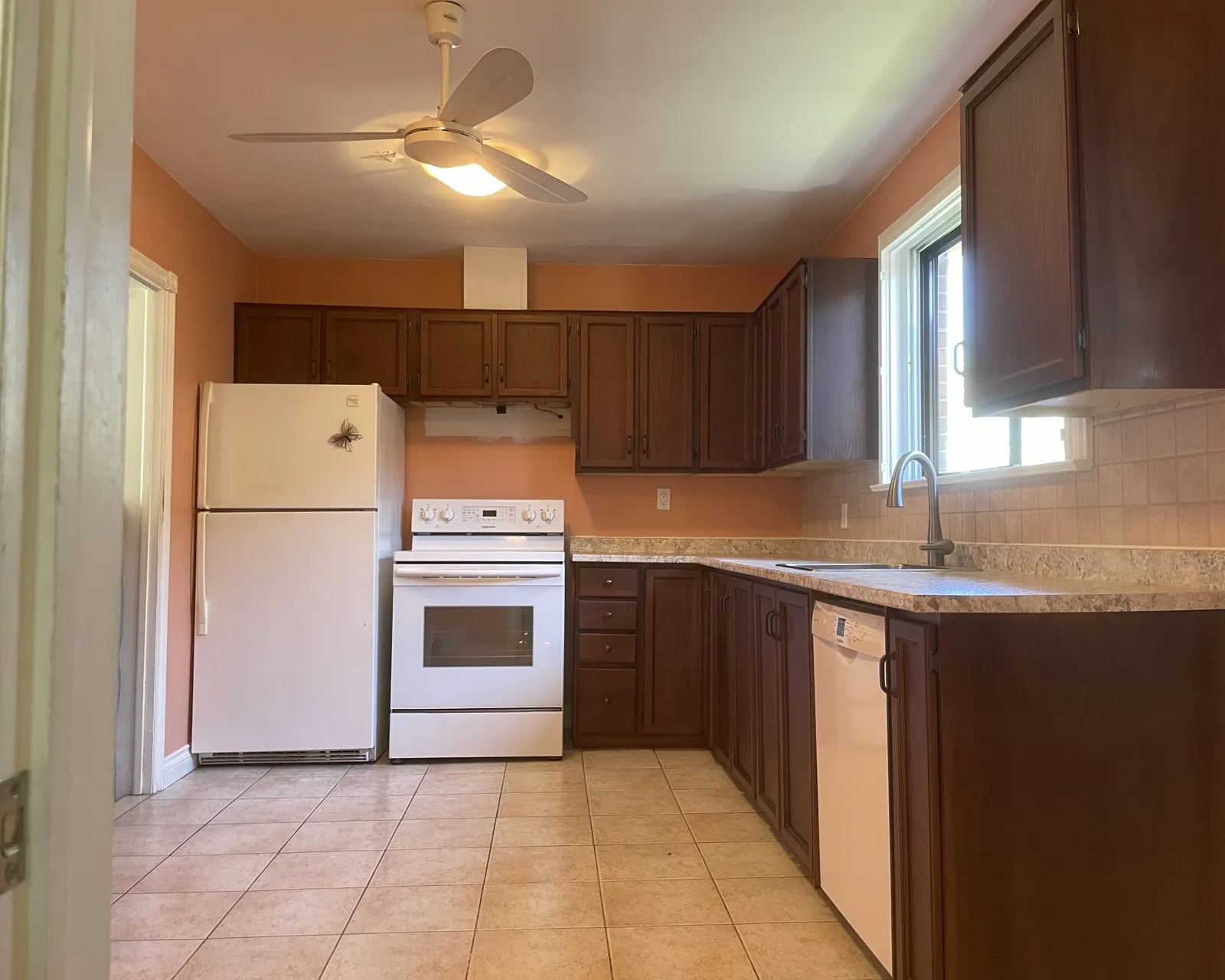
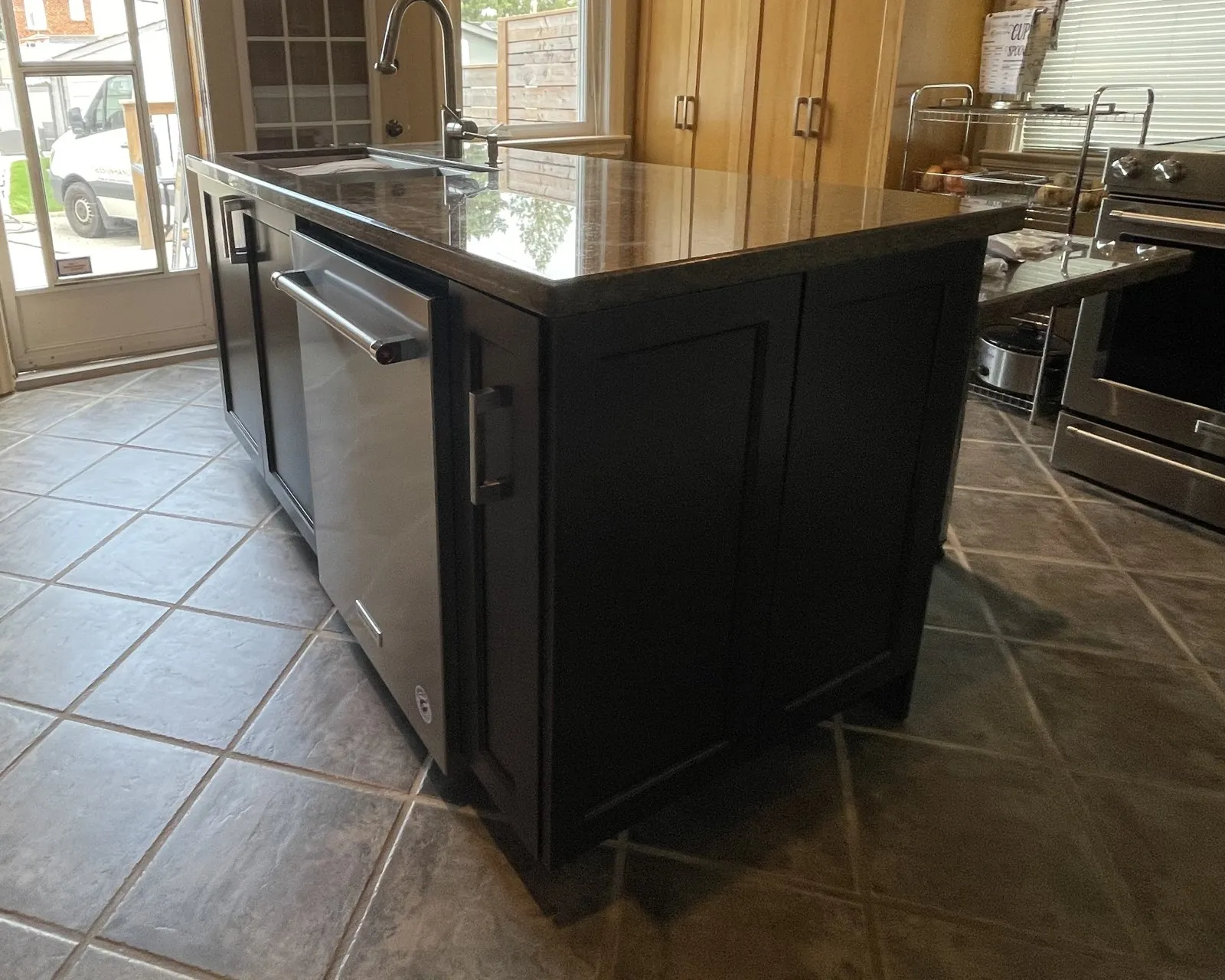
Kitchen cabinet refinishing in Oakville, before and after
Stripped back to bare timber, then stained and sealed in 2K.
 Before
  After
After 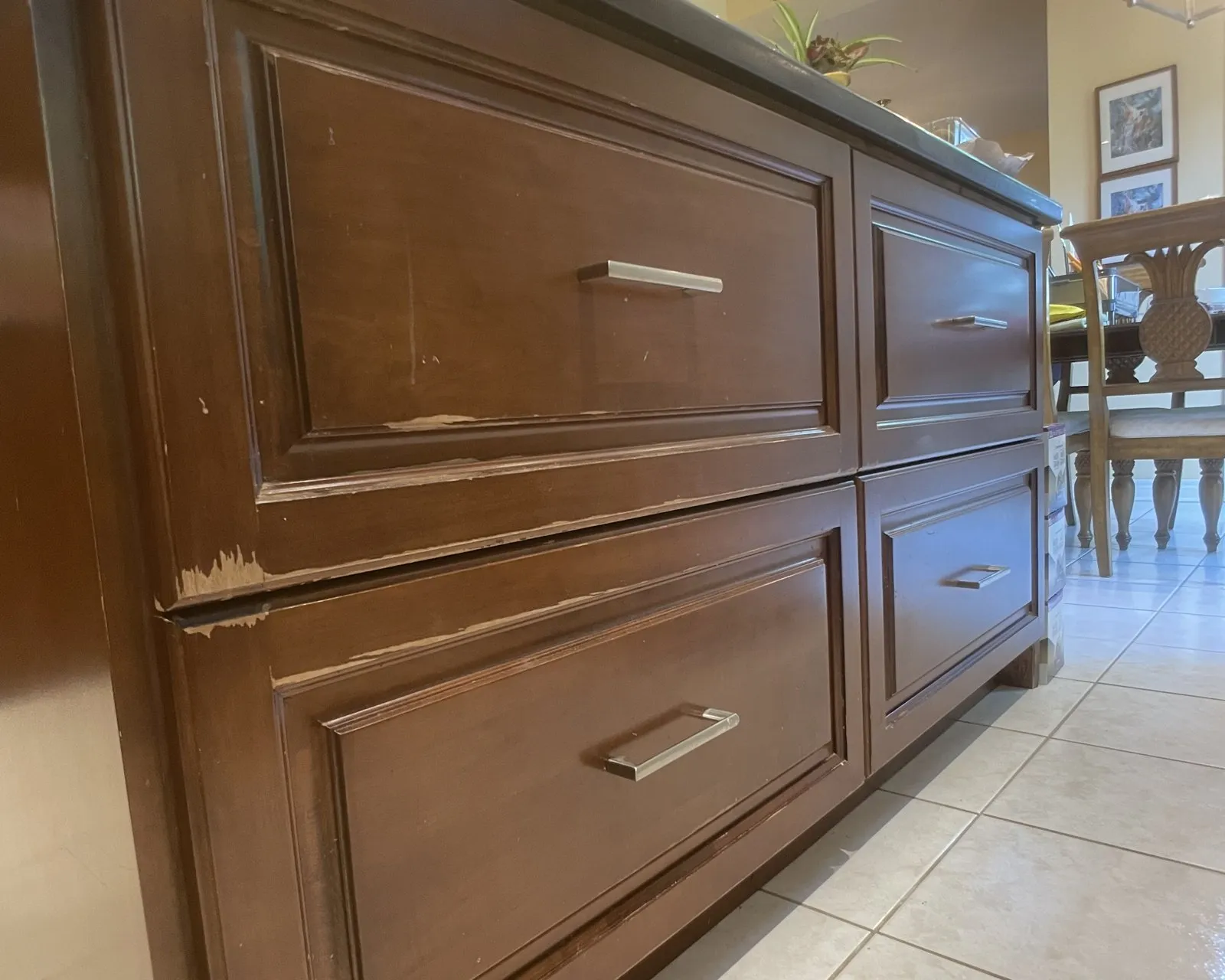 Before
  After
After 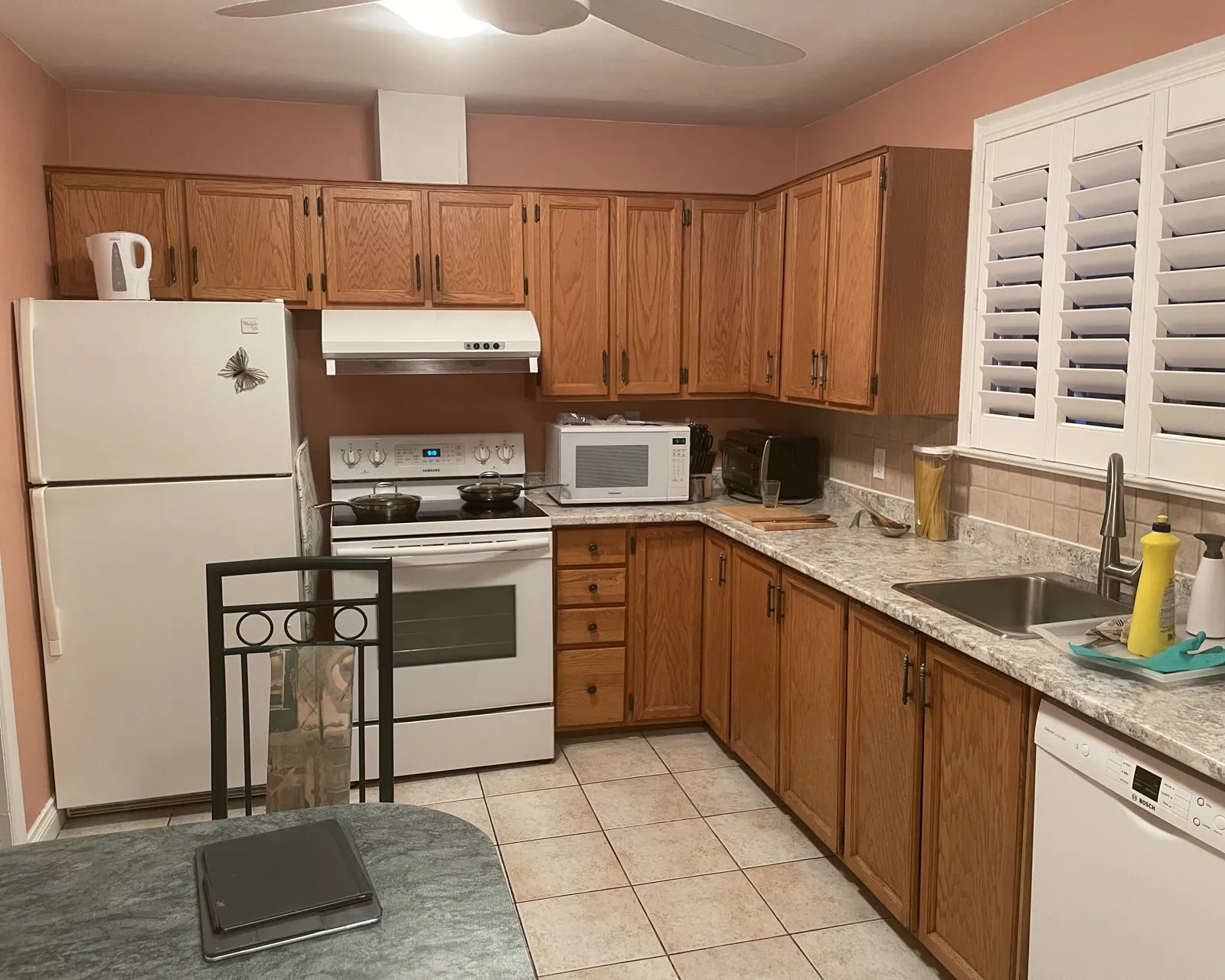 Before
  After
After 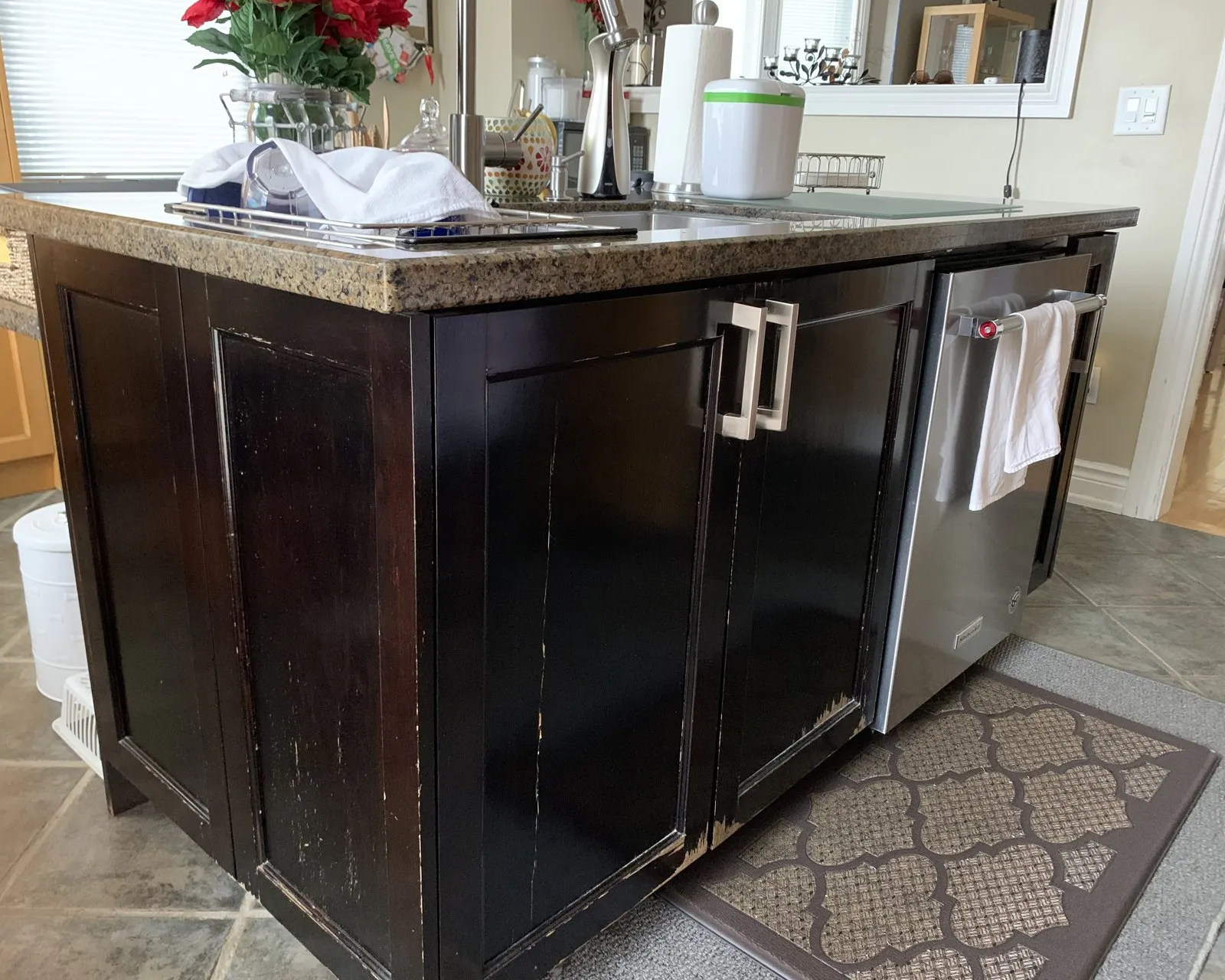 Before
  After
After Kitchen Cabinet Refinishing Cost in Oakville
Refinishing costs considerably more than painting the same kitchen, and the difference is almost entirely labour. It is worth understanding where it goes before deciding between them.
Painting preparation is degreasing and sanding. Refinishing preparation is chemical stripping back to bare timber, which takes multiple applications, careful handling of the softened finish, and a great deal more sanding afterwards to leave a surface that will take stain evenly. On the doors that happens in our booth. On the cabinet boxes it has to happen in your kitchen, which is slower and needs containment.
The timber then sets the rest. Species with open grain need conditioning before any stain goes on, and a kitchen where the old finish has worn through unevenly takes more work to bring back to one tone than one that has simply darkened.
There is also a condition gate that painting does not have. Refinishing needs solid wood underneath — veneer that has lifted or thinned cannot be sanded back without going through it. That is why we look before promising it, and why a photograph sometimes leads to a conversation rather than a price.
Book it
Find out what refinishing your kitchen costs
Photographs of each run of cabinet are enough for a real price, back inside 24 hours. If the doors are better painted than stripped, we will say so.
Questions
Common questions about cabinet refinishing in Oakville
- What is the difference between refinishing and painting?
- What you end up looking at is the difference. Painting leaves you with a colour and covers the timber completely. Refinishing takes the old finish off entirely, stains the bare wood to the tone you want and seals it under a clear coat, so the grain is still visible. The other difference is the stripping — painting does not need it, and it is the single most expensive part of this job.
- Why does it cost so much more than painting?
- It comes down to where the labour goes. Painting prep is degreasing and sanding. Refinishing prep is chemical stripping back to bare wood, and on the cabinet boxes that has to happen in your kitchen rather than in our booth. It takes multiple applications, careful handling and far more sanding afterwards. Expect half again the cost of painting the same kitchen, sometimes more.
- Can you change the colour of the wood, or only restore it?
- Both. Stain changes tone as well as renewing it, so orange-toned oak can be taken to a walnut, a grey-brown or something much closer to neutral. What stain cannot do is go lighter than the timber underneath, or hide it. If you want a colour rather than a wood tone, that is a painting job.
- Will refinishing work on my cabinets?
- It depends on what is under the finish, and it is a stricter test than painting. Solid timber in good condition is the ideal. Thin veneer is risky because sanding can go through it, and once that happens it cannot be undone. Particle board and similar substrates do not take stain properly at all. We look before promising anything, because a stain shows every one of those problems where paint would have covered them.
- How long does refinishing take?
- Longer than anything else we do, and the stripping is the whole reason. The doors are in our shop for four to five weeks rather than the fortnight a painting job needs, because taking a finish off and building a stained one back up is slow work. Then one to two weeks in your kitchen for the boxes. Five to seven weeks end to end.
- Can I use my kitchen while the work is happening?
- For most of it, yes. Through the four to five weeks the doors are in the shop the kitchen works normally, just with open shelving where they used to be. What you lose is the one to two weeks we are in the house stripping and finishing the boxes, which is a longer interruption than either painting or refacing asks for. We also ask you out for the days we are spraying the clear coat, because it is solvent-based like everything else we spray.
- What if you find something under the old finish?
- We tell you, and it is the honest risk in this work. Stripping reveals filler that was invisible under the old coating, repairs made in a different timber, and water damage that had been sealed over. None of it takes stain the way the wood around it does. Where we can see enough beforehand to judge, we say so at quoting. Where we cannot, we say that instead of guessing.
Want to know whether your cabinets can take a stain?
Send wide photographs of each run, in daylight if you can — the tone the timber is now tells us a great deal about where it can reasonably be taken. Written quote inside 24 hours, and we do not revise it afterwards.
Free in-home consultation · no obligation
Refaced. Repainted. Refinished.