
The Best Materials for Cabinet Refacing in Oakville
Four materials come up, and only two of them are genuinely good choices for most Oakville kitchens. The other two are worth understanding before somebody sells you one.
Painted MDF, which suits most kitchens
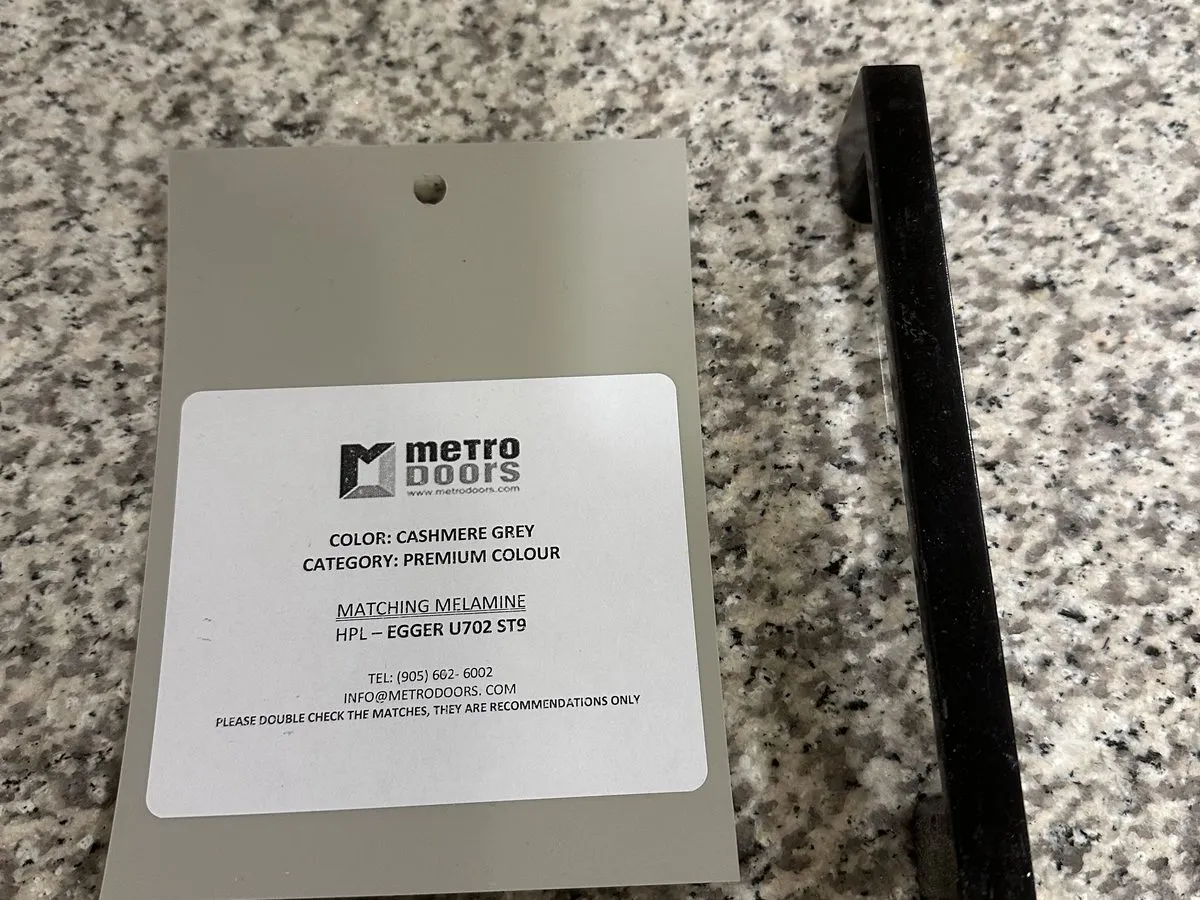
If your doors are going to be a colour rather than a wood tone, MDF is the better material, and that surprises people who assume solid timber must be superior.
The reason is movement. Timber expands and contracts with humidity, and a five-panel door made of it moves at every joint. Under a painted finish that movement telegraphs through as fine cracking along the rails and stiles — not a failure of the paint, a failure to stay still underneath it. MDF does not move, which is why high-end painted cabinetry is made from it rather than in spite of it.
It also takes a sprayed finish better. The surface is uniform with no grain to fill or raise, so the result is flatter than timber can be without considerably more preparation.
The waterproof grade is what we use where it matters, and it carries fifteen years — the longest warranty we put on anything.
Solid timber, where the grain is the point
If you want to see wood rather than colour, MDF cannot help you and timber is the only answer.
Solid hardwood doors — rift-cut white oak, maple, cherry — stained and sealed under clear 2K let the grain show, which is the entire reason to choose them. They cost meaningfully more than a painted MDF door across a whole kitchen, and they are worth it to the people who want them.
The trade is the one described above in reverse: timber moves, and on a stained door that movement is invisible because there is no continuous painted film to crack. Material and finish have to be chosen together rather than separately.
Thermofoil, which is a substrate rather than a choice
Not something we offer. Something we find, in kitchens built from the late nineties.
Thermofoil is a thin vinyl film heat-wrapped over MDF, common in kitchens built from the late nineties on. It is not something we offer — it is something we find.
Where the film is still fully bonded, a kitchen with thermofoil doors can sometimes be worked with. Where it has begun to lift at a corner, near the oven or above the kettle, it cannot be sprayed back down. The honest quote there is for new doors, and it costs more than the customer was hoping, which is why we would rather explain it than quietly spray over it.
What we will not do to your boxes
There is a shortcut sold as refacing that is not the same job.
There is a shortcut in this trade worth knowing about, because it is sold as refacing and it is not the same job.
Some companies wrap the cabinet boxes in a self-adhesive film or a thin sheet, matched to the new doors. It is faster and it is cheaper. It also has visible seams at every edge, it lifts at the corners over a few years, and heat from an oven or a kettle accelerates all of it.
We spray the boxes instead — degreased with our own solvent degreaser, sanded, primed, and finished in the same 2K polyurethane as the doors. That is why a refaced kitchen matches across every surface rather than nearly matching, and it is most of the reason our installation week is five days rather than two.
Choosing between them
Not which material is best, but which suits the kitchen you want to look at.
The question is not which material is best. It is which is best for what you want the kitchen to look like.
- Painted, any colour — MDF, and the waterproof grade if the budget allows it. This is most kitchens.
- Visible grain — solid hardwood with a stain, and expect to pay for it.
- Existing thermofoil — a conversation about condition before anything else, because the answer depends on whether the film has let go.
We bring samples to your kitchen rather than asking you to choose from a board in a showroom, because a material looks different against your own floor in your own light. That visit is free and carries no deposit.
Where the material choice shows up
Material is one of the three layers a refacing price is built from, alongside the door count and the days on site, and it is the layer you have the most control over. Reading how the material changes what a refacing quote comes to shows how a change of material moves the number across a whole kitchen, which is the context that makes the choice below a budget decision rather than only a taste one.
Once the material is chosen
Choosing the material is the last decision before anything is made. What follows is roughly four weeks of manufacturing during which nothing happens at your house, and then one week when it all does. Knowing what happens between choosing a door and using the kitchen again is what lets you plan around the job rather than be surprised by it, and it is the question people ask immediately after settling on a door.
Questions
Common questions
- What is the best material for refaced cabinet doors?
- For most Oakville kitchens, painted MDF — it is dimensionally stable, takes a sprayed finish better than timber does, and the waterproof grade carries our fifteen-year warranty. Solid timber is the better choice where you want visible grain.
- Is MDF worse than solid wood?
- For a painted door, no — it is genuinely better. Timber moves with humidity and can telegraph that movement through a painted finish as fine cracking at the joints. MDF does not move, which is why high-end painted cabinetry uses it.
- Can you reface thermofoil doors?
- Where the film is still sound, sometimes. Where it has begun to lift at a corner or near the oven, no — it cannot be sprayed back into place, and the honest answer is new doors rather than a finish that will fail again.
- What about wrapping the boxes in veneer?
- We do not do it. Our boxes are sprayed in 2K polyurethane, the same finish as the doors, which is why the colour matches across the whole kitchen. Wrapping is the shortcut some refacing companies use and it shows at the edges within a few years.
Not sure which material suits your kitchen?
Send wide photographs of each run of cabinet and say what you have in mind. The written quote comes back inside 24 hours with the material priced as its own line.
Free in-home consultation · no obligation
Refaced. Repainted. Refinished.