
What Cabinets Cannot Be Refaced in Oakville
Refacing works on the front of a sound box. Where the box has failed, or the surface will not hold a finish, no amount of care on the doors rescues it.
Water damage, which is not repairable from the front
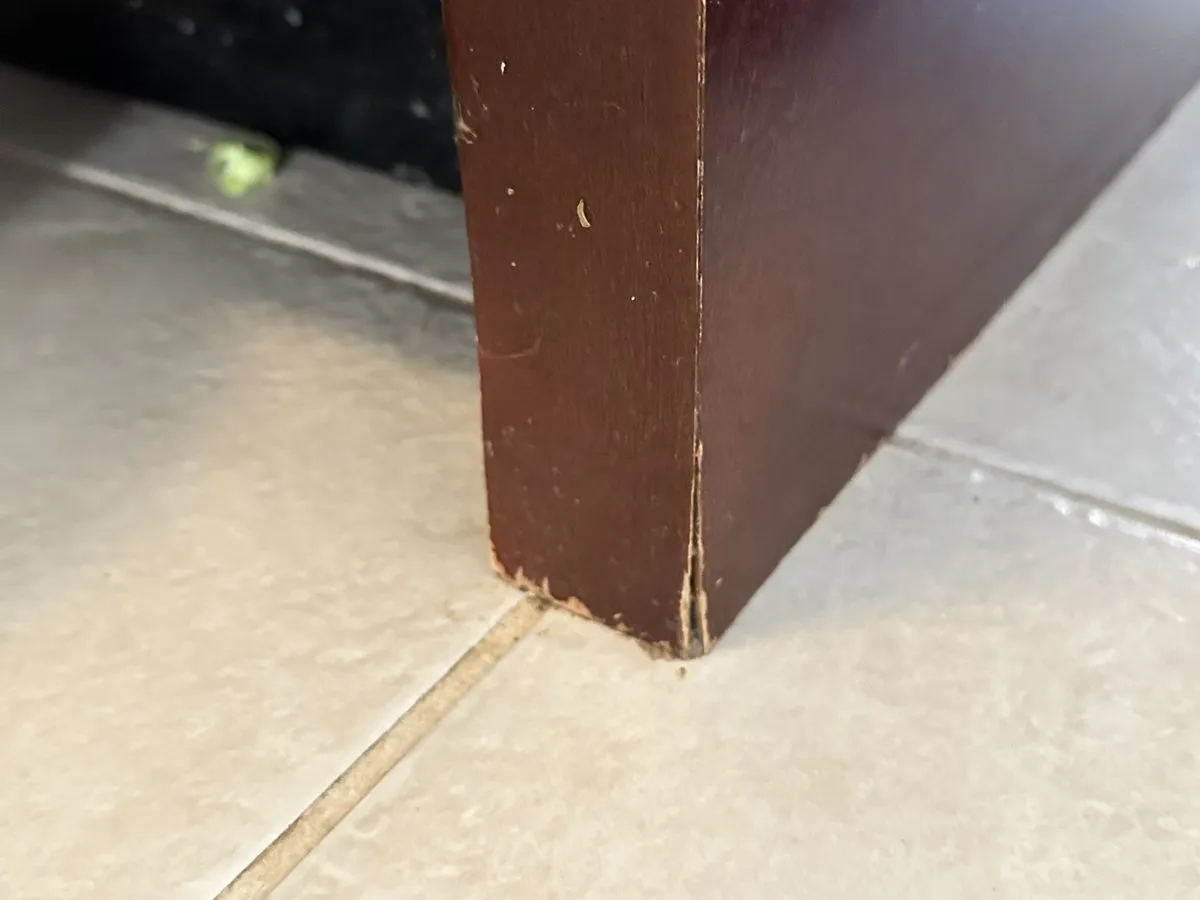
The most common disqualification, and the one owners most often have not noticed.
A slow leak under a sink does its damage over months. The cabinet base swells, particle board absorbs and expands and does not return to shape when it dries, and the panel loses the strength it had. Melamine facing lifts along the edges. Screws that were holding into board no longer hold into anything.
A new door hung on that box will not stay square, because what it is fixed to is moving. Refacing there is not a compromise, it is money spent on the wrong component.
This is why photographs of under the sink matter more than photographs of the doors. It is the one place where a kitchen that looks entirely fine is often not.
Thermofoil that has begun to let go
The substrate problem rather than the condition problem.
Thermofoil is a thin vinyl film heat-wrapped over MDF, and it is common in kitchens built from the late nineties onward. While the film is fully bonded, a thermofoil kitchen can sometimes be worked with. Once it has lifted — and it lifts first beside the oven, above the kettle, and along the top edge of the door under the counter — it cannot be sprayed back into place.
Coating over lifting film traps the problem rather than solving it: the finish bridges the gap, looks fine for a season, then cracks along exactly the line that was already failing.
The honest answer on those kitchens is new doors, and it costs more than the owner was hoping. We would rather explain why than spray something that will carry our name and fail in two years.
Particle board with stapled joints
Not all cheap cabinetry is disqualified, and the distinction matters.
Not all cheap cabinetry is disqualified, and the distinction is worth drawing carefully because it gets used as a shortcut.
Builder-grade boxes are frequently fine. Plenty of them are square, dry, well fixed and doing their job perfectly, and refacing them is exactly the right call — the fronts dated long before the boxes did.
What does not work is thin particle board held together with staples, especially where shelves have started to bow under weight or the sides flex when a drawer is pulled. That is a box at the end of its life, and it does not have another twenty years in it however good the door on the front is.
The test is not the price of the original kitchen. It is whether the box is still square, still dry and still firmly attached to the wall.
When the layout is the disqualification
The one category where the boxes are innocent.
The other category, and the only one where the boxes are innocent.
If the room does not work — a corner nothing reaches into, a fridge in the wrong place, no space to stand at the sink, two people who cannot pass — then the cabinet fronts are not the problem and changing them will not make the room stop annoying you. Refacing cannot move anything.
That is a remodel, and refacing would be an expensive way to postpone it by a few years.
What we do when a kitchen fails the test
We say so in the quote, before any money has moved.
We say so, in the quote, before any money has moved.
Sometimes the answer is a smaller job than expected — the boxes are fine and only the doors were ever the issue. Sometimes it is a larger one, and we would rather be the company that told you early than the one that discovered it on day two with your kitchen already in pieces.
Either way the assessment costs nothing and comes from photographs, which is the entire reason we ask for wide shots and a look inside rather than a booking.
What refacing does need
Every exclusion below is the mirror of a requirement — a box that is square, dry and firmly fixed, and a surface a finish will bond to. Reading the condition a kitchen has to be in for this to work describes the positive case, what is actually replaced, and how the boxes are assessed before anything is quoted. The two pages are the same test written from opposite ends.
If the boxes do pass
Where the boxes are sound, the next question is nearly always about everything attached to them — and the counters in particular, because taking those off turns a five-day job into something much larger. Knowing whether the counters have to come off for any of it settles the most common practical worry about the week, and the answer is more reassuring than most people expect.
Questions
Common questions
- What kitchen cabinets cannot be refaced?
- Boxes that have failed structurally — swollen at the base from a slow leak, soft particle board, joints that have worked loose — and surfaces that will not hold a finish, chiefly thermofoil where the film has begun to lift.
- Can thermofoil cabinets be refaced?
- Where the film is fully bonded, sometimes. Where it has started lifting at a corner or near the oven, no — it cannot be sprayed back down, and the honest quote is for new doors rather than a finish that will fail again in the same place.
- What about cheap builder-grade cabinets?
- It depends on the box rather than the label. Thin particle board with stapled joints is not worth refacing. A builder box that is square, dry and solidly fixed usually is — and plenty are.
- How do you tell before quoting?
- Photographs, including the inside of a few cupboards and under the sink. The fronts almost always look worse than the boxes, and occasionally the reverse is true — which is exactly the case where a quote based on the fronts alone would be wrong.
Not sure whether your boxes qualify?
Send wide photographs of each run, plus a few of the inside and under the sink. If the boxes are not worth keeping, the quote will say so rather than quietly proceeding.
Free in-home consultation · no obligation
Refaced. Repainted. Refinished.