
What Colour to Paint Kitchen Cabinets in Oakville
We are finishers, not designers, so this is not a page about taste. It is about what Oakville kitchens are actually being painted, and how each of those colours behaves once it is on a sprayed door.
What Oakville kitchens are actually being painted
The honest answer to “what colour” is that most people arrive with the decision half made, and it is nearly always a version of white. Looking back over the kitchens we have sprayed in Oakville: espresso to white in Glen Abbey, dark cherry to off-white in Westmount, espresso to soft white in Morrison, maple to cream in Sixteen Hollow. Golden oak in Winston Park went to a soft grey instead. The dark, heavily grained kitchen going light is the job we do most.
That is not a fashion observation so much as a practical one. The kitchens being painted in Oakville are mostly the dark ones — the espresso and cherry runs from a decade or two ago — and the reason they are being painted is that the room feels dark. Lighter is the point, and white, cream and soft grey are the ways to get there.
White, and the reason it got a bad name
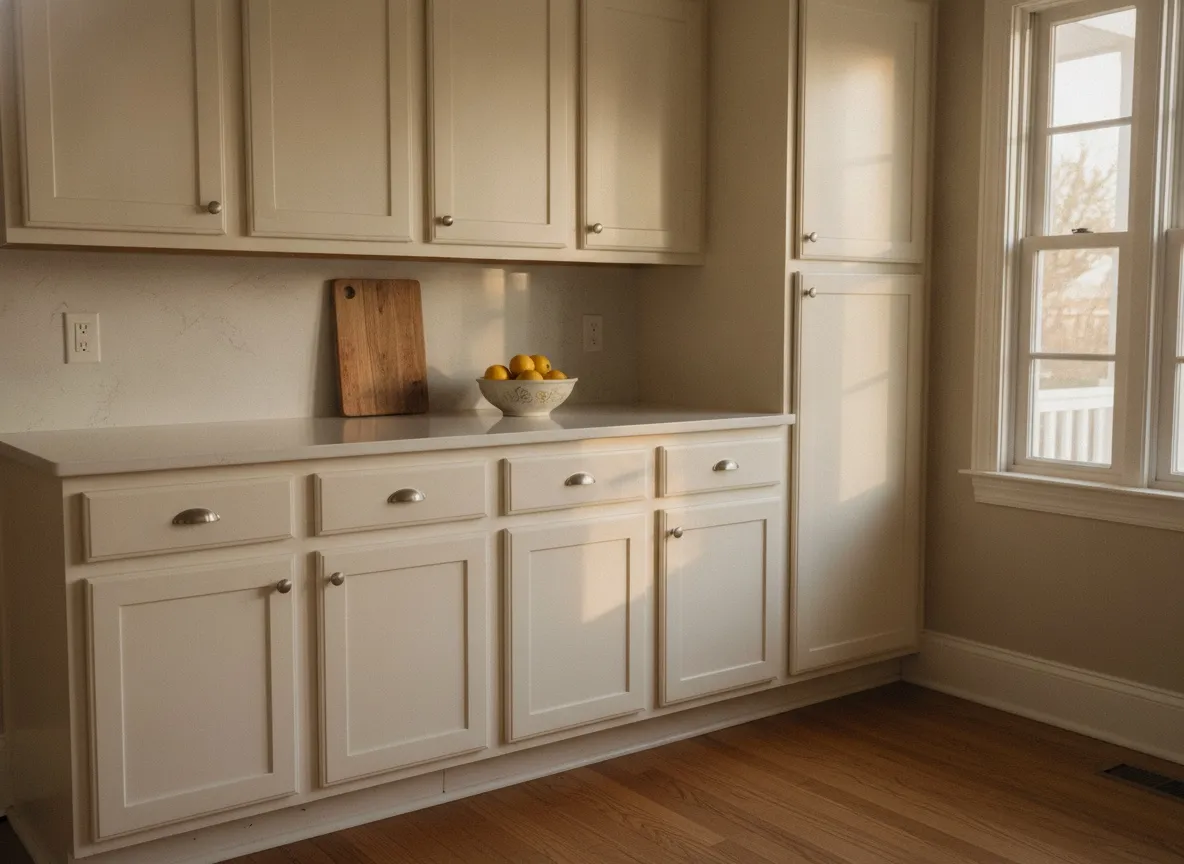
White is the most chosen colour and the most maligned, and the two facts are connected. A white kitchen painted in a water-based enamel yellows within a few years, and enough Oakville kitchens have done exactly that for people to have decided white “goes off”. It is the coating that goes off, not the colour. A catalysed two-component polyurethane does not amber as it ages, so the white you chose is the white you keep.
Within white there is more range than a card suggests. A pure white against a warm oak floor looks clinical; a soft white or cream picks up the warmth and sits with it. Against cool white quartz the same cream can read yellow, and a cleaner white works better. This is precisely why the samples are held against your own countertop and floor rather than chosen from a chip, and why the decision is made in the kitchen rather than in a shop.
Two colours, one finish
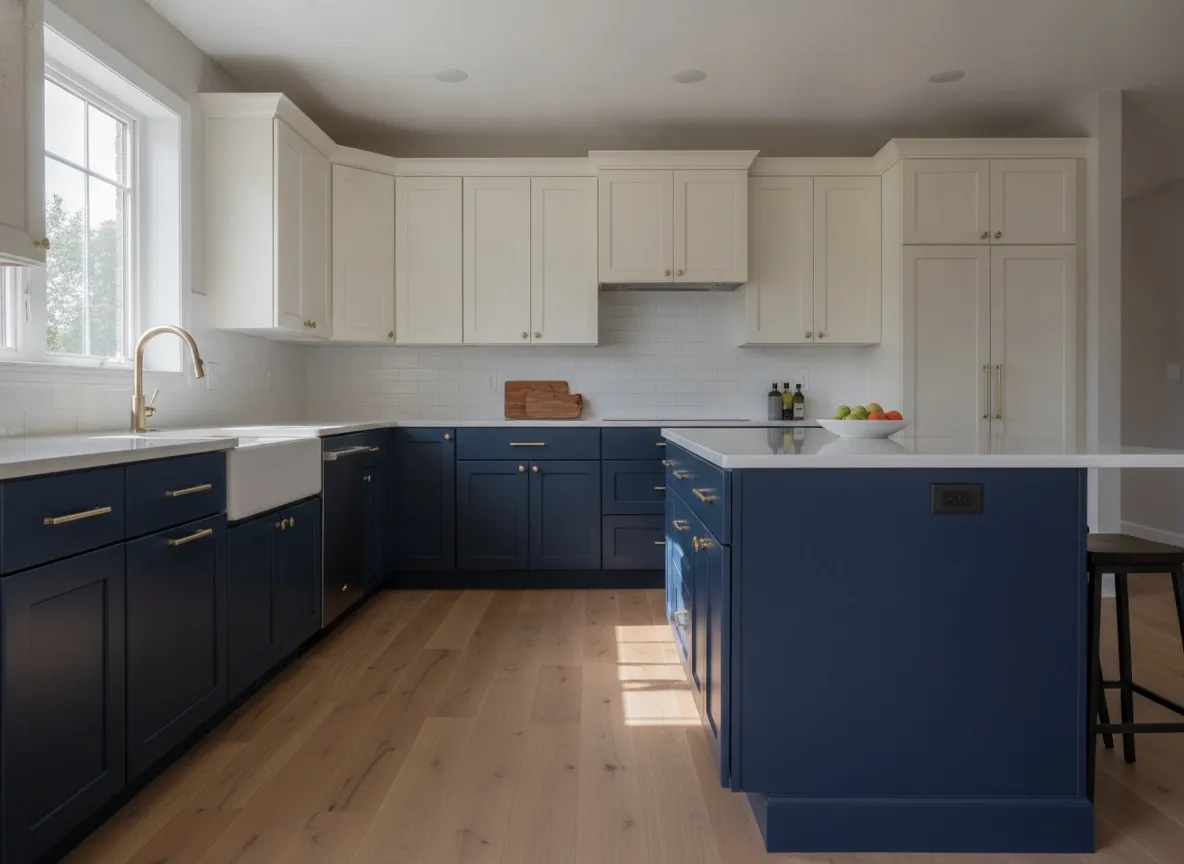
Two-tone kitchens are common enough now to deserve their own note. The usual version is dark below and light above — a maple kitchen in Merton went navy on the lowers and white on the uppers, with the boxes and layout untouched. The other version is a single dark island in an otherwise white room.
What makes it work is that both colours go on in the same system. The same 2K polyurethane, sprayed in the same booth, with the same sheen. Where two colours meet at an island end or a run break, the join is clean because nothing differs between them but the pigment. A two-tone scheme done in two different products, one sprayed and one brushed, shows the difference at every meeting point, and it is the difference in sheen rather than the difference in colour that the eye catches.
What the finish does to the colour
Sheen changes the shade. One pigment reads twice, in matt and in semi-gloss.
Two things about the coating change how any colour behaves, and neither shows on a card. The first is sheen. The same pigment in a matt finish and in a semi-gloss reads as two different shades, because gloss reflects the light source and matt scatters it. This is why a printed chip is not enough and why the samples we bring are real finish on real substrate.
The second is the primer. Most painters prime in white whatever the topcoat. Ours is tinted to match it, so when a door is eventually chipped — and every kitchen door is eventually chipped — the mark is a dent in the same colour rather than a flash of white. On a navy island or a charcoal run that is the difference between a chip you notice from across the room and one you find by touch. The colour you choose is only half of what you see; the coating under and over it is the rest.
The finish the colour goes on
Every colour on this page is described as it behaves in one finish — a catalysed two-component polyurethane, sprayed in a booth over a tinted primer, which is why a dark door here does not flash white when it chips and a white one does not yellow. The page above covers that finish, the weeks it takes and what it costs, and reading the service that puts a colour on the doors is the right next step once a colour is forming in your mind, because how a shade ages depends far more on the coating than on the shade.
The question underneath the colour
Choosing a colour assumes painting is the right thing to do, and for some kitchens it is not — a layout that does not work, or doors whose profile you have never liked, are not helped by any shade. The last page in this set takes up whether professional cabinet painting is worth paying for — when a sprayed catalysed finish is the sensible money and when it is the wrong money, what the price buys against doing it yourself, and the honest cases where we tell people to reface instead.
Questions
Common questions
- What is the most popular colour for painted kitchen cabinets?
- White and its near neighbours, by a wide margin. Soft white, off-white and cream account for most of the kitchens we spray in Oakville, usually over espresso, cherry or golden oak. Soft grey is the second choice, and navy is the usual pick when one part of the kitchen goes dark.
- Are white kitchen cabinets going out of style?
- Not in what Oakville homeowners are asking us to spray. What has gone out of style is the yellowed white — a water-based enamel that ambered in a few years. A catalysed polyurethane does not yellow, so a white kitchen stays the white you chose.
- What colour hides wear and fingerprints best?
- A mid-tone on a profiled door. Very dark colours show dust and fingerprints most, and most of all on a flat slab door. Very light colours show marks least but show a chip if the primer under them is white — ours is tinted to the topcoat, so a chip does not flash.
- Does going from dark cabinets to white cost more?
- It can need a third or fourth topcoat for full coverage, and so can a saturated red or yellow, or heavy wood grain. That is worked out at quoting from the photographs and the colour you are leaning towards, not discovered after the doors are off.
- Can I do two colours?
- Yes. Dark lowers or a dark island under white uppers is the most common version — a maple kitchen in Merton went navy below and white above. Both colours are sprayed in the same system, so the sheen matches and the join is clean.
- Will you help me choose?
- With what we finish, yes. We bring painted samples to your kitchen on the day the doors come off and tell you honestly how a shade will sit against your countertop and floor. We will not specify your wall colour or your tile — that is a designer's job, and we do not sell it.
- Can I preview a colour before deciding?
- Our colour visualiser shows your own kitchen in a different colour from a photograph, in seconds and at no charge. It narrows a longlist to two or three. The final call is still made from real sprayed samples in your own light, because a screen cannot show sheen.
Leaning towards a colour?
Send wide photographs of every cabinet run and tell us where you are leaning. The quote comes back inside 24 hours, and the samples come to your kitchen on the first day.
Free in-home consultation · no obligation
Refaced. Repainted. Refinished.