
Quartz Countertop Installation in Oakville — Cut From the Cabinets Already Standing
New stone goes in near the end of a kitchen project, and it is cut from the cabinets that are already standing. That single fact decides how the whole job has to be sequenced.
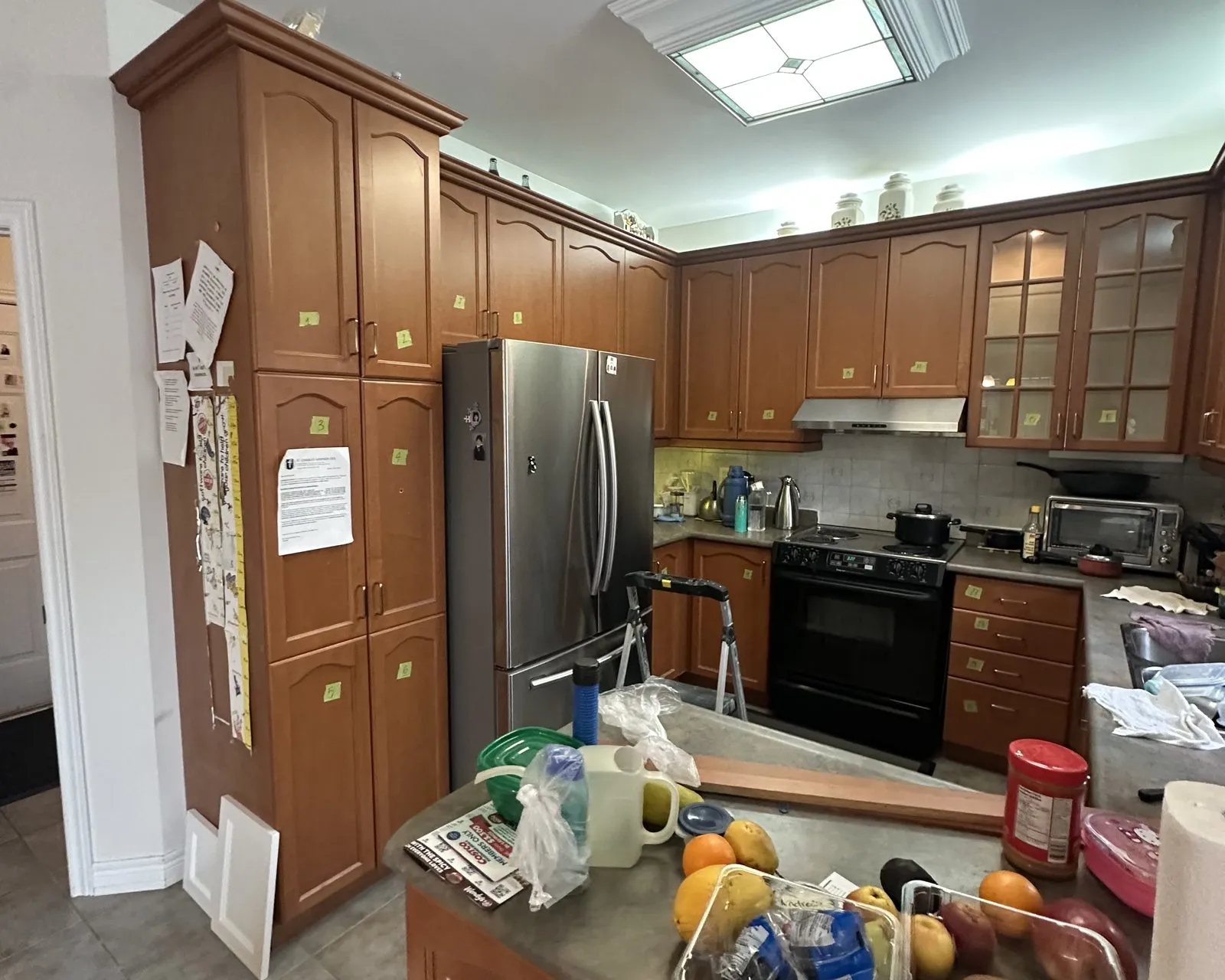 Before
 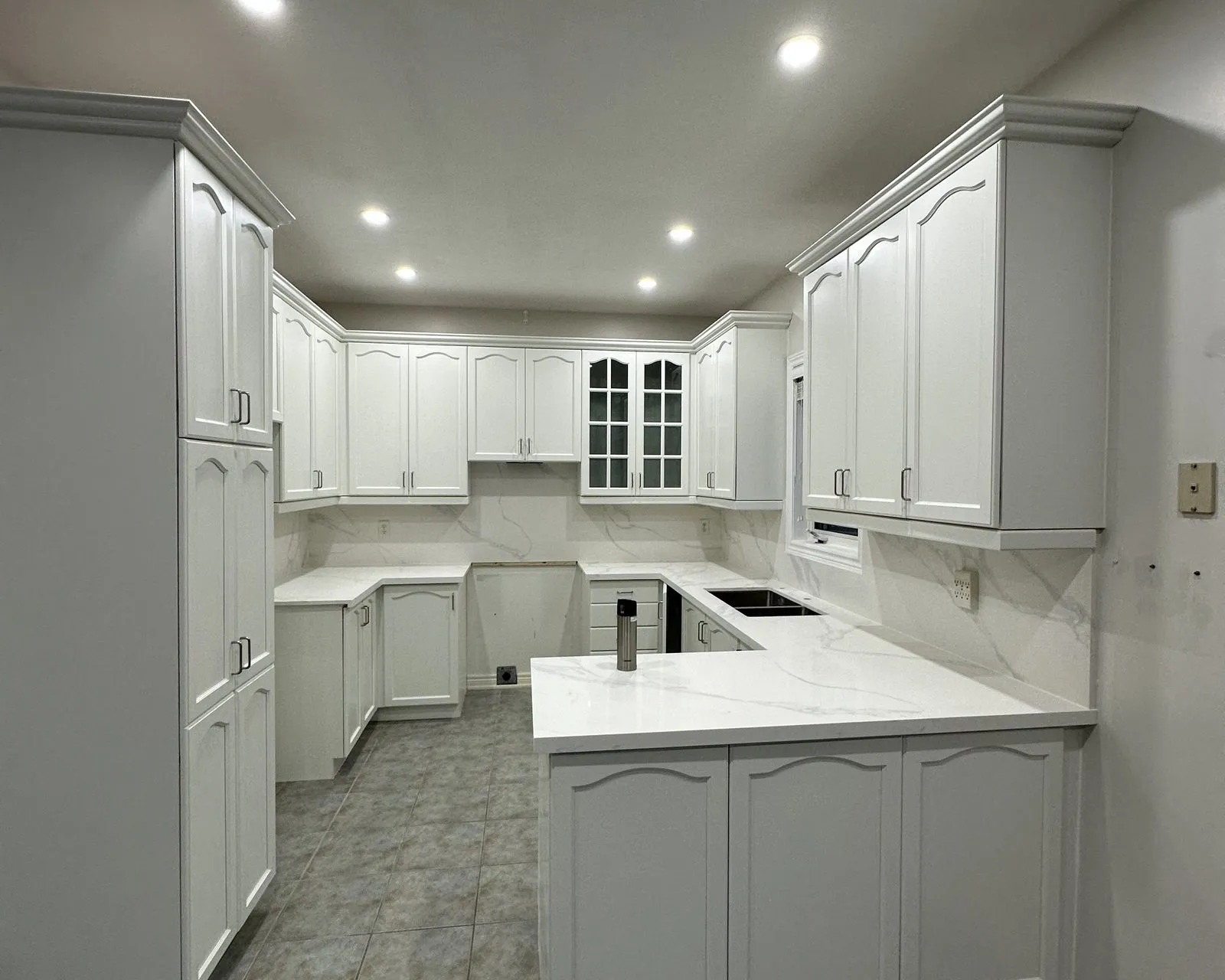 After
After Templated
Cut from your cabinets, not a drawing
100+
Kitchens completed
25 years
In the trade, and here since 2013
5.0
Rated on Google
Who does which part
We are the countertop contractor. The stone shop cuts the stone.
That is worth stating at the top because a lot of companies leave it vague. Kitchen Made New does not fabricate or install countertops. What we do is specify the material, price it as one line in the quote for the whole job, hold the contract, and run the schedule so the slab turns up at the point in your project where it belongs.
What you are actually buying
In the trades that is what a contractor means. A general contractor does not lay the bricks. The value is not in owning the saw. It is in three things:
- One contract instead of two
- A fabricator chosen by somebody who has seen a lot of fabricators' work
- One sequence, decided by one person rather than argued over by two crews who have never met
The alternative
What most people end up doing. Hire a cabinet company. Hire a stone shop separately. Discover on fitting day that neither of them will take responsibility for the quarter-inch where their work meets.
Backsplash works the same way. Tile setting is a third trade and we contract it to a tiler, then schedule it so the wall and the counter are not two projects you are chasing separately.
Quartz, granite and quartzite are not the same material
This confuses people constantly, and the names are the reason.
Quartz is engineered. Ground mineral bound in resin, pressed into slabs, consistent from one to the next. Quartzite is a natural stone quarried in blocks, with all the variation that implies. Granite is another natural stone again. Two of those three need sealing on a schedule. Quartz does not, because the resin makes it non-porous, and that is the practical reason it has taken over most kitchens.
Non-porous has consequences you notice. Red wine left overnight wipes off. Turmeric does not stain it. There is no annual resealing appointment and nothing to remember. Warm water and a cloth is the entire maintenance routine, and a drop of washing-up liquid handles anything sticky.
Heat is where it gives up. The resin scorches, and a scorch mark is permanent because there is no finish to sand back. Use a trivet.
The other thing worth knowing is that quartz is consistent between slabs in a way natural stone is not. If your kitchen needs more than one piece, that matters. Two granite slabs from the same block still differ; two quartz slabs of the same product do not.
Why the cabinets come first
Stone is cut from a physical template of what is actually in the room. Not from a drawing, not from the dimensions on a plan, and not from what the kitchen measured before work started.
So the cabinets have to be finished and cured before anyone templates. New doors change the face of a run. A box that gets reinforced or levelled changes a dimension. Even the build of a sprayed finish on a frame edge moves things fractionally, and stone is cut to tolerances where fractionally is enough.
Template before the cabinet work is settled and the slab gets cut to a kitchen that no longer exists.
Where this goes wrong
This is the single most common way countertop projects go wrong in a renovation, and it almost never happens because somebody measured badly. It happens because two contractors were working to two schedules. The cabinet crew runs late. The stone shop has a fabrication slot booked and does not want to lose it. Somebody templates anyway. The fit is out by an amount nobody will own, and the customer is the one holding two invoices and a gap along the back wall.
Holding both halves of the schedule is what stops that conversation happening. If the cabinet work slips, the template moves with it. They are one project rather than two suppliers with separate deadlines.
The carpentry underneath
There is a carpentry side to this as well. Quartz is heavy, base cabinets in an older kitchen are not always level after years of settling, and a long overhang or a waterfall edge needs support built for it. That work is ours and it happens before the template, not discovered by a fabricator on fitting day with nobody there to fix it.
From slab to fitted counter
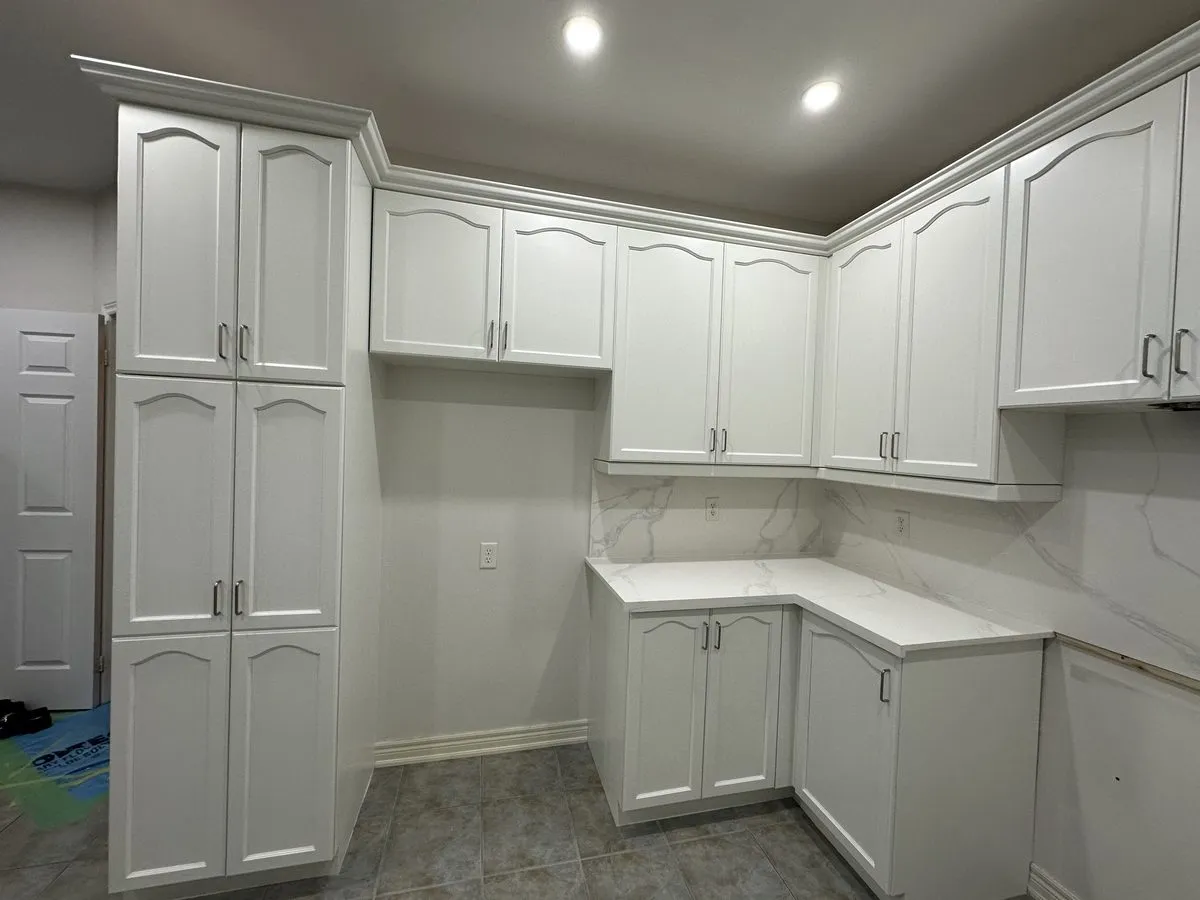
The sequence runs like this.
You choose the material first, and you choose it at the fabricator rather than from a photograph. They hold far more stone than anyone could keep at an office, and a slab looks different in person than it does on a screen. We will tell you which of our fabricators suits what you are after and arrange the viewing.
Templating happens once the cabinets are done. The fabricator measures the finished run, confirms where the sink and hob sit, agrees the overhangs, and works out where any seam will fall if the run is longer than a single slab. Be there for that last part if you can. Seam placement is as much a decision about what you will be looking at for fifteen years as it is a technical constraint.
Cutting, then fitting day
Then the stone goes to the shop. Cutting, the cutouts for the sink and hob, and the edge profile all happen off-site, which is why the mess and the noise of fabrication never reach your house. Lead time varies with the slab. Something the fabricator stocks moves quickly and something ordered in does not.
On fitting day the old counter comes out, the new one goes in, seams are bonded with a colour-matched adhesive, and the sink is reconnected. It is usually a single day. The silicone around the sink and the backsplash wants about a day before heavy use, but the quartz itself needs no curing time at all. The kitchen goes back into service that evening.
What it costs and what the price includes
The quote is fixed. Whatever figure we send is the figure you pay, on the photo route or after a visit, and we do not revise it once given.
Stone appears in that quote as its own line, alongside the cabinet work and anything else in the project. That matters practically. You can take a line out without renegotiating the whole job, and you can see what the counter is costing rather than having it absorbed into one number.
What moves the stone line is the slab you pick, the area of it, how many seams the layout forces, the edge profile, and the cutouts. Removal and disposal of the old counter is part of it. So is the coordination, which is the part that is easy to undervalue until you have tried to run a fabricator and a cabinet crew against each other yourself.
One caution on warranties, because one contract can be mistaken for one warranty. Our five years covers the work we carry out. The stone carries one year from the fabricator who cut and fitted it. Those are different terms from different companies, and it is better to know that now.
Stone is one of three things that happen to a counter
The slab is the horizontal part. The wall behind it is tile-setting, which is a different trade again, and an island brings its own questions about overhang and support. All three usually turn up in the same conversation and all three sit on one contract, which is what the page above this one sets out. Seeing the rest of the stone work on one contract together is more useful than pricing the slab on its own, because the order they happen in is what decides the schedule.
Quartz Countertop Installation Cost in Oakville
Stone is priced by the slab and by what has to be cut into it. The material band you choose sets the floor — quartz ranges widely by pattern and by how much of the slab a book-matched vein wastes — and the fabrication adds to it: sink cutouts, cooktop cutouts, drainage grooves, and the edge profile you pick.
We are the contractor rather than the stone shop. We specify the material, price it into the job, hold one contract and run the schedule; the cutting and fitting go to fabricators we have used for years. What you are buying with that is a single point of responsibility rather than two trades to coordinate.
The sequencing carries a real cost consequence. Stone is templated off the cabinets that are already standing, so it goes in near the end. Templating early, from the old counter or from drawings, is how overhangs and cutouts end up in the wrong place, and a slab cut wrong is not adjustable.
Countertops carry a one-year warranty from the fabricator who cuts them rather than our five-year warranty on our own work.
Questions
Common questions about quartz countertop installation in Oakville
- Do you cut and fit the stone yourselves?
- No. We specify the material, price it into the job, hold the contract and run the schedule. The cutting and fitting go to fabricators we have used for years. We are the countertop contractor rather than the stone shop, and the difference is worth stating because it is what you are buying. One company answerable for the whole kitchen, and a fabricator picked by somebody who knows which ones do good work.
- Whose warranty covers the countertop?
- The fabricator's, and it runs one year. Our own five-year warranty covers the work we carry out, which means the cabinetry, the finish and the installation of it. Stone is the exception. We would rather say that plainly than let one contract be mistaken for one warranty, because that is the kind of thing people only discover at the worst possible moment.
- Can the counter go in before the cabinets are done?
- No, and this is the most useful thing on the page. Stone is cut from a template taken off finished cabinets. If the cabinets are still being refaced, sprayed or rebuilt, the dimensions are still moving, and a slab cut to yesterday's measurements does not fit today's kitchen. Cabinets first, cured, then template.
- How long does it take from template to install?
- Fabrication sits between the two and the lead time depends on the slab. A colour the fabricator holds moves quickly. Something ordered in does not. We give you the date once the slab is confirmed rather than guessing at it in advance, and the install itself is usually a day.
- What happens at the template visit?
- The fabricator measures the finished cabinets, and it is a precise job rather than a tape measure and a notepad. Sink and hob positions are confirmed, overhangs are agreed, and seam placement is decided if the run is longer than a slab. That conversation is the fabricator's rather than ours, and we tell people to be there for it, because where a seam falls is a visual decision as much as a technical one.
- Can I put a hot pan straight onto quartz?
- No. It is the one real weakness of the material. The resin that makes quartz non-porous will scorch under a pan taken off the burner, and the mark cannot be polished out. Almost every call anyone in this trade gets about damaged quartz is a hot pan and no trivet. Everything else it handles well.
Planning new stone as part of a bigger kitchen job?
Send photographs of the kitchen and the runs you want in quartz. The written quote covers the stone alongside whatever cabinet work is happening, inside 24 hours, and it does not change afterwards.
Free in-home consultation · no obligation
Refaced. Repainted. Refinished.