
Quartz Countertop Installation in Toronto — From the Yard to Your Kitchen
A quartz countertop is decided four times — the slab, the seams, the edge and the support. Only the first is chosen in a showroom, and it is the least important.
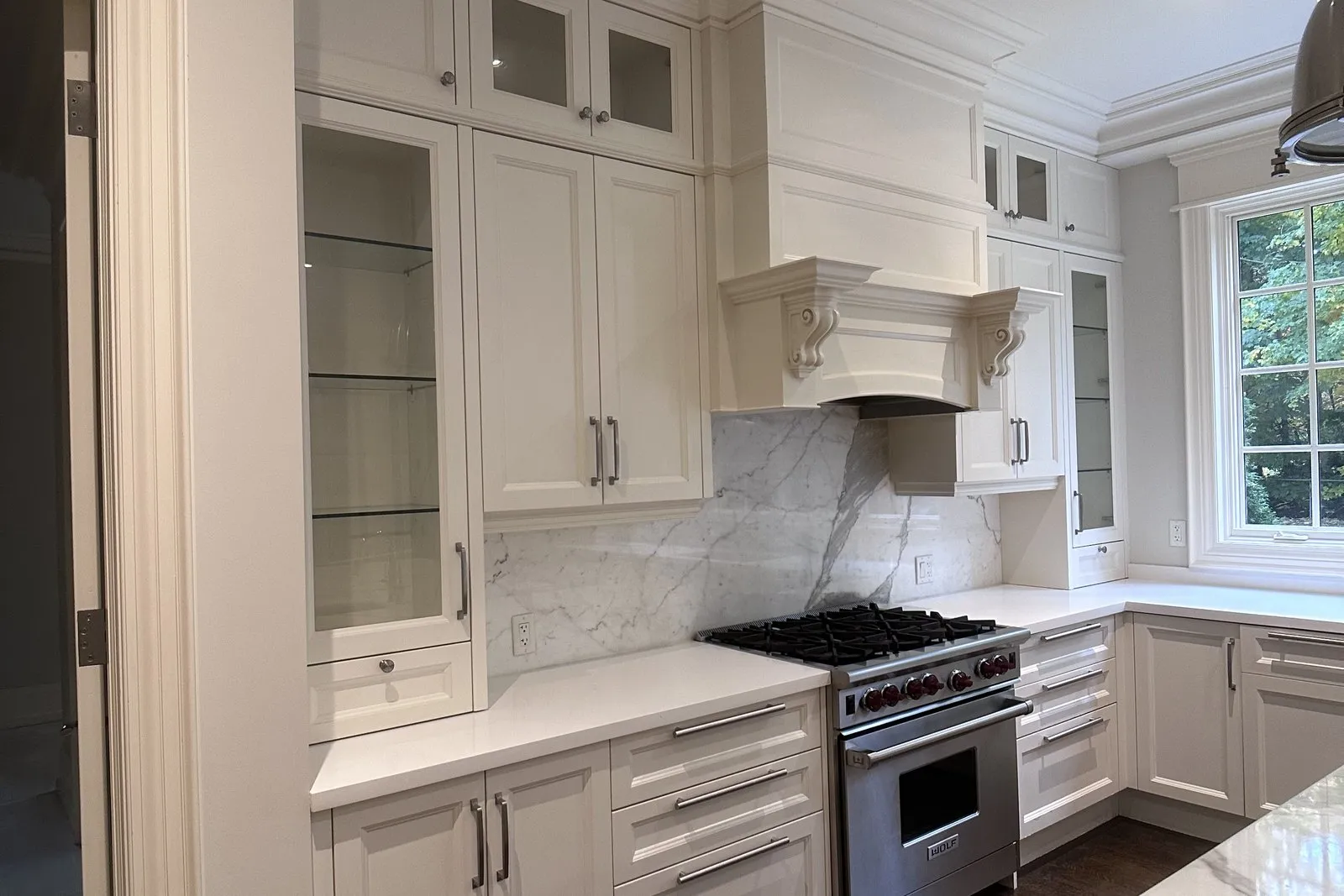
At the yard
Slabs seen whole, not as thumbnails
Digital
Templating, so you see the layout first
10 days
From template to installation
5.0
Rated on Google
Choosing the slab, which is not the same as choosing the colour
Most people choose quartz from a sample the size of a postcard, and for a plain colour that is genuinely adequate.
For anything with movement in it — the veined marble-effect quartzes that most of the market now buys — a postcard tells you almost nothing. A vein that reads as a delicate thread on a sample can be a bold diagonal stripe two hundred millimetres wide on a slab, and where that stripe lands on your island is a decision somebody is going to make with or without you.
So for patterned material we go to the yard and look at the actual slabs reserved for your job. It takes an hour. You see the whole sheet, the direction of the movement, and how two slabs from the same batch relate to each other if your kitchen needs two.
It is also the moment to decide whether the pattern should be book-matched across a seam — mirrored, so the veining runs continuously — which is a striking effect on an island and costs more because it constrains how the pieces can be cut.
For a plain white or a fine speckle, none of this applies and a sample is fine. We will say which category your choice is in rather than sending everyone to a yard out of principle.
Templating, and what it settles
Templating is the measurement that turns your kitchen into a cutting drawing, and it happens after the old countertop is off.
It is done digitally, with a laser device that records the actual geometry of your cabinets — including the fact that the wall is not straight and the corner is not ninety degrees, which in a Toronto house it will not be. That produces a shape that fits your room rather than a rectangle that has to be scribed on the day.
What gets confirmed while the templater is there: the exact sink position and whether it is undermount or top-mount, the hob cutout, tap holes and any pop-up outlets, the overhang everywhere, and the seam positions.
That last one is why being present for twenty minutes is worth it. A seam has to go somewhere, and the options are usually a corner, a sink cutout, or the middle of a long run. Which is least objectionable depends on where the light falls and where you stand, and you know that about your kitchen and the templater does not.
The template is also the last point at which anything can change. After it, the stone is cut and the drawing is what you have.
Levelling, which happens before any of it
Stone does not bend. That single property drives most of the preparation.
A quartz countertop laid across cabinets that are not level is supported at some points and unsupported at others, and the stone takes the stress at its weakest section — which is almost always the narrow bridge in front of or behind the sink cutout. Cracks there are the most common quartz failure and they appear weeks or months after installation, not on the day.
So before a template is taken, the runs get checked with a long level and shimmed where they need it. In an older Toronto house that is normal rather than exceptional; floors settle, and a run installed level in 1962 is frequently not level now.
The other preparation is the substrate. Where a cabinet run has a wide unsupported span, or where a dishwasher leaves a gap with nothing across it, a support rail or a plywood subtop goes in first. This is invisible in the finished kitchen and it is the reason the countertop is still intact in ten years.
If a box turns out to be compromised — swollen board under a sink is the usual one — it has to be dealt with before stone goes on it. Putting a heavy, rigid countertop on a failing box is a problem deferred at some expense.
Installation day
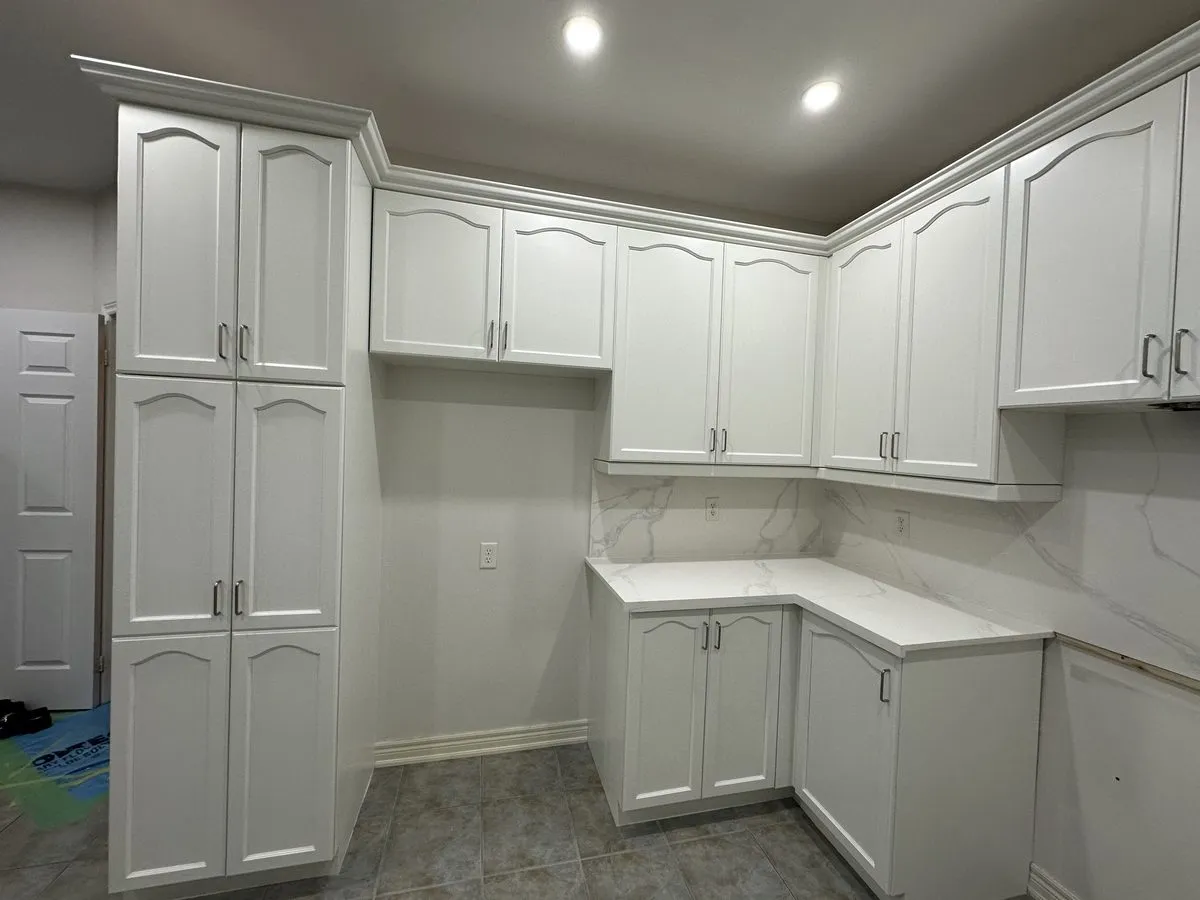
The stone arrives cut, polished and profiled, and the fitting is faster than people expect — most kitchens are a single day.
Pieces are carried in, dry-fitted and checked against the cabinets. Any final scribing to the wall happens now, on site, with the piece in position. Then the stone is set on adhesive, the seams are joined with a colour-matched epoxy and pulled tight, and the joint is polished flush.
A good seam on quartz is genuinely hard to find afterwards. It is a fine line rather than a gap, and the two pieces should be level with each other across it — a seam you can feel with a fingertip is a seam that was rushed.
The sink is fitted and sealed, the tap holes are used, and the plumbing is reconnected. Silicone goes in at the wall junction rather than grout, because that joint moves seasonally and a rigid filler there cracks.
Then it is usable. Quartz needs no sealing, no curing period and no special treatment. The only instruction we give is about heat.
Living with it
Two rules and then nothing.
Trivets, always. This is the one genuine vulnerability of engineered quartz and it is not a warranty matter — the resin binder scorches, the mark is permanent, and it happens at temperatures a pan reaches routinely. A hot pan straight from the hob to the countertop is the way most damaged quartz gets damaged.
Ordinary cleaning, nothing aggressive. Soap and water handles everything. What to avoid is anything strongly alkaline — oven cleaner, some drain products — which attacks the resin rather than the quartz. Bleach in normal dilution is fine, neat is not.
Beyond that there is nothing. No sealing, ever. No polishing. Cutting on it will blunt your knives long before it marks the stone, though a board is still a good idea for the knives' sake.
The stone is one of three things that happen at the same wall
A quartz installation almost always arrives with a splashback decision behind it and frequently with island work under it. All three share a template, a delivery and a fitting day, which is why they belong in one quote rather than three. Reading how stone, splashback and island work share one visit covers how they are sequenced and what running them separately actually costs in time.
Quartz Countertop Cost in Toronto
Four things drive the number, and the first one dwarfs the others.
The slab. Quartz is graded, and the spread between an entry-level plain colour and a premium veined one is large enough that the same kitchen can differ by more than the entire cost of fitting it. This is the lever worth understanding first, and it is why the fabricator's figure is shown separately in your quote.
Square footage, which is straightforward, measured from the template rather than estimated.
Cutouts, priced individually. Sink, hob, tap holes, outlets. An undermount sink cutout costs more than a top-mount because the exposed edge has to be polished.
Edge profile, priced per linear foot. A square eased edge is the baseline; mitred edges that make the stone look thicker than it is, and any ornate profile, cost meaningfully more.
Then removal and disposal of the old countertop, which is its own line and is higher for stone than laminate, and any levelling or substrate work the cabinets need.
The written price comes back inside 24 to 48 hours, with the fabricator's portion and ours shown separately. Cash, debit, credit and Visa.
Questions
Common questions about quartz installation in Toronto
- Can I see the actual slab before it is cut?
- Yes, and you should. Quartz is consistent enough that a sample is broadly reliable, but veined patterns vary across a slab and a strong vein is a design decision. Going to the yard takes an hour and it is the difference between choosing a product and choosing your countertop.
- How many seams will I have?
- As few as the slab size allows, and the positions are agreed with you rather than decided at the wall. A slab is finite, so any run longer than it needs one. A well-placed seam is nearly invisible; a badly placed one sits under the window where the light rakes across it.
- Do I need to be there for the template?
- Ideally yes, for about twenty minutes. Templating is digital and quick, but it is also the moment when overhangs, seam positions and the sink placement are confirmed, and those are far easier to agree standing in the room than over the phone afterwards.
- What happens to my sink and tap?
- The old sink comes out with the old countertop and the new one goes in with the new stone. Plumbing disconnection and reconnection is coordinated as part of the job. If you are keeping an existing undermount sink, it needs checking against the new cutout before anything is cut.
- Should I be looking at granite instead?
Worth a proper comparison rather than a preference. The practical differences all follow from one being made and the other quarried — sealing, consistency, repairability and heat. Reading what being manufactured rather than quarried changes sets them side by side, and it occasionally sends people back to natural stone for good reasons.
- What is quartz actually bad at?
It has real weaknesses and we would rather name them than be asked later. Heat is the serious one — a scorch cannot be removed — and seams show more than they do on granite. Reading the four places engineered stone falls short covers all four, including the two that are avoidable at template stage rather than afterwards.
- How do I look after it?
Warm water and washing-up liquid, and that genuinely is most of it — the anxiety around quartz care is out of proportion to the risk. What matters is what you keep off it rather than what you put on it, and the short list of things to keep away from it is shorter than the internet suggests.
- Can quartz go over my existing cabinets?
- Usually, if they are sound and level. Stone does not flex, so an unsupported or twisted run cracks — normally at a cutout and normally months later. Levelling and shimming is part of the preparation and it is why the cabinets get checked before the template rather than after.
Ready to price a quartz countertop properly?
Send wide photographs of every run with the existing countertop visible, plus the sink area. The quote shows the fabricator's figure separately from ours, so you can see exactly what the stone itself costs.
Free in-home consultation · no obligation
Refaced. Repainted. Refinished.