
Kitchen Cabinet Refacing in Toronto — New Fronts on Sound Boxes
Refacing replaces every part of a kitchen you look at and keeps every part you do not. Done properly the join is invisible; done cheaply it is all you see.
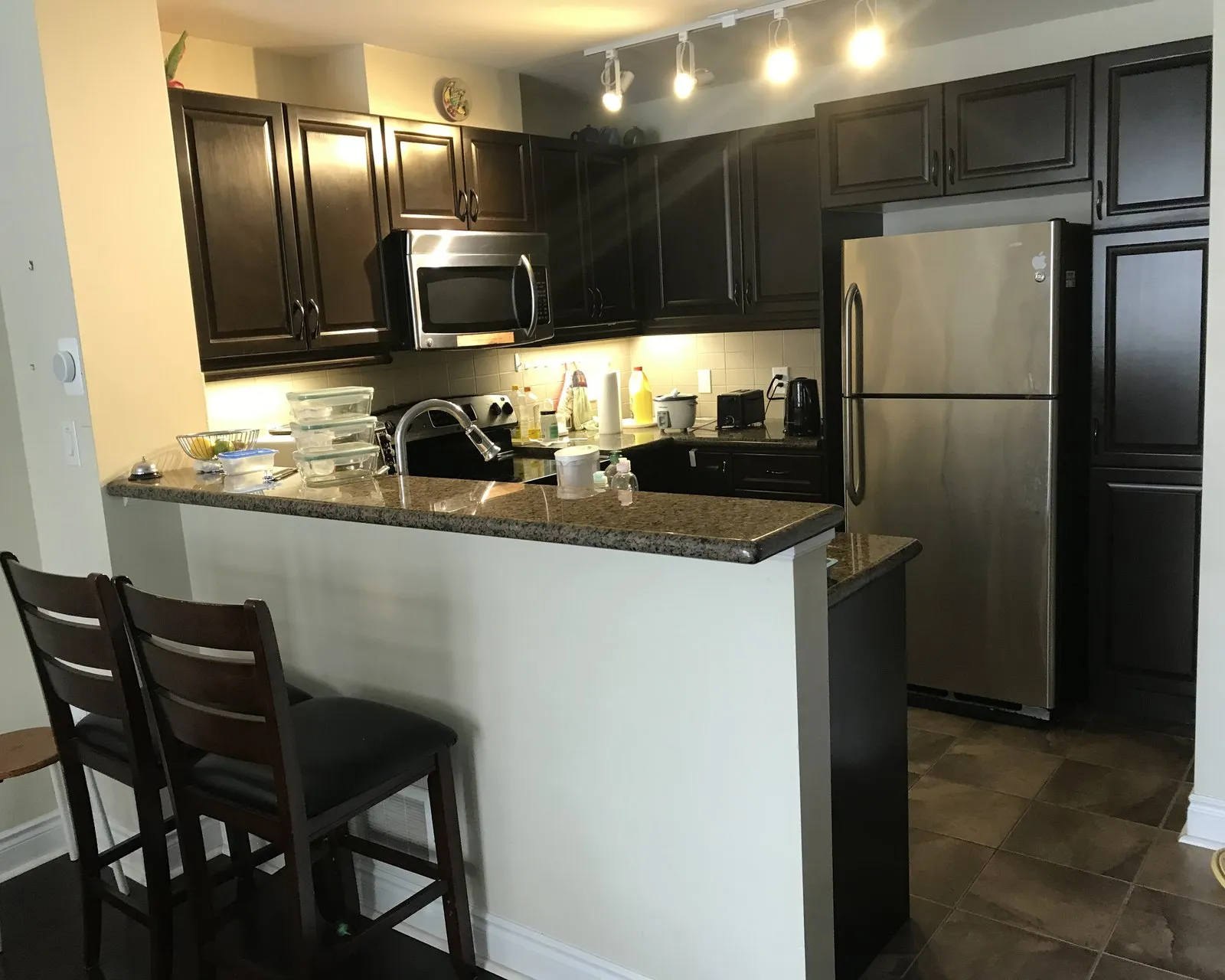 Before
 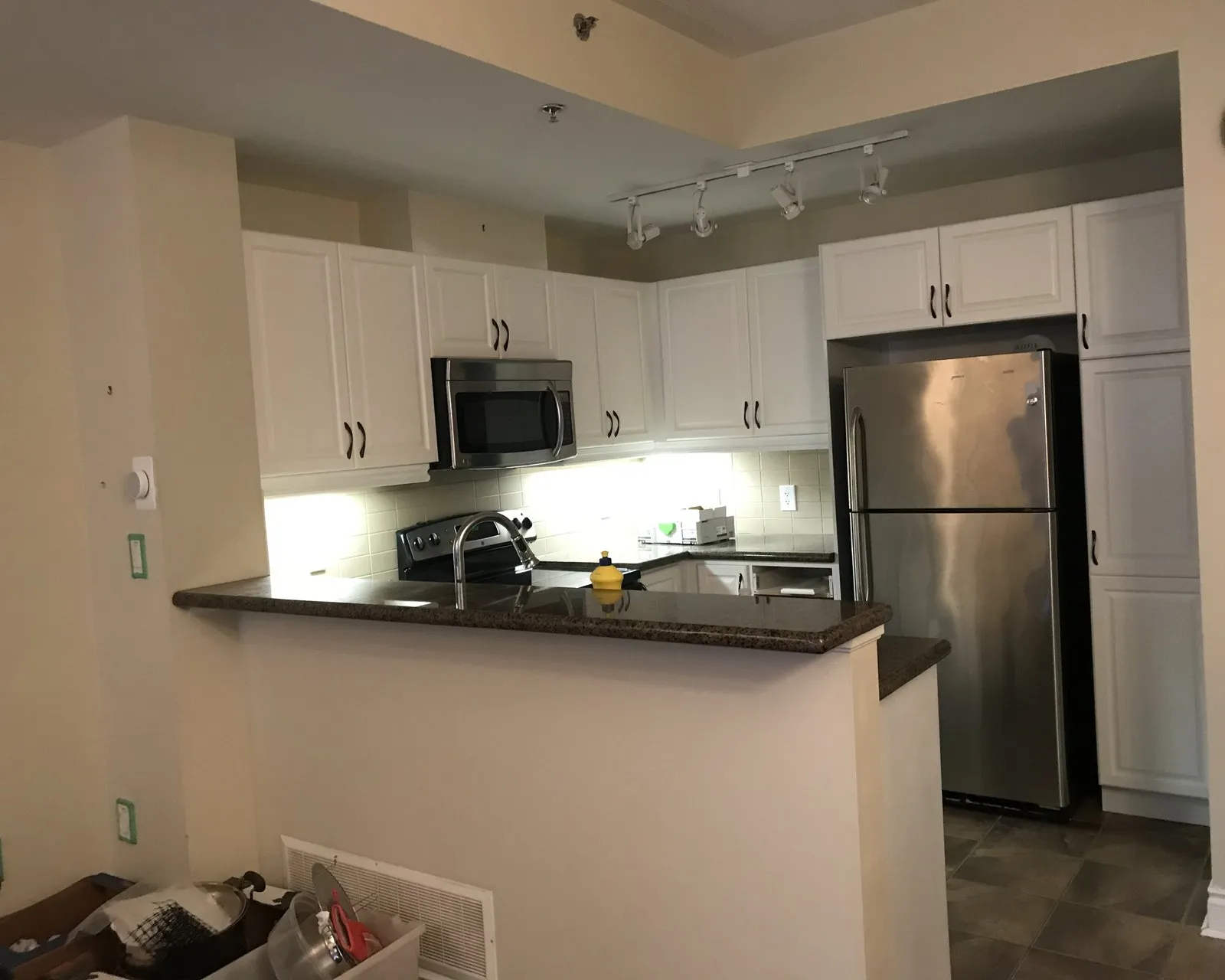 After
After 5 days
Without a kitchen, of four to five weeks
15 years
On waterproof MDF doors and fronts
2K
Sprayed, on doors and boxes alike
5.0
Rated on Google
What refacing actually replaces
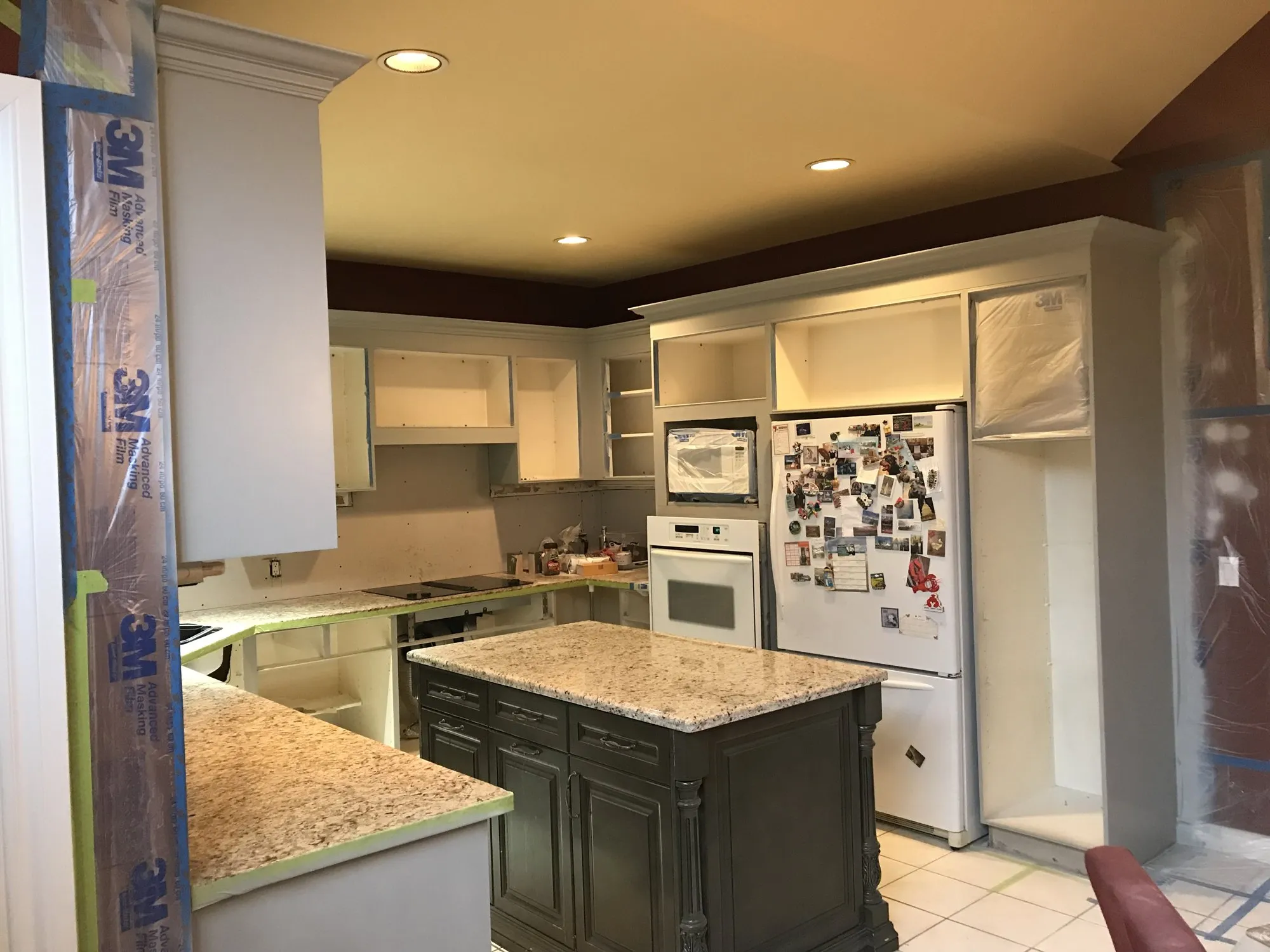
Every visible surface, and nothing behind them.
The doors and drawer fronts come off and are not reused — new ones are built to your openings, in the profile and colour you choose. The face frames, the exposed end panels and any visible side of a run get sprayed in the same finish as the doors. Hinges, runners and handles are new. Toe kicks and light valances are replaced or refinished depending on what is there.
What stays is the box: its sides, its shelves, and its position on the wall. It is not touched except to be cleaned, prepared and sprayed.
The result is a kitchen in which nothing you can see is original. That is worth being precise about, because the word "refacing" makes people picture a partial job, and the visible outcome is not partial at all. What is partial is the demolition, the cost and the disruption.
Why the box is usually the last thing worth replacing
A cabinet box holds weight, square, for decades, and it is the part of a kitchen least exposed to anything that destroys kitchens. It does not get wiped with degreaser twice a day. It does not get slammed. It does not sit in the sun.
In a North York bungalow built in 1958 the boxes are frequently solid stock with proper joinery, and they are better than what a modern kitchen would put in their place — which is very often melamine-faced particleboard with a cam-lock at each corner. Tearing out the first to install the second is a downgrade that costs money.
What has actually failed by the time somebody calls us is the layer in front. The door finish has yellowed or chipped. The thermofoil has lifted at the corner nearest the oven. The hinges have dropped so the doors no longer line up. The handles are dated. Every one of those is on the outside.
There is a real exception and we look for it first. Water under a sink base that has spread into the box, a run that has racked out of square as a house settled, particleboard that has swollen and will not hold a screw again. Those boxes are gone and we say so rather than putting new doors on them.
The seam problem, and the reason we spray
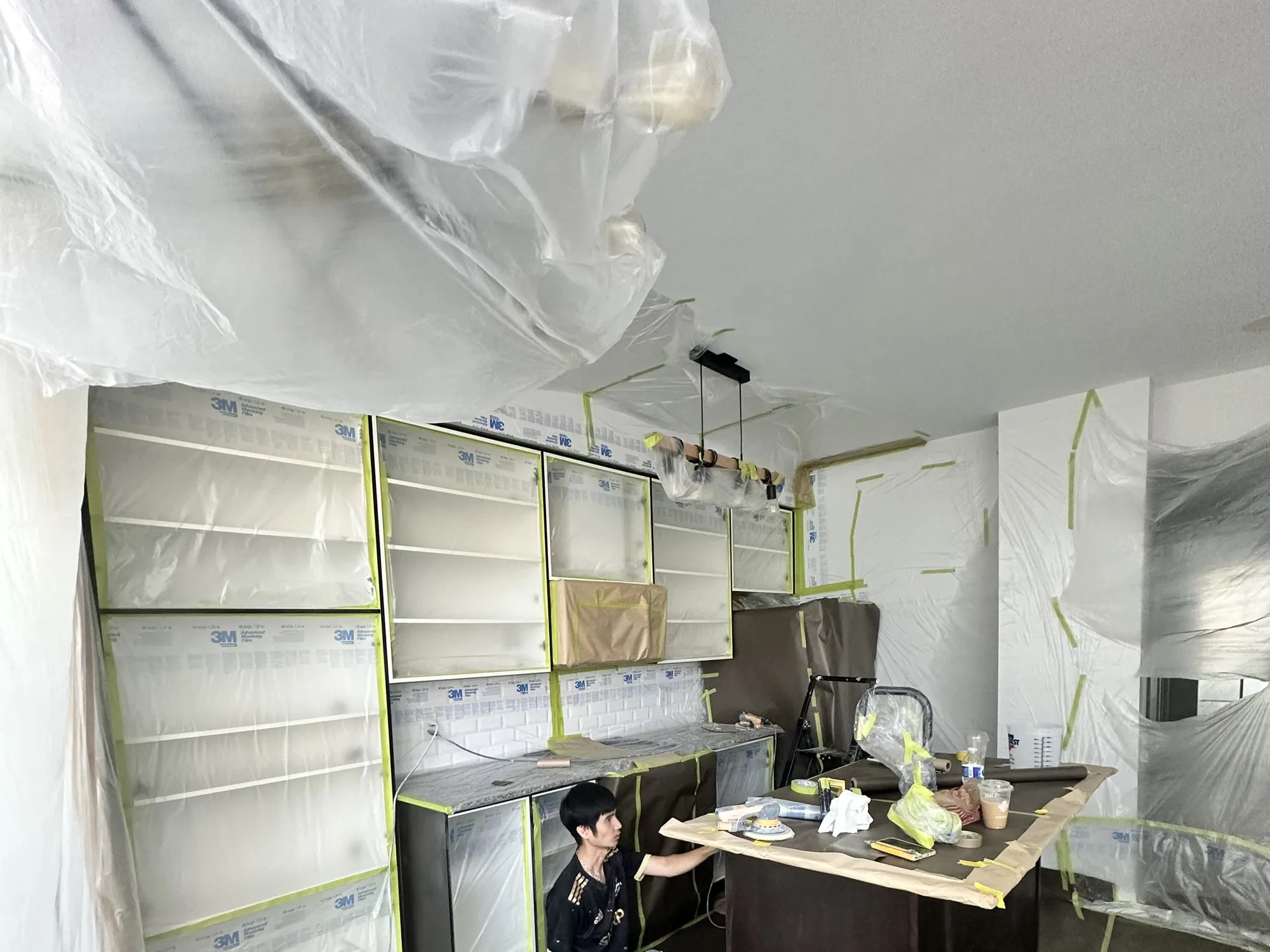
This is the part that separates refacing that lasts from refacing that embarrasses everyone in three years.
Most companies that reface do it by wrapping. A thin sheet of rigid thermofoil or wood veneer, backed with adhesive, is cut and pressed onto the face frames and end panels. It goes on quickly, it looks convincing on the day, and it is the cheapest route by a distance.
It also has a seam at every corner, and a bond that has to survive a kitchen. Wood and vinyl expand at different rates through a Toronto year — a house that runs humid in August and dry in February works that joint several hundred times. The adhesive gives up first at the corners, then along the stile edge nearest the heat source, and a lifted veneer edge cannot be repaired. It can only be removed and redone.
We spray the frames in place instead. The same catalysed 2K that goes on the doors, applied behind containment, so the finish on the box and the finish on the door are the same material from the same batch. There is no sheet, so there is nothing to lift. The run reads as one surface because it genuinely is one surface.
That takes longer and costs more, and it is the whole reason to have us do this rather than somebody quoting two-thirds of the number.
What the doors are made from, and why MDF is not a compromise
Most of what we build is a waterproof MDF door with a sprayed 2K finish, and people occasionally arrive expecting to be talked into solid timber.
They should not be. For a painted or sprayed kitchen door, MDF is the better material and it is not close. It has no grain to telegraph through the finish, no seasonal movement to open a joint at the panel, and no knots to bleed. A five-piece solid maple door painted white will show its rail-and-stile joints as fine cracks within a few winters, because the timber moves and the paint film does not.
The MDF we use is the moisture-resistant grade rather than standard board, which matters directly under a sink and beside a dishwasher. We warrant those doors for fifteen years, which is three times our own standard term, and that is only affordable to offer because the material and the finish suit each other.
Where solid timber is right is a stained or clear-finished kitchen, where you want the grain visible — and that is refinishing rather than refacing, on the doors you already own.
What five weeks looks like from your side
Day one is photographs and a written price, which arrives inside 24 to 48 hours and does not change.
Then a design visit, at your kitchen, with door samples and colour chips on your own counter. The quote is already in your hand by then; the visit is for choosing rather than for pricing, which is why nobody is trying to close you on the day.
Then roughly four weeks in which nothing happens at your house. Doors are built to your measurements and sprayed at the shop on Barmac Drive. Your kitchen works exactly as it does now.
Installation week is the one you feel. Old fronts come off, hardware is stripped, frames are prepared and sprayed in place behind containment. We ask you to be elsewhere for two or three nights of that because 2K is solvent-based. Then new doors, new hinges, new handles, adjustment, and a walk round with you.
Five days without a kitchen, at the end of five weeks. That ratio is the entire argument for refacing over replacement, and it holds in every house we have done it in.
Refacing is one of four answers, not the default one
Refacing is right when the layout works and the door style is the problem. Where the doors are sound and only the colour has dated, painting costs less and does more. Where there is real timber under old lacquer, refinishing keeps something refacing throws away. And where the boxes have gone, none of the three apply. Reading which service a Toronto kitchen is actually asking for takes a minute and occasionally saves several thousand dollars.
Cabinet Refacing Cost in Toronto
Refacing is priced on the count of doors and drawer fronts plus the days the job needs on site. It is not priced per linear foot, and there is a reason to be wary of anyone who does — a linear-foot number cannot tell the difference between a run of three tall pantry doors and a run of twelve small ones, and those are very different jobs.
The lines you will see are the doors and fronts themselves, the hardware, the frame spraying, the installation days, and anything separately chosen: drawer boxes rebuilt, soft-close retrofitted, interiors sprayed, a new toe kick. Everything is its own line so you can decline any of it.
Ninety-nine percent of our quotes come from photographs. The written price follows inside 24 to 48 hours and it does not move once anyone is on site. If a visit turns up something awkward, that is absorbed rather than added — which is only possible because the quote was calculated carefully rather than guessed at on a doorstep in ten minutes.
Payment is staged, there is no deposit taken at the design visit, and we take cash, debit, credit and Visa.
Questions
Common questions about cabinet refacing in Toronto
- Can I see how a refacing job runs before I book?
Yes. Our showcase shows how a refacing job runs, start to finish, with real kitchens we have finished, what gets sprayed where, prices and warranties.
- What is the difference between refacing and veneer wrapping?
- Wrapping glues a thin adhesive sheet over your existing frames. It is faster and cheaper and the seams show at every corner within a few years, because the adhesive and the timber move at different rates. We spray the frames instead, in the same 2K that goes on the doors, so there is nothing bonded to the box that can lift off it.
- Can you match a colour to something already in my kitchen?
- Yes, and it is normal rather than an extra. Colour is matched to a physical sample — a tile, a floor board, a fan deck chip — under the light in your own room rather than under the shop's. A colour agreed on a screen or in a showroom is the single most common regret in this trade.
- Do the drawer boxes get replaced too?
- Only if they need it, and it is quoted as its own line so you can decline it. A dovetailed timber box from the sixties is usually better than what would replace it. A stapled particleboard box with a sagging bottom is not, and putting a new front on one is putting a new door on a failing hinge.
- How much of my kitchen is unusable, and when?
- Four of the five weeks are entirely normal — the doors are being built and your kitchen works as it always has, with open shelving where the fronts were. The installation week is the disruptive one, and we ask you out of the house for two or three days of it while the frames are sprayed.
- What if you open it up and find something?
- Then it is our problem rather than a change order. The price is calculated from photographs before anyone starts and it does not move afterwards. The one thing we will stop for is a box that turns out to be structurally gone, and in that case you are told before any of it is charged.
Wondering what refacing your kitchen would cost?
Send wide photographs of every run of cabinet and a written price comes back inside 24 hours, itemised and fixed. If your boxes are not worth keeping, you will hear that before you hear a number.
Free in-home consultation · no obligation
Refaced. Repainted. Refinished.