
Soft-Close Hinge Upgrades in Toronto — The Smallest Change You Notice Daily
This is the cheapest thing on this website and the one people mention first when we go back. A door that will not slam stops being noticed by being right.
Per door
Quoted individually, decline any of them
3-way
Adjustment, so a whole run can be trued
1 hour
Per door, including the alignment
5.0
Rated on Google
What a soft-close hinge actually is
A concealed hinge with a fluid damper built into its body.
The mechanism is a small cylinder of viscous oil with a piston in it. For most of the door's travel the damper does nothing at all — the door swings normally and feels normal. In the last inch or so of closing, the piston engages and the oil resists, so the door slows to a stop instead of arriving.
That is the whole trick, and its virtue is that it is invisible. Nothing about the kitchen looks different, nothing hangs off the door, and the only evidence is that the sound of a kitchen changes.
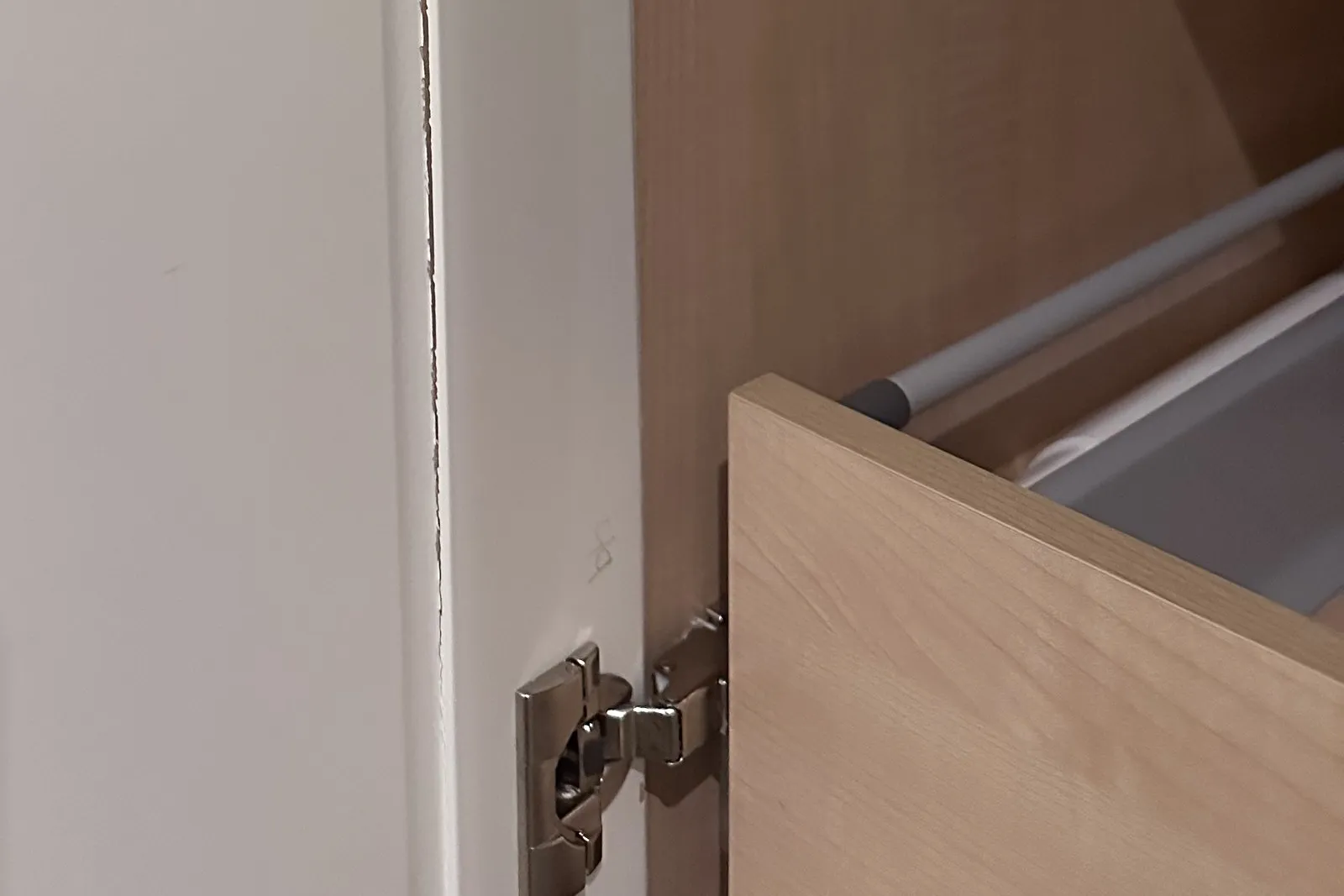
Concealed means it lives inside the cabinet: a cup bored into the back of the door, an arm, and a mounting plate on the frame or the box side. Nothing is visible with the door shut, which is a secondary benefit in a kitchen that currently has exposed barrel hinges from 1962.
Why the alignment matters more than the damping
Most people ask for soft-close because doors bang. What they usually get, and value more once they have it, is a run of doors that line up.
An old hinge has almost no adjustment. Some have a slotted screw hole giving a few millimetres one way. That means every door hangs where its own hinge and its own screw holes put it, and as those holes wear and the pins wear, the doors drift out of relation with one another. A run of six upper doors in a sixty-year-old kitchen is very often visibly uneven and everyone in the house has stopped seeing it.
A modern concealed hinge adjusts independently in three axes. Height, so a door can be lifted or dropped. Depth, so it can be brought closer to or further from the frame. And side to side, so the reveal between two doors can be equalised.
The consequence is that a run can be trued as a set rather than each door being hung as well as its own opening allows. That is the last hour of the job and it is where the visible improvement comes from.
People book this for the silence and keep talking about the straightness.
Face-frame versus frameless, and why it changes the part
This is the one genuinely technical thing on the page, and it is worth knowing before comparing quotes.
There are two ways a cabinet is built. A face-frame cabinet has a solid timber frame across the front of the box, and the door closes against that frame. It is the North American tradition and it is what nearly every Toronto kitchen built before about 1995 is.
A frameless cabinet — the European system — has no front frame; the door covers the edge of the box itself.
The hinge is different for each, and not interchangeable. A face-frame concealed hinge has a mounting plate designed to screw to the front of a timber frame at the right offset. A frameless hinge mounts to the inside of the box side. Fitting the wrong one is the single most common error in a do-it-yourself retrofit, and the symptom is a door that will not close flat or fouls its neighbour.
There is a further variable in face-frame kitchens: overlay. How much of the frame the door covers — full overlay, partial, or inset — determines the crank of the hinge arm. Getting that wrong produces doors that collide with each other at the corners.
We identify both from a photograph of the inside of one cabinet with the door open. It takes about ten seconds and it decides which part is ordered.
The boring, which is why this is shop work
Fitting a concealed hinge means boring a 35mm cup into the back of the door, at a precise distance from the edge and at a precise depth.
Too shallow and the cup stands proud, so the door will not sit flat. Too deep and the cutter comes through the front of the door, which on a painted door is unrecoverable. Too close to the edge and the thin remaining material breaks out under load, usually months later. The tolerance is small and it is not a job for a hand drill and a spade bit.
So doors come off and come to the shop, get bored on a press with a stop set for that door thickness, and go back. On a door that is thin, or veneered, or a five-piece where the cup would land on a joint, the position has to move and the mounting plate has to compensate — which is exactly the sort of judgement that cannot be made from a catalogue.
This is also why we quote per door rather than per cabinet. Two doors on one box are two borings, two hinge pairs and two alignments.
Where we say no, or say something else first
There are cabinets this is not worth doing to, and it is better to hear it now.
A door that is delaminating, swollen at the bottom, or has a broken panel will not hold a hinge cup properly, and putting good hardware on it is money on a door that needs replacing. We will say so and quote the door instead.
A cabinet whose frame is soft — water damage under a sink is the usual cause — will not hold the mounting plate screws under repeated load. That is a cabinet problem and it needs addressing before hardware.
And there is a genuine alternative worth knowing about. If the doors are sound, the alignment is fine, and the only complaint is the noise, a surface-mounted damper is a fraction of the cost and it works. It is visible inside the cabinet, it does nothing for alignment, and for some kitchens it is exactly enough. We will point at it rather than pretend it does not exist.
The cheapest item the shop fits, and rarely the only one
Hinges are almost never bought alone, because the moment to change them is when the doors are already off for something else. Fitted alongside a refacing or a repainting job the labour is nearly free; fitted as their own visit it is the whole cost. Reading what else is worth doing while the doors are off shows what else the shop makes, and why the sequence matters more than the individual prices do.
Soft-Close Hinge Cost in Toronto
Priced per door, and the labour is where the number moves rather than the hardware.
The hinges themselves are a modest per-door cost. What varies is what the door needs around them: whether it has to be bored fresh, whether old exposed hinges leave holes to fill and touch in, and how much alignment the run needs afterwards.
Timing is the real lever and it is worth being direct about. Fitted during a refacing or repainting project, the doors are already off, already at the shop, and already being adjusted on the way back — so the marginal cost is close to the hardware alone. Fitted as a standalone visit, somebody removes thirty doors, transports them, bores them, brings them back and rehangs them, and that labour is most of the bill.
If a repaint or a reface is anywhere in your plans, this is the item to do alongside it rather than before or after.
Every door is its own line, so a kitchen where only the four doors nearest the children need it is a perfectly reasonable quote to ask for. Written price inside 24 to 48 hours from photographs. Cash, debit, credit and Visa.
Questions
Common questions about soft-close hinges in Toronto
- Will these fit my old cabinets?
- Almost certainly, and the type depends on how your cabinets are built. Face-frame cabinets — which most older Toronto kitchens are — take a face-frame concealed hinge. Frameless European boxes take a standard one. Both are retrofits and both need the door boring correctly, which is shop work rather than a screwdriver job.
- Can I just buy soft-close dampers instead?
- You can, and for some cabinets they are a reasonable answer. They are small plungers that mount to the frame and catch the door in the last inch. What they do not do is fix the alignment, and misalignment is usually the real complaint behind "my cabinet doors are annoying".
- Is it worth doing on doors I am replacing anyway?
- It is the same job, and yes — new doors go on new hinges as a matter of course, so if you are refacing, soft-close is already included rather than an upgrade. This service is for kitchens where the doors are staying and only the hardware is changing.
- Do drawers get the same treatment?
- Drawers use runners rather than hinges, and soft-close undermount runners are the equivalent upgrade. Whether they can be retrofitted depends on the drawer box — undermount runners need a box with a specific bottom detail, and a stapled particleboard box usually will not take them.
- Will the doors look different afterwards?
- Only if your current hinges are the exposed kind. Concealed hinges live inside the cabinet and nothing shows from the front, so a kitchen with visible barrel hinges will look cleaner. Old exposed hinges leave screw holes on the frame, which get filled and touched in.
Doors that bang, or sit crooked, or both?
Photograph the inside of one cabinet with the door open so the existing hinge is visible, plus a wide shot of the run. The written price comes back inside 24 hours, per door, and you can take as many or as few as you like.
Free in-home consultation · no obligation
Refaced. Repainted. Refinished.