
Drawer Box Replacement in Toronto — The Part That Actually Fails
A drawer is the hardest-worked thing in a kitchen. It is also the part built cheapest, which is why the bottoms drop out long before anything else goes.
Ply or solid
Not stapled particleboard
Undermount
Soft-close, full extension, hidden runners
Per box
Quoted individually, replace only what needs it
5.0
Rated on Google
Why drawers fail before doors do
A door swings on two hinges and carries its own weight. A drawer carries everything in it, moves in and out under load several times a day, and stops abruptly at both ends of its travel.
Then consider what is in it. A cutlery drawer is light. A pan drawer holds twenty kilos of cast iron and gets slammed. The bottom drawer of a base unit in a family kitchen is the single most abused component in the house.
Now consider how those boxes were built. Through the eighties and nineties the standard was 12mm particleboard with stapled butt joints and a 3mm hardboard bottom sitting in a shallow groove. That construction is adequate for a cutlery drawer and inadequate for anything else, and the failure is entirely predictable: the staples work loose in the corners, the box racks out of square, and once it is out of square the bottom slips out of its groove and drops.
A dropped drawer bottom is the most common thing we find when fronts come off a kitchen from that era. Frequently the homeowner has known about it for years and has been lifting the drawer to open it without quite registering that they do.
What a good box is made of
Birch ply, in the multi-ply Baltic style, is what we build most boxes from, and the reason is that it does three things particleboard does not.
It holds a fastener. A screw into the edge of particleboard has very little to bite on and works loose under repeated load; a screw into ply edge grain holds indefinitely. That alone accounts for most of the difference in lifespan.
It is dimensionally stable. Ply does not swell when something spills in it. A particleboard box with a leaking bottle in it swells, and swollen board never returns to its dimensions — it binds in its opening and stays bound.
And it takes a proper joint. Ply can be dovetailed, rebated or dowelled with a joint that has mechanical strength rather than relying on the fastener alone. A dovetailed corner cannot rack, which is the failure mode that starts everything else.
Solid timber boxes we build where somebody wants them, usually maple or poplar, and they are excellent. They cost more and they move slightly with the seasons, which in a drawer running on tight undermount runners is a small consideration rather than a problem.
What we will not build is a particleboard box. There is no saving in it worth having.
Undermount runners and what they require
The runners are half of what makes a drawer feel right, and the modern ones are a genuine improvement rather than a fashion.
Side-mount runners — the ball-bearing sort visible on both sides of an open drawer — are what most kitchens of a certain age have. They work, they are cheap, and they have two limitations: they are visible, and they typically give partial extension, so the back four inches of the drawer are under the countertop and effectively unusable.
Undermount runners sit beneath the box and are invisible when the drawer is open. They give full extension, so the whole drawer clears the cabinet and you can reach the back of it. They carry more weight. And they come with soft-close integrated, so a drawer cannot be slammed.
The catch is that they are not a retrofit onto an existing box. An undermount runner needs a box built to a specific width relative to the opening, with a particular bottom thickness and a notch at the back for the locking device. A box not built for them will not accept them.
Which is why the two arrive together. Somebody asking for undermount runners on their existing particleboard boxes is asking for something that does not work, and we would rather explain that than fit something that binds.
Turning doors into drawers, which is the real upgrade
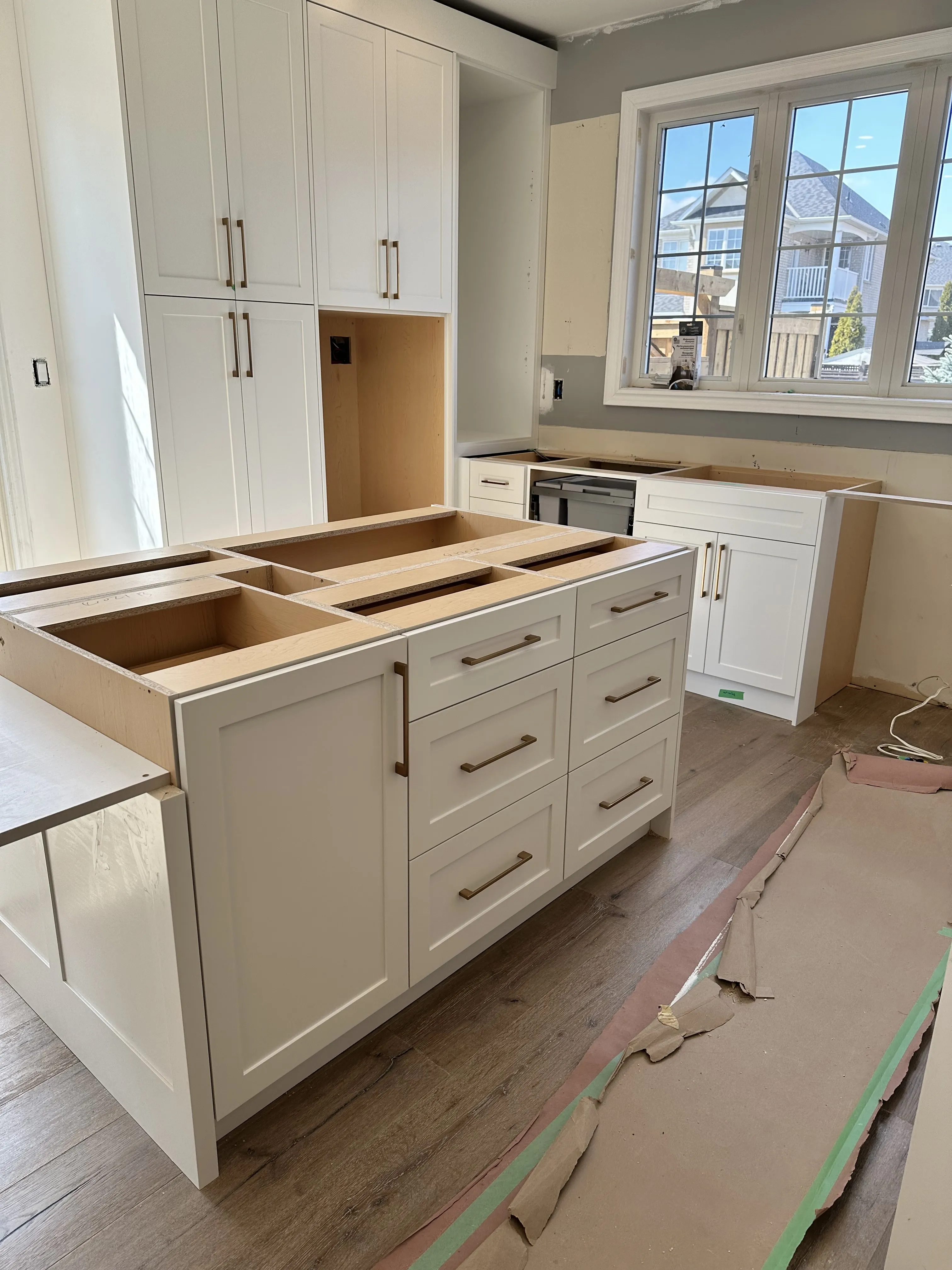
If there is one change that transforms an older kitchen for a modest sum, it is converting base cabinets from doors to drawers.
A standard base unit with a door and a fixed shelf has a deep, dark cavity in which everything migrates to the back and is never seen again. Everybody with one of these has a stack of pans at the front and something unidentifiable behind them.
The same cabinet fitted with two or three deep drawers holds the same volume and makes all of it reachable, because the contents come to you rather than you going into the cabinet. People consistently describe this as the change that made the biggest difference to how their kitchen works.
The constraint is the frame. A face-frame cabinet has a centre stile in some configurations, and where there is one, a full-width drawer is not possible without altering the frame — which is doable and is a bigger job. Where the opening is clear, it is straightforward.
It is all readable from a photograph of the cabinet with the door open, and we will tell you which of your base units can be converted and which cannot before quoting anything.
What we check before quoting
Three things, all visible in photographs, and they decide whether this service is even the right one.
The opening. Width, height and depth of the frame opening, because the box is built to it. This also flags where a centre stile blocks a conversion.
The cabinet sides. Undermount runners fix to them and need something solid to fix into. A particleboard cabinet side that has swollen under a sink will not hold them, and that is a cabinet problem which has to be dealt with first.
The fronts. If they are staying, they need to be sound enough to remove and refit — a front that is delaminating will not survive being taken off. If they are being replaced anyway as part of a refacing job, this is moot and the whole thing gets simpler.
The part of a kitchen most often discovered rather than requested
Almost nobody calls about drawer boxes. They surface during a refacing quote, when the fronts come off and half the boxes behind them turn out to be stapled board with the bottoms sitting loose. A new front on a failing box is a good-looking drawer that still does not work. Reading what the shop builds when a kitchen is being kept puts this alongside the other parts made here and explains the order they get done in.
Drawer Box Replacement Cost in Toronto
Priced per box, by size, with the runners as their own line so you can see the hardware separately from the joinery.
Size drives the box cost — a deep pan drawer is more material and more machining than a shallow cutlery drawer — but not proportionally, because the setup is the same either way.
The runner line varies with what you choose. Soft-close undermount is the default we quote. Standard side-mount is available and cheaper and we will fit it if you want it, though on a new ply box it is a strange saving to make.
Converting a door cabinet to drawers is quoted as its own item, because it involves removing the door and hinges, building the drawer front or fronts to suit, and sometimes altering the frame.
Everything is per box, which means replacing the three that have failed and leaving the nine that are fine is a perfectly normal quote. We would generally recommend that over doing all twelve, and we will say which of yours we think can carry on.
Written price inside 24 to 48 hours from photographs. Cash, debit, credit and Visa.
Questions
Common questions about drawer boxes in Toronto
- Can you keep my existing drawer fronts?
- Yes, and it is common where the fronts are sound and only the boxes have gone. The front is removed, the new box built to the opening, and the front refitted with adjustment so it sits flush with its neighbours. If you are refacing, new fronts and new boxes usually happen together.
- How do I know if my boxes need replacing?
- Pull one right out and look at the bottom and the back corners. A bottom panel sagging or slipped out of its groove, corners held with staples that have worked loose, or a back that has separated are all terminal. Particleboard that has swollen does not go back.
- What are the new boxes made from?
- Baltic-style birch ply for most, or solid stock where a client wants it. Ply is dimensionally stable, holds a fastener properly, and does not swell if something spills. It is what the good boxes in a sixty-year-old kitchen were made from, which is why those are still working.
- Are undermount runners worth it over side-mount?
- In almost every case, yes. Undermount runners are invisible with the drawer open, give full extension so you can reach the back, and carry more weight. They also need a box built for them — a specific bottom detail and a precise width — which is why they usually arrive with a new box rather than on their own.
- Can you make a deep drawer where there is a door now?
- Frequently, and it is the single best storage change available in an older kitchen. A base cabinet with a door and a fixed shelf becomes two or three deep drawers, and everything in it becomes reachable. It depends on the frame opening, which is readable from a photograph.
Drawers that stick, sag, or will not open fully?
Pull one out completely and photograph it from the side and from underneath, plus a wide shot of the run. The written price comes back inside 24 hours, per box, so you can replace the three that have failed and leave the rest.
Free in-home consultation · no obligation
Refaced. Repainted. Refinished.