
Custom Cabinet Door Replacement in Toronto — Built to the Opening
Every opening in a sixty-year-old kitchen is a slightly different size. A door ordered from a list ignores that; a door that is made cannot.
Each opening
Measured individually, not multiplied
15 years
On waterproof MDF doors and fronts
Sprayed first
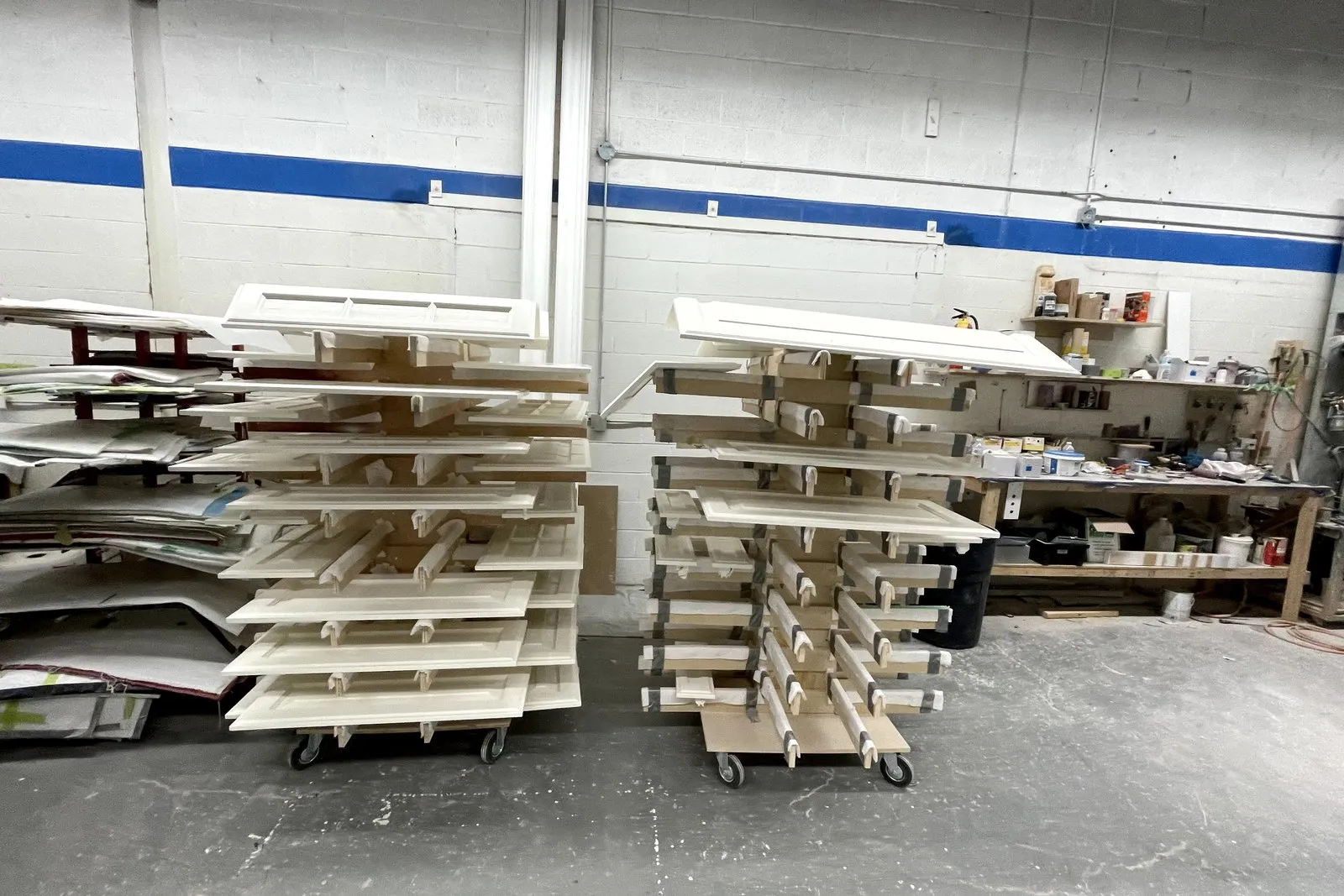
Finished before they reach your house
5.0
Rated on Google
What a door has to do, dimensionally
A cabinet door has one job that people never think about: it has to leave the same gap all the way around itself, and the same gap as every door next to it.
That gap — the reveal — is what the eye reads. Nobody assesses whether a door is 518mm or 521mm wide. Everybody registers, without being able to name it, that the space between two doors is wider at the top than the bottom, or that one gap in a run of six is visibly larger than the others.
In a kitchen built in a factory to a drawing, all the openings are identical and the reveal takes care of itself. In a kitchen built into a Toronto house in 1962, the openings are close to identical and not actually identical, and sixty years of a house settling has widened that spread.
So every opening gets measured on its own. Not one measured and multiplied, which is faster and is how a run ends up looking approximate. Each one, recorded, and the door for it cut to the size that produces the reveal we want at that specific opening.
The measure, and why it happens after the quote
The order of operations here is deliberate and it is worth explaining.
The written price comes from photographs, inside 24 to 48 hours, and it does not change. Door and drawer counts are readable from good wide shots, and count plus profile plus finish is what drives the number.
The physical measure happens later, once you have decided to go ahead, and it is a separate visit with a purpose that is not sales. Somebody comes with a tape and a sheet and records every opening, checks whether the runs are square, notes where a frame has moved, and identifies anything that will need a scribe rather than a straight cut.
Doing it this way round means nobody is measuring your kitchen while also trying to sell you something, and it means the measure can take as long as it needs to. It also means you are not paying for a measure on a job you may not proceed with.
Nothing gets cut until that measure exists. A door made from a photograph would be a guess, and a guess in this trade is a filler strip.
Profiles, and what suits which house
The profile is the single biggest visual decision on this page and it outlives every other choice.
Shaker is the default and there is a reason beyond fashion: a flat panel inside a square frame is legible in almost any house, from a 1920s semi to a 2010 build. The variable people underestimate is rail width. A narrow-rail shaker reads contemporary and delicate; a wide-rail one reads solid and traditional, and on a small door a wide rail leaves a panel so small the door looks heavy. We size the rail to the door rather than using one width throughout.
Flat slab is uncompromisingly modern, has no dust ledge at all, and is the easiest profile to keep clean. In a 1958 side-split with original trim it can read as though the kitchen belongs to a different house.
Raised and recessed panels — ogee, cathedral, arched top — are what a great many older Toronto kitchens originally had, and reproducing one is often the right answer in a house with strong period character. They are more work and they cost more, and on a stained finish they are the ones worth the money.
The advice we give most: match the door to the age of the house rather than to the year you are renovating in. A kitchen legible with its house still looks right in fifteen years.
Material, and why MDF is the correct choice for paint
People arrive expecting to be talked up to solid timber and are often surprised.
For a painted or sprayed door, waterproof-grade MDF is the better material and it is not close. It has no grain to telegraph through the finish. It has no seasonal movement, so a panel joint cannot open into a hairline crack across a white door after two winters. It has no knots to bleed through. And it machines to a crisper profile edge than timber does, because there is no grain direction to tear out.
A five-piece solid maple door painted white will, in a Toronto house that runs humid in August and dry in February, show its rail-and-stile joints as fine cracks within a few years. The timber moves and the paint film does not. That is not a defect in the door and it is not preventable.
The grade matters as much as the material. Standard MDF swells if it gets wet, and the two places a kitchen door gets wet are under the sink and beside the dishwasher. We use the moisture-resistant grade throughout rather than only where it seems necessary, and that is why the doors carry fifteen years rather than five.
Solid timber is right where the finish is a stain or a clear coat and the grain is meant to be visible. In that case we specify the species with you, because the species decides how the stain will behave.
Panel-ready appliances, which are also a door
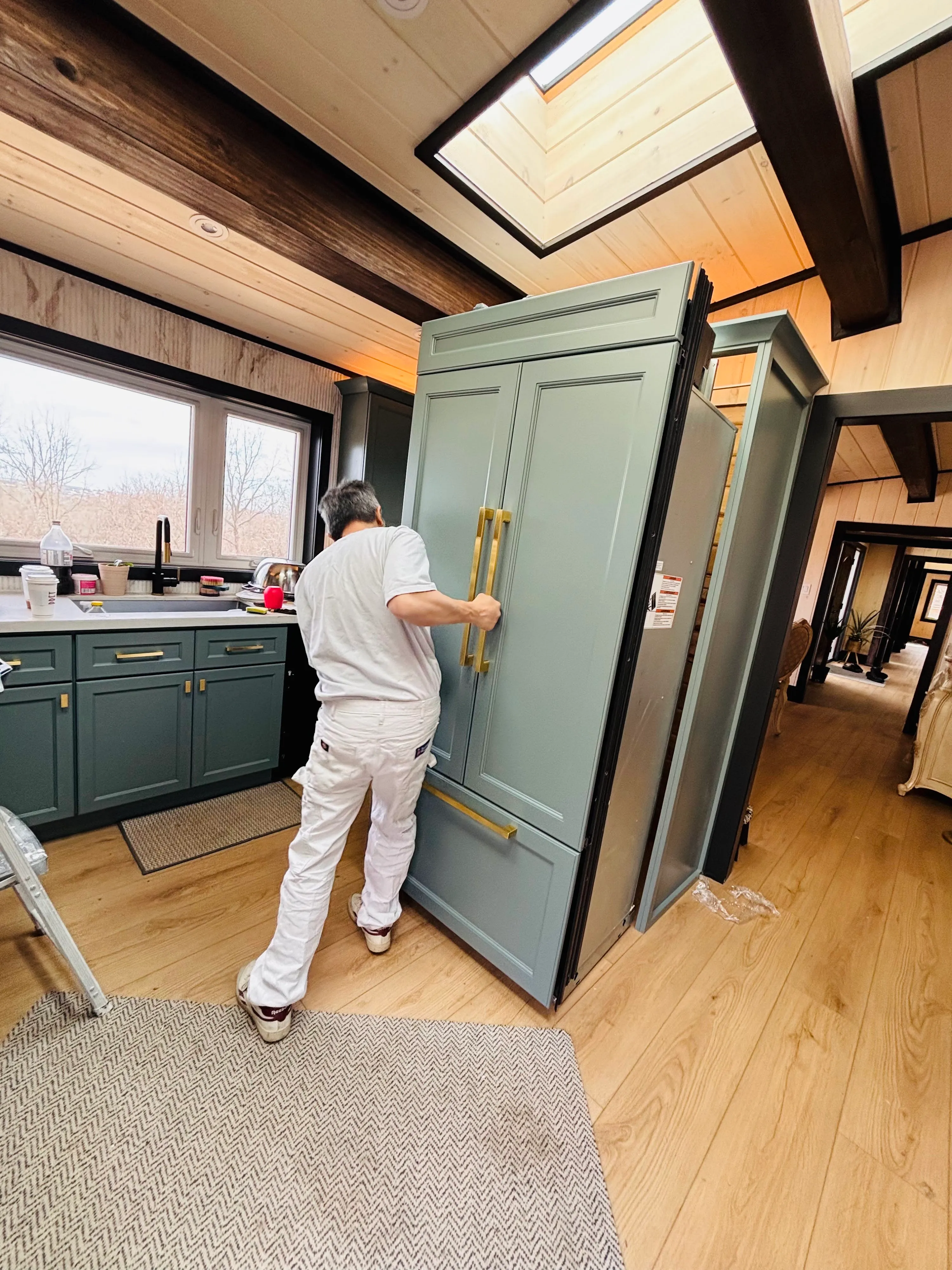
A panel-ready fridge, dishwasher or freezer is built with a front frame designed to accept a cabinet door rather than its own finished face — so instead of a stainless or black panel breaking up a run, the appliance disappears behind a door that matches everything beside it.
That door is still made to an opening, but the opening is the appliance manufacturer's frame rather than a cabinet box, and it is usually larger and heavier than a standard door — a full-height panel-ready fridge front is substantial furniture in its own right. Hardware gets specified for that weight rather than assumed, and the profile, colour and hinge line are matched to the rest of the kitchen so the appliance reads as another cabinet rather than as the one thing in the room that stands out.
It is one more case of the same rule the rest of this page runs on: the door is made for the specific thing it has to fit, and an appliance panel is no different from a drawer front in that respect, just larger and better paid.
Hanging, which is where the run comes together
New doors go on new hinges. Reusing forty-year-old hardware on a set of new doors is the false economy in this service.
Old hinges are worn at the pin, which is usually the actual reason the previous doors no longer lined up. They also have limited adjustment, and adjustment is exactly what a run of new doors needs to be brought into alignment with each other rather than each with its own opening.
Modern concealed hinges adjust in three directions independently — height, depth and side to side — which means a run can be trued as a run. That is the last hour of an installation and it is the hour that decides whether the kitchen looks made or looks fitted.
Where the cabinets are face-frame construction, which most older Toronto kitchens are, the hinges have to be the face-frame type and the boring has to be right for them. It is a fitting problem rather than a shopping one, and it is why hinges are quoted per door.
Handles go on last, from a template rather than by measuring each door, so the handle sits in the same place on every door in a run. It sounds obvious and it is the most common thing to find wrong in a kitchen somebody else refaced.
Doors are the largest thing this shop makes
A door replacement is rarely the whole job. The same measure that produces doors usually produces drawer fronts, end panels and fillers, and it frequently turns up drawer boxes and hinges worth dealing with while everything is apart. Reading what else comes off the same bench covers the rest of what the shop makes, and why doing it in one visit costs less than in three.
Custom Cabinet Door Cost in Toronto
Priced per door and per drawer front, with the profile and the finish as the two main variables.
Profile drives it because of machining time. A flat slab is quick. A shaker is five pieces assembled. A raised panel with a moulded edge is considerably more work than either, and a cathedral top more again.
Finish drives it second. A standard sprayed colour is the baseline; a custom-matched colour, a two-tone kitchen, or a stain on solid timber each add. So does anything that has to be finished on both faces to a display standard, which applies to glass-fronted doors and to any door on an island seen from behind.
Size affects it less than people expect. A tall pantry door costs more than a small upper door but not proportionally, because the setup and the handling are the same. This is why we price per door rather than per square foot, and why a linear-foot quote from anyone should be treated carefully — it cannot distinguish three tall doors from twelve small ones.
The measure, the removal and disposal of the old doors, and the hanging and adjustment are each their own line. The written price comes back inside 24 to 48 hours and does not move. Cash, debit, credit and Visa.
Questions
Common questions about custom cabinet doors in Toronto
- Can I replace only the doors and keep everything else?
- Yes, and it is a legitimate way to stage the spend. What you should look at first is whether the frames and end panels will still match — new sprayed doors against forty-year-old lacquered frames is a visible mismatch, and it is the reason most people end up spraying the frames at the same time.
- How do you get the sizes right without being here?
- We do not. Photographs produce the quote; a physical measure produces the doors. Somebody comes and measures every opening individually before anything is cut, because an old kitchen is not consistent and a measurement taken once and multiplied is how a run ends up with uneven gaps.
- What door styles can you make?
- Shaker in any rail width, flat slab, and traditional raised or recessed panels including the ogee and cathedral profiles common in older Toronto kitchens. If you have a sample or a photograph of something specific, it is usually reproducible — the constraint is the cutter profile rather than the shape.
- Do the doors arrive finished or do you paint them here?
- Finished. They are sprayed in the booth before they travel, which is the entire reason for having one. A door finished on site is a door finished in dust, in uncontrolled humidity, hanging vertically.
- What happens to my old doors?
- They are taken away and disposed of, and that is a line on the quote rather than a surprise. If any of them are worth something — solid timber, unusual profiles, period pieces — we will say so before they go in the truck.
Doors that never quite fit their openings?
Send wide photographs of every run plus a straight-on shot of a typical door. The written price comes back inside 24 hours, per door, so you can see exactly what changing the fronts costs before deciding on anything else.
Free in-home consultation · no obligation
Refaced. Repainted. Refinished.