
What to Know Before Painting Your Cabinets in Oakville
Five things people tell us afterwards they wish they had known first. None of them would have changed the decision — all of them would have changed what they expected.
You keep the door profile
This is the one that catches most people, and it is the difference between two jobs that get confused constantly.
Painting changes the colour and the surface. It does not change the shape. A raised-panel door that has gone out of favour is still a raised-panel door in a new colour. A slab front is still a slab front.
For a great many kitchens that is exactly right — the doors are well made, the layout works, and it is the honey-oak or the nineties cream that has aged. Painting is the cheapest route to a kitchen that reads as new, and it is the shortest.
But if what you dislike is the shape, painting will not fix it whatever colour goes on, and the honest answer is refacing instead. That is a more expensive job and we would rather say so before a deposit than after.
Prep is the job, and it is invisible
The spraying is a day. The preparation is most of the week.
People expect the spraying to be the skilled part. It is not — the spraying is a day. The preparation is most of the week, and it is entirely what decides whether the finish is still good in five years.
Kitchen cabinets carry years of cooking grease and, on older kitchens, layers of furniture polish and wax. Most painters clean with TSP, which is water-based: it cannot cut wax, and it swells solid timber and raises the grain while failing to. We use a modified solvent degreaser for exactly this reason, then sand every surface.
None of that shows in a photograph. All of it shows in year three, when a finish that went onto a contaminated surface begins to let go around the handles and along the bottom rails.
The interiors are not included
What is sprayed is everything you see with the doors shut.
The most common surprise on the quote, and worth stating plainly.
What gets sprayed is everything you see with the doors shut — the door and drawer faces, the frames, the exposed end panels. Cabinet interiors and shelving are not part of the standard job.
The reason is arithmetic rather than reluctance: interiors roughly double the surface area, which roughly doubles that part of the price. They are quoted as their own line so you can decide, and most people look at the number and decide the inside of a cupboard does not need a factory finish.
The doors are away for a fortnight, and it is fine
The timeline surprises people in the good direction.
The timeline surprises people in the good direction, once they understand its shape.
Your doors and drawer fronts come off on day one and go to the booth. For about two weeks after that your kitchen is open-fronted — every box, the sink, the countertops and all the appliances work exactly as normal. The only inconvenience is that the doors are not there.
Most people find that far less disruptive than they braced for. Some tell us afterwards they rather liked being able to see everything.
The five days that actually cost you a kitchen come at the end, when the crew is in the house doing the boxes and hanging the doors back.
You need to be out for two or three days
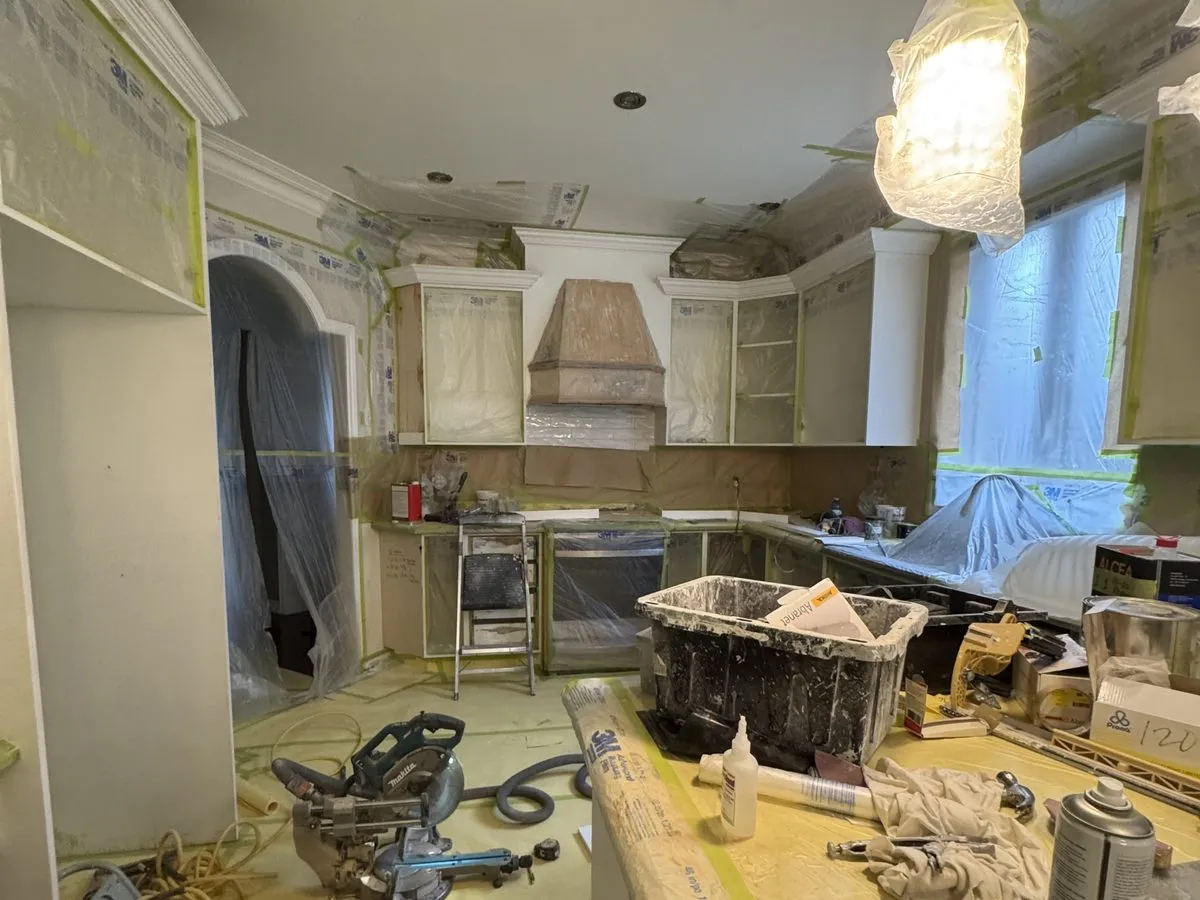
Not a nicety, and worth planning around rather than discovering.
The finish is 2K polyurethane — catalysed and solvent-based, which is what makes it hard enough to survive a kitchen. Containment goes up between the kitchen and the rest of the house and filtration runs throughout, but that keeps solvent out of the rest of the building rather than making the kitchen a pleasant place to be.
So for the two or three days of actual spraying, the honest advice is to plan a short trip. People who knew that in advance arrange it easily. People who find out on day two do not.
The service this is about
Everything below is what customers say afterwards. The page it sits under is what we say beforehand — the booth, the finish, the fortnight your doors are away and the week the crew is in the house. Reading how cabinet painting actually runs here alongside this is the closest thing to knowing in advance what the people quoted below only learned partway through.
The honest version of all this
Four of the five below are expectations rather than problems, and they are fixed by knowing them in advance. There is a shorter list of things painting simply cannot achieve at any price, and those are worth reading before committing rather than after. Knowing what painting genuinely cannot do for a kitchen is the difference between a job that disappoints and one you would not have booked.
Questions
Common questions
- What do people most often wish they had known?
- That painting keeps the door profile you already have. It changes the colour and the surface and nothing else. Where the shape of the doors is what has dated, no colour fixes it — that is a refacing job, and it costs more.
- Are the cabinet interiors painted?
- Not as standard, and it surprises people. What gets sprayed is everything visible with the doors shut. Interiors and shelving roughly double the surface area, so they are quoted separately and most people decline once they see the line.
- How long is the kitchen unusable?
- About five days at the end. Before that the doors are away for roughly a fortnight and your kitchen works normally — open-fronted, but the sink and appliances are all in use.
- Will it look like new cabinetry?
- On the surfaces you touch, yes — a sprayed 2K finish reads as factory-finished rather than painted. What it will not do is change the layout, the sizes or the shape of the doors.
Want to know what your kitchen would take?
Send wide photographs of each run of cabinet. The written quote comes back inside 24 hours and does not change afterwards.
Free in-home consultation · no obligation
Refaced. Repainted. Refinished.