
Spray or Brush Kitchen Cabinets in Oakville?
Spray, and it is not close. A cabinet door is looked at from a foot away in daylight, which is the least forgiving surface in the house.
Why the distance matters
A wall is looked at from across a room. A cabinet door is looked at from about a foot away, at eye level, several times a day, usually in daylight from a window.
That single fact decides the whole argument. Brush and roller marks that would be invisible on a wall are conspicuous on a door — strokes in the direction of the stroke, stipple from a roller, and lap lines wherever a wet edge met one that had begun to dry.
Spraying atomises the coating into a fine mist that lands as an even layer. There is no direction to it and no join. The surface comes out flat in a way that hand application cannot reproduce, however skilled the hand.
What professionals actually spray
The equipment gets the attention. The material matters more.
The equipment gets the attention and the material matters more.
We use 2K polyurethane — two-component, catalysed, solvent-based — for both the primer and the topcoats. Catalysed means it cures by chemical reaction rather than by drying, cross-linking into a film considerably harder than anything that hardens by evaporation alone.
It is the class of finish used on high-end furniture and in automotive refinishing. It resists kitchen cleaners and cooking grease rather than being slowly degraded by them, it takes daily knocks without chipping through, and it does not yellow with age the way water-based enamels on white cabinetry famously do.
The trade-off is real: it costs several times what a tin of cabinet enamel costs, and once the two parts are mixed it cannot be kept. A slow afternoon throws material away.
The coats, and the sanding between them
Unglamorous, and most of what is being paid for.
The schedule is unglamorous and it is most of what you are paying for.
One coat of tinted primer, then two topcoats, sanded between every coat — 180 grit after the primer, 240 between the topcoats. Each coat gets at least eight hours to cure before the next goes on.
Some colours need more than two topcoats. Reds and yellows are the usual culprits, and so is any large jump from a dark existing finish to a pale new one, where coverage rather than colour is the problem.
The sanding between coats is what people are surprised by. It is also why the result feels like glass rather than like paint.
What the booth actually provides
Three things a kitchen cannot, which is why the doors leave the house.
Filtered air, so what settles on a wet surface is nothing. Dust is the enemy of a flat finish and a domestic room is full of it, however carefully it is swept.
Controlled conditions. Catalysed finishes cure by reaction, and temperature and humidity change how that reaction runs. A booth holds them steady; a kitchen in February does not.
Extraction. Solvent-based material needs air moved away from the work and away from the person doing it, at a rate no domestic ventilation reaches.
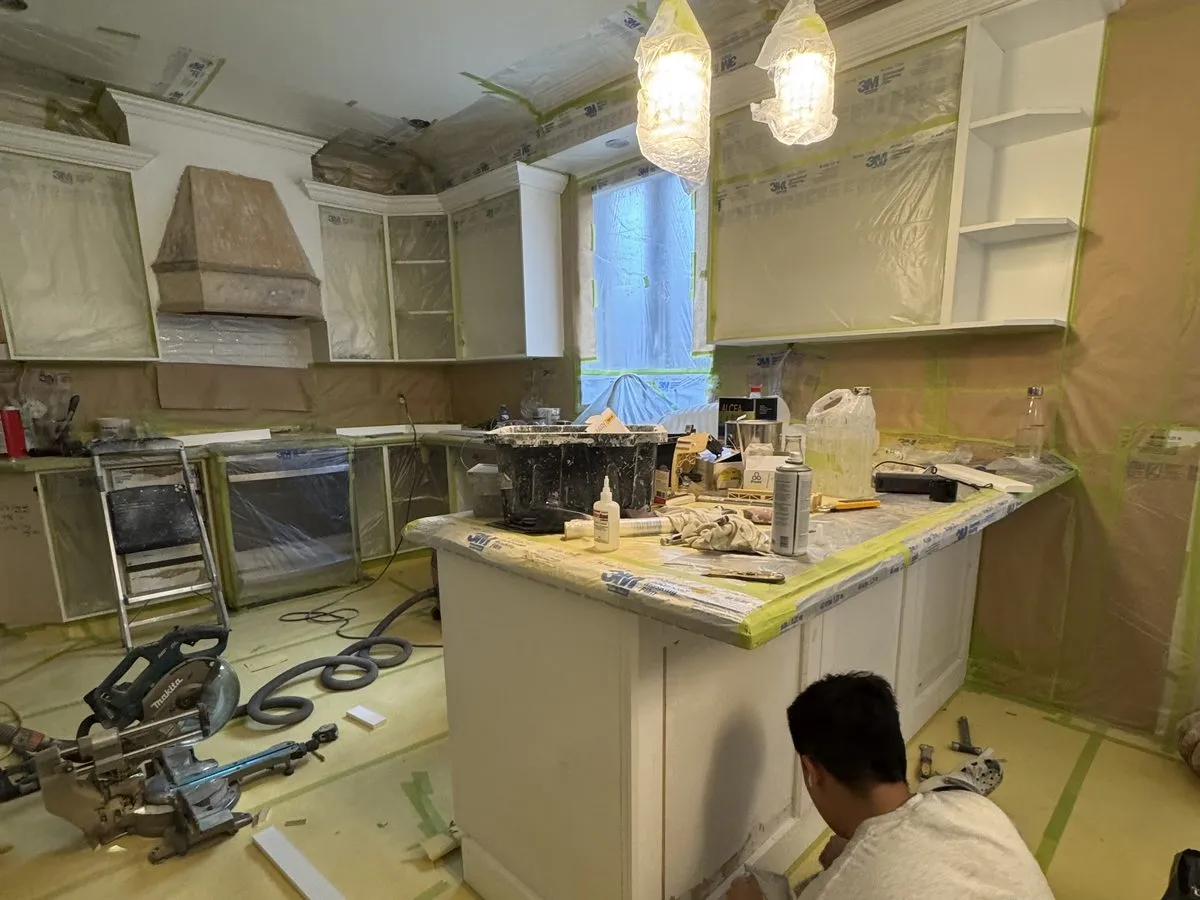
What cannot come off the wall — the frames and the boxes — is sprayed in your kitchen instead, behind full containment with filtration running. That is the compromise the job is built around, and it is why those two or three days are the ones we ask you to be elsewhere for.
Where a brush is still right
Not everything in a kitchen is a door, and pretending otherwise is dogma.
Not everything in a kitchen is a door, and pretending otherwise would be dogma.
- Cupboard interiors, on the rare occasions they are done, are not viewed closely and are full of awkward internal corners.
- Some trim, depending on the profile and what is around it.
- Touch-ups after the fact, where masking and spraying a whole run for one mark would be absurd.
What does not get brushed is any face you look at with the doors shut. There is no cheaper brushed option offered here, and that is a constraint we hold rather than an upsell — the finish is the product, and a brushed version of it would be a different and worse product sold under the same name.
In one glance
Spray against brush, on a cabinet door
| Aspect | Spray | Brush |
|---|---|---|
| Finish | Flat, atomised, no direction. | Visible strokes, stipple, lap lines. |
| Used here on | Every door, frame and drawer front. | Cupboard interiors, some trim, touch-ups. |
| Equipment | A booth — filtered air, controlled cure, extraction. | A brush and a roller. |
| Coats | Primer plus two topcoats, sanded between each. | Fewer coats, no sanding schedule. |
Where the spraying happens
The argument below is about method; the page above it is about where that method is carried out. Doors and anything else that comes off go to a booth with filtration and controlled conditions, and what cannot come off the wall is sprayed in your kitchen behind containment. Reading the booth, and what goes into it covers that split, which is the practical reason a sprayed job takes five days on site rather than two.
The step that matters more than either
Spraying beats brushing on appearance, and neither survives being applied to a surface that was not properly cleaned first. The choice of equipment decides how a finish looks on day one; what happened before it decides whether it is still there in year five. Reading why preparation decides the result more than the sprayer does is the part of this trade that never appears in a photograph.
Questions
Common questions
- Is it better to spray or brush kitchen cabinets?
- Spray, for a surface viewed this closely. Brush and roller both leave texture — strokes, stipple, lap lines where wet met dry — and on a cabinet door that texture is the first thing the eye finds.
- What do professionals use to spray kitchen cabinets?
- A catalysed two-component system. We use 2K polyurethane for both primer and topcoat, which is the class of finish used on high-end furniture and in automotive refinishing rather than anything sold as cabinet enamel.
- Can I get a good result with a brush?
- On trim and on the inside of cupboards, yes — those are not viewed at a foot away. On door faces, no. That is why we offer no brushed option on cabinets — it would undo the material it was applied with.
- Does spraying take longer?
- The spraying itself is quick. The masking, containment and preparation around it are what take the time — which is why a sprayed job is five days on site and a brushed one could be done in two, and why the two do not look alike afterwards.
Want to see the difference on your own doors?
Send wide photographs of each run of cabinet. The written quote comes back inside 24 hours, and samples come to your kitchen before anything is sprayed.
Free in-home consultation · no obligation
Refaced. Repainted. Refinished.