
Quartz Countertop Replacement in Oakville — Fitted in the Same Week as Your Doors
Counters and cabinet fronts wear out at different rates, and a new door against a chipped laminate edge sends your eye straight to the counter.
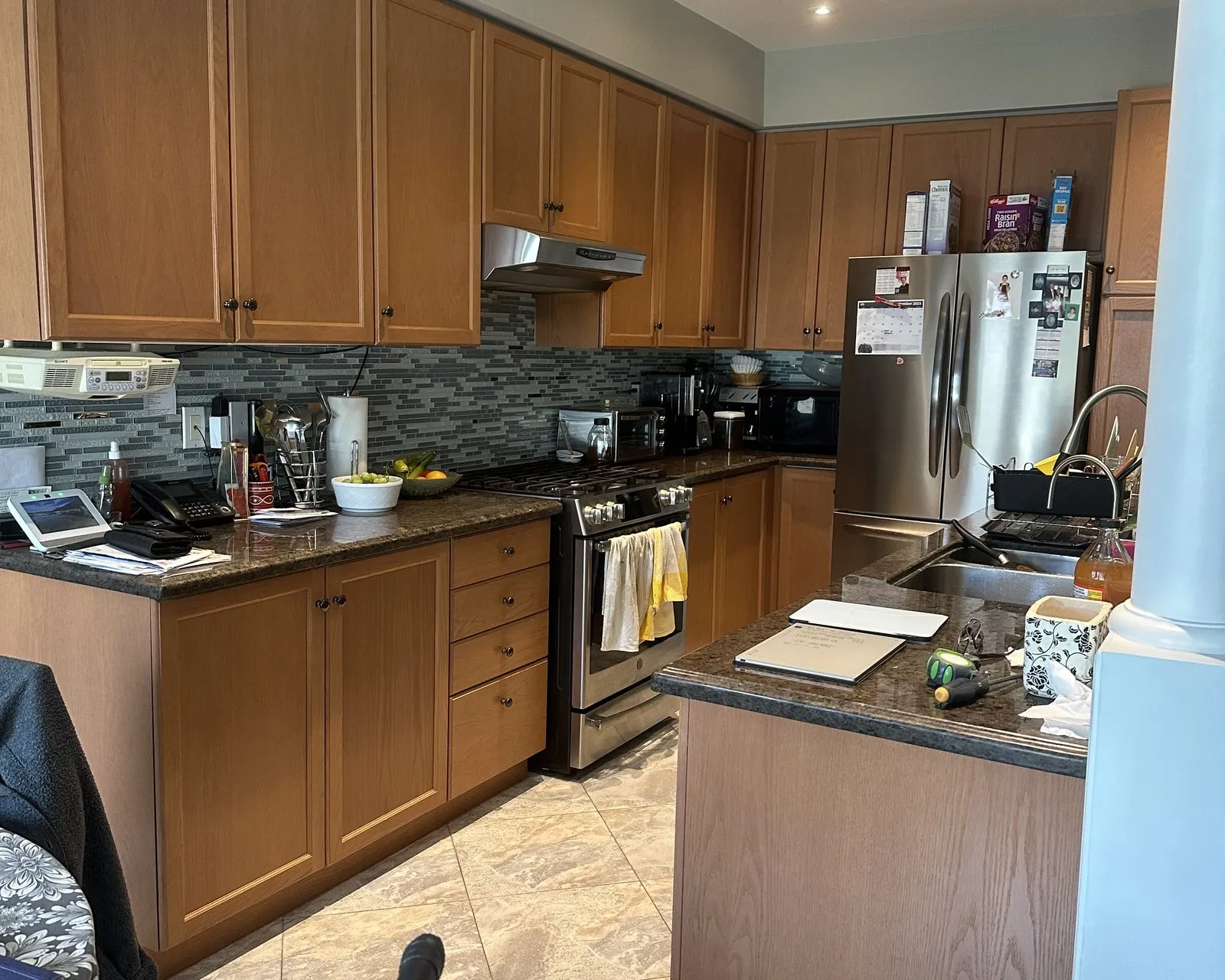 Before
 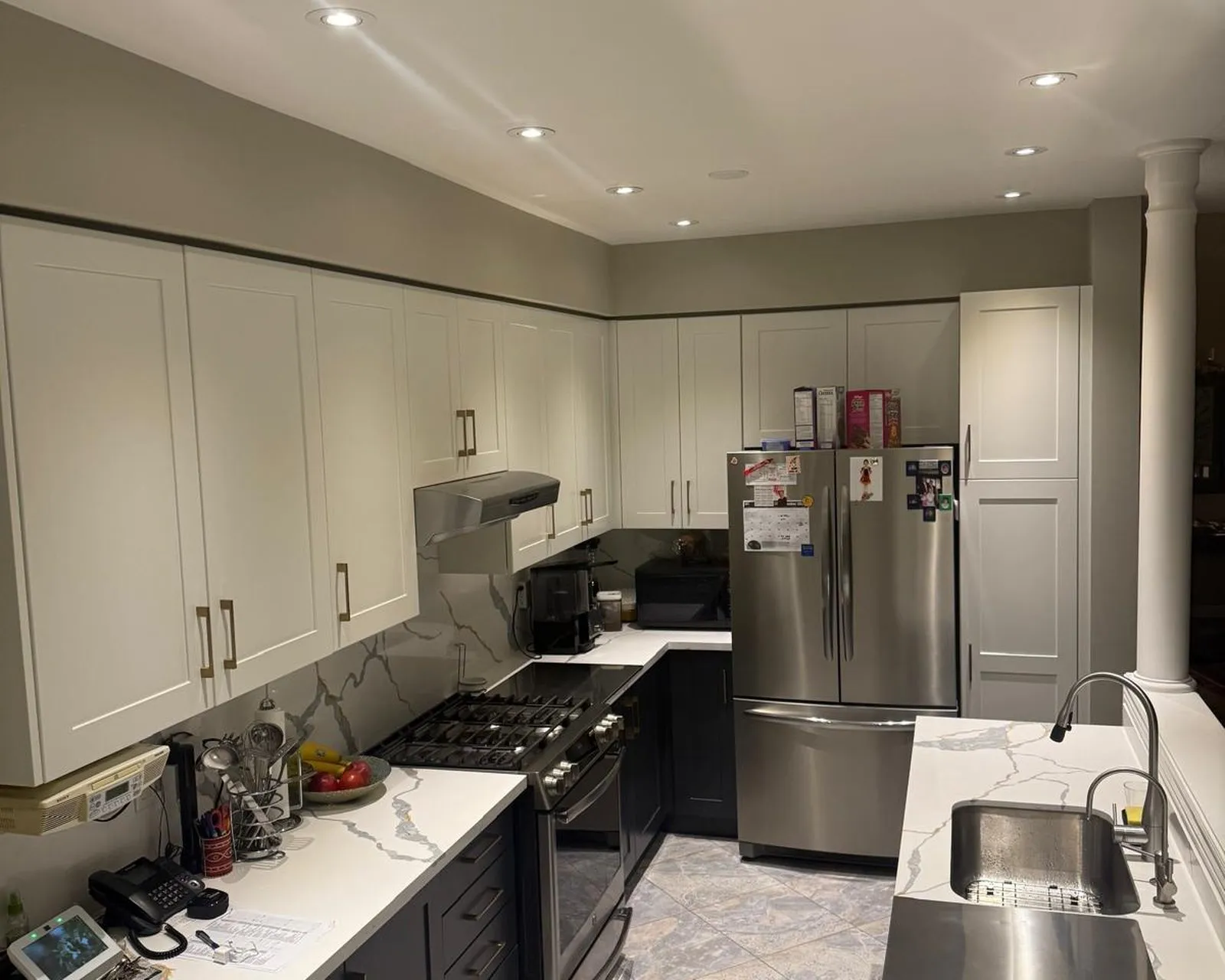 After
After Counter only
When the fronts are fine and it is not
100+
Kitchens completed
25 years
In the trade, and here since 2013
5.0
Rated on Google
What we do and what the stone shop does
We are the contractor. The stone shop cuts the stone.
That distinction is worth setting out at the top, because a lot of companies blur it. Kitchen Made New does not fabricate or install countertops. Templating your layout, cutting the slab and fitting it are done by fabricators we have used for years and chosen because their work holds up. What we do is specify the material, price it as part of the whole job, hold the contract, and run the schedule so the stone arrives at the point in your project where it belongs.
In the trades that is what a contractor is. A general contractor does not lay the bricks. The value is not in owning the saw — it is in one contract instead of two, a fabricator picked by somebody who knows the difference between them, and a schedule where the counter and the cabinets are sequenced by one person rather than negotiated between two crews who have never met.
The alternative is what most people end up doing by default: hiring a cabinet company, then a stone shop, then discovering that neither of them will take responsibility for the quarter-inch where their work meets.
Why the order matters more than the material
Stone is cut to what is actually in the room, from a physical template taken off your finished cabinets. That single fact determines the whole sequence of a kitchen project.
If cabinets are being refaced, repainted or replaced, that work has to be complete and cured before the template is taken. New doors change the face of a run. A box that gets adjusted or reinforced changes a dimension. Even a thick finish build on a frame edge moves things fractionally. Template before all of that is settled and the slab is cut to a kitchen that no longer exists.
This is the most common way countertop projects go wrong, and it almost always happens where two contractors are working to two schedules. The cabinet crew runs late, the stone shop has a slot booked, somebody templates anyway, and the fit is out by an amount that nobody will own.
Because we hold both parts of the schedule, that conversation does not happen. Cabinets first, cured, then template, then install. If the cabinet work slips, the template moves with it, because they are the same project rather than two suppliers with separate deadlines.
When the counter is the problem and when it is not
Not every tired countertop needs replacing, and not every kitchen that needs new stone needs anything else.
Laminate that has swollen at a seam near the dishwasher, or where you can press near the sink and feel the substrate give, is past saving. Once water is into the particleboard underneath, the structure is failing rather than the surface, and no amount of caulk buys much time. Tile counters with cracked grout have a version of the same problem — water gets through the grout to the plywood beneath, and regrouting delays it rather than fixing it.
If you already have quartz
Existing quartz is a different conversation. A single chip, a hairline crack or a burn mark from a pan is usually repairable, and replacing a whole slab over one flaw is money badly spent. We arrange that through the same fabricators, so you are still dealing with one company. Where the damage runs across multiple areas, or a seam keeps opening, or the staining has gone into the resin, repair stops making sense — and there is a rough rule that once a repair approaches half the cost of replacing, you are paying to preserve something that is still failing.
When it is not the counter
Sometimes the honest answer is that the counter is fine and the cabinets are what is dating the room. A sound quartz top above tired doors is a common combination, and refinishing or repainting the cabinets underneath changes the room for considerably less than new stone would. We would rather tell you that than sell you a slab.
What quartz is actually good at
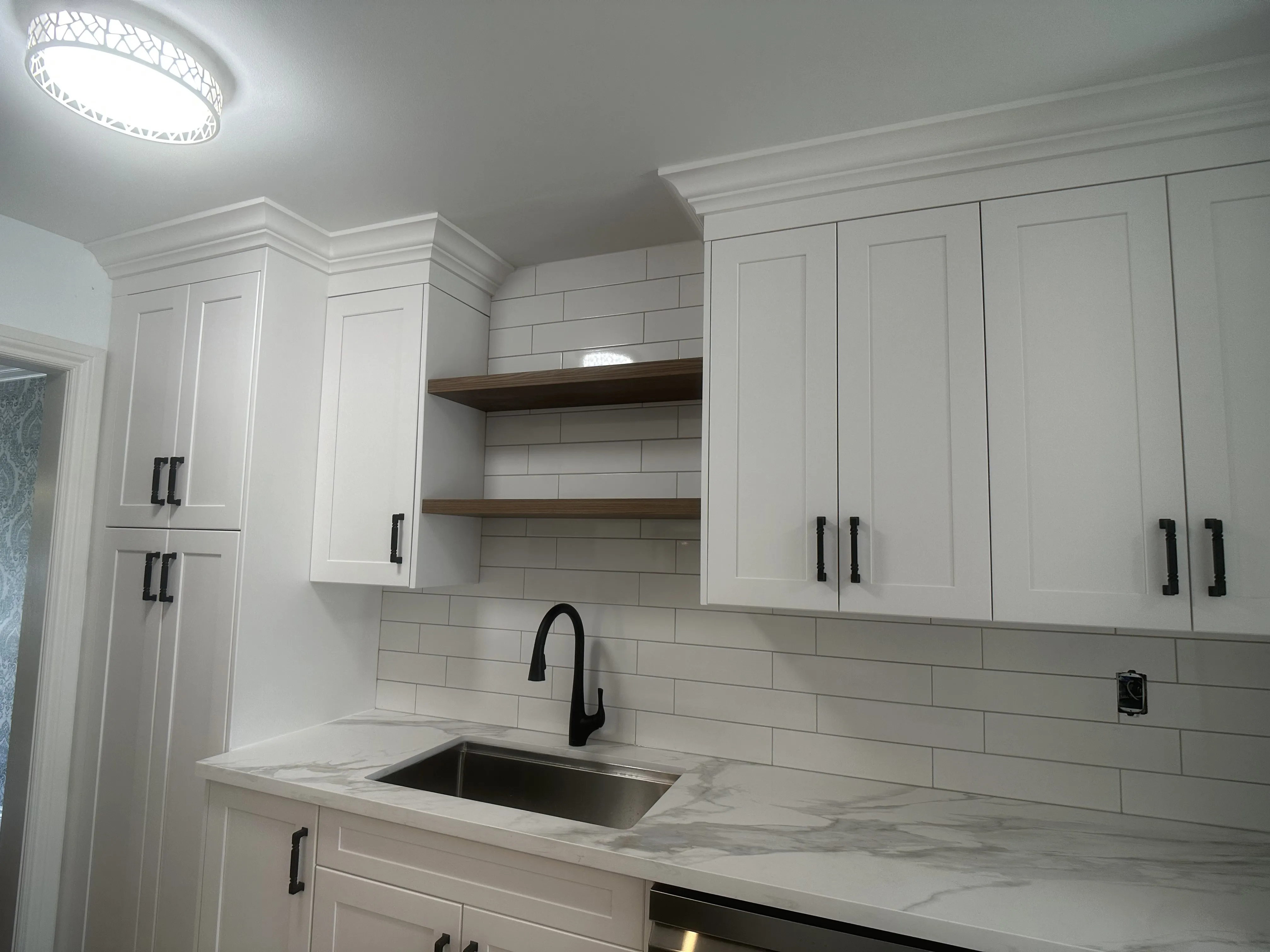
Quartz is engineered rather than quarried — mineral content bound in resin — and the practical consequence is that it is non-porous.
That is most of why it has replaced granite and marble in kitchens:
- No sealing on installation, and no resealing every year
- A spill that sits overnight wipes off — red wine and turmeric are not an emergency
- Nothing harbours in the surface
- Consistent slab to slab in a way natural stone is not, which matters if your kitchen needs more than one piece
What it is not is heatproof
The resin that makes it non-porous will scorch under a pan taken straight off a burner, and that mark cannot be polished out. Almost every call anyone gets about damaged quartz traces back to a hot pan and no trivet. Harsh chemicals — oven cleaner, bleach, paint stripper — will also dull the surface if left on it, and abrasive pads take the finish off slowly enough that people do not notice until it is uneven.
None of that is demanding compared with stone that needs sealing twice a year. It is two habits: a trivet, and wiping spills before they dry.
Doing it alongside the cabinets
The reason this page sits under kitchen remodelling rather than on its own is that most quartz replacements happen as part of something bigger.
The economics are straightforward:
- The kitchen is out of action once instead of twice
- One set of protection goes down
- One crew coordinates with one fabricator against one schedule
- The counter is templated off finished cabinets, which is the only order that produces an exact fit
The carpentry underneath
There is a practical point about the boxes as well. Quartz is heavier than laminate, and older base cabinets are not always level after decades of settling, or strong enough where a long overhang or a waterfall edge is planned. Where reinforcement or levelling is needed, that is carpentry and it is ours — it happens before the template, as part of the cabinet stage, rather than being discovered by a fabricator on fitting day with nobody to fix it.
Backsplash is a separate trade again, and we contract that to a tiler rather than attempting it. Same arrangement as the stone: we scope it, price it in the same quote, and hold the schedule so the wall and the counter are not two projects you are chasing.
The counter is usually half of a bigger decision
Almost nobody replaces a countertop on its own. It comes up because the cabinets are being done and the old counter would let the new doors down, or because the counter failed and the cabinets under it turned out to be worth keeping. Either way the two decisions are linked, and the order matters — stone is templated from finished cabinets, never the other way round. Which is why replacing the counter while the cabinets are already open is cheaper and less disruptive than doing them a year apart, and the page above sets out the rest.
Quartz Countertop Replacement Cost in Oakville
Replacement is priced on the slab, the fabrication and the removal of what is there now. The material band sets the floor, the cutouts and edge profile add to it, and taking out the old counter is its own line — laminate lifts easily, stone does not, and tile set into the counter is slower again.
The saving worth knowing about is scheduling. Fitted into the same installation week as a refacing or painting job, the kitchen goes out of use once rather than twice, and the template is taken from the newly fitted cabinets rather than from the old counter. That puts the overhang and the sink cutout exactly where they should be. Booked as a separate project later, you pay for a second disruption and inherit whatever the old counter's dimensions were.
Quartz brings no sealing schedule with it, which is a genuine long-run difference against natural stone rather than a sales point.
The countertop itself carries a one-year warranty from the fabricator who cuts it, not our five-year warranty — worth stating plainly, because the two are often assumed to be the same.
Questions
Common questions about quartz countertop replacement in Oakville
- Do you fabricate and install the stone yourselves?
- No, and we would rather say so plainly. We are the contractor, not the stone shop. Templating, cutting and fitting go to fabricators we have worked with for years, and we hold the contract, the schedule and the responsibility. What that buys you is one point of contact instead of managing a cabinet crew and a stone shop against each other, and a fabricator chosen by somebody who knows which ones are good.
- What does a quartz countertop replacement cost?
- The slab drives it, and quartz ranges widely by pattern and brand — a plain white and a Calacatta-look are not the same number for the same kitchen. Beyond the stone itself, it comes down to the square footage of the run, the edge profile, and the cutouts for sink and hob. The one people do not expect is the seam. A run longer than a single slab needs one, which means a second piece. Send wide photographs and a written price comes back inside 24 hours.
- What warranty covers the countertop?
- Not ours, and this is worth being clear about because one contract can easily be mistaken for one warranty. Our five-year warranty covers the work we carry out — the cabinetry, the finish, the workmanship. Stone carries a one-year warranty from the fabricator who cuts and fits it. You would rather hear that now than at the moment it matters.
- My quartz has one chip. Do I need a whole new counter?
- Probably not. A single chip, a hairline crack or a small burn is often repairable, and replacing a slab over one flaw is a waste of money. We coordinate that the same way we coordinate everything else in stone — the fabricator does the work, we arrange it and you deal with us. Where repair genuinely will not hold, we will say so rather than take the job twice.
- When does the template happen?
- After the cabinet work is finished and cured, never before. Stone is cut to what is actually there, and the openings move slightly when doors are replaced or boxes are adjusted. Templating early is the single most common way a countertop ends up a quarter-inch out, and it happens when two contractors are working to two schedules. Holding one schedule is how we avoid it.
- How long is the kitchen out of use?
- The stone itself goes in inside a day, and quartz needs no curing time — it is ready for normal use almost immediately, though the sealant around the sink and the backsplash wants about 24 hours. The longer part is whatever cabinet work is happening around it, and the reason to do both together is that the kitchen shuts once rather than twice.
- Does quartz need sealing?
- No. It is non-porous, which is most of why people choose it over granite or marble — no annual resealing, no sealing schedule to remember, and it does not absorb a spill left overnight the way natural stone can. Warm water and a cloth handles daily cleaning. The one real vulnerability is heat, so use a trivet.
Replacing the counters while the cabinets are being done?
Send photographs of the kitchen and the runs you want replaced, and the written quote covers both together inside 24 hours. One contract, one schedule, and the kitchen out of action once instead of twice.
Free in-home consultation · no obligation
Refaced. Repainted. Refinished.