
Spray Painting in Oakville — Doors to the Booth, Boxes Sprayed in Place
Half of your kitchen goes to a spray booth and half of it cannot move. Doing both properly is the whole job, and it is the half most painters are not equipped for.
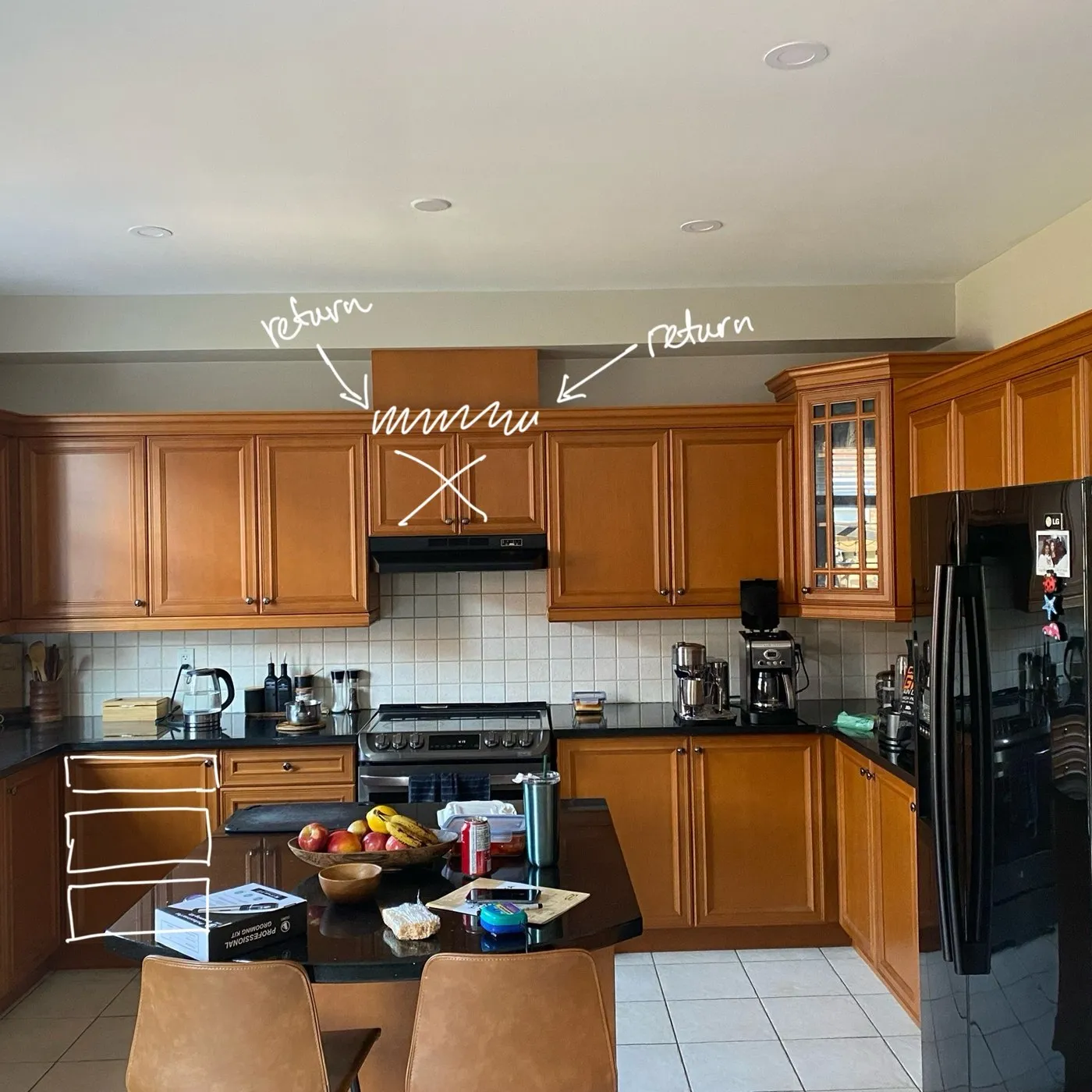 Before
 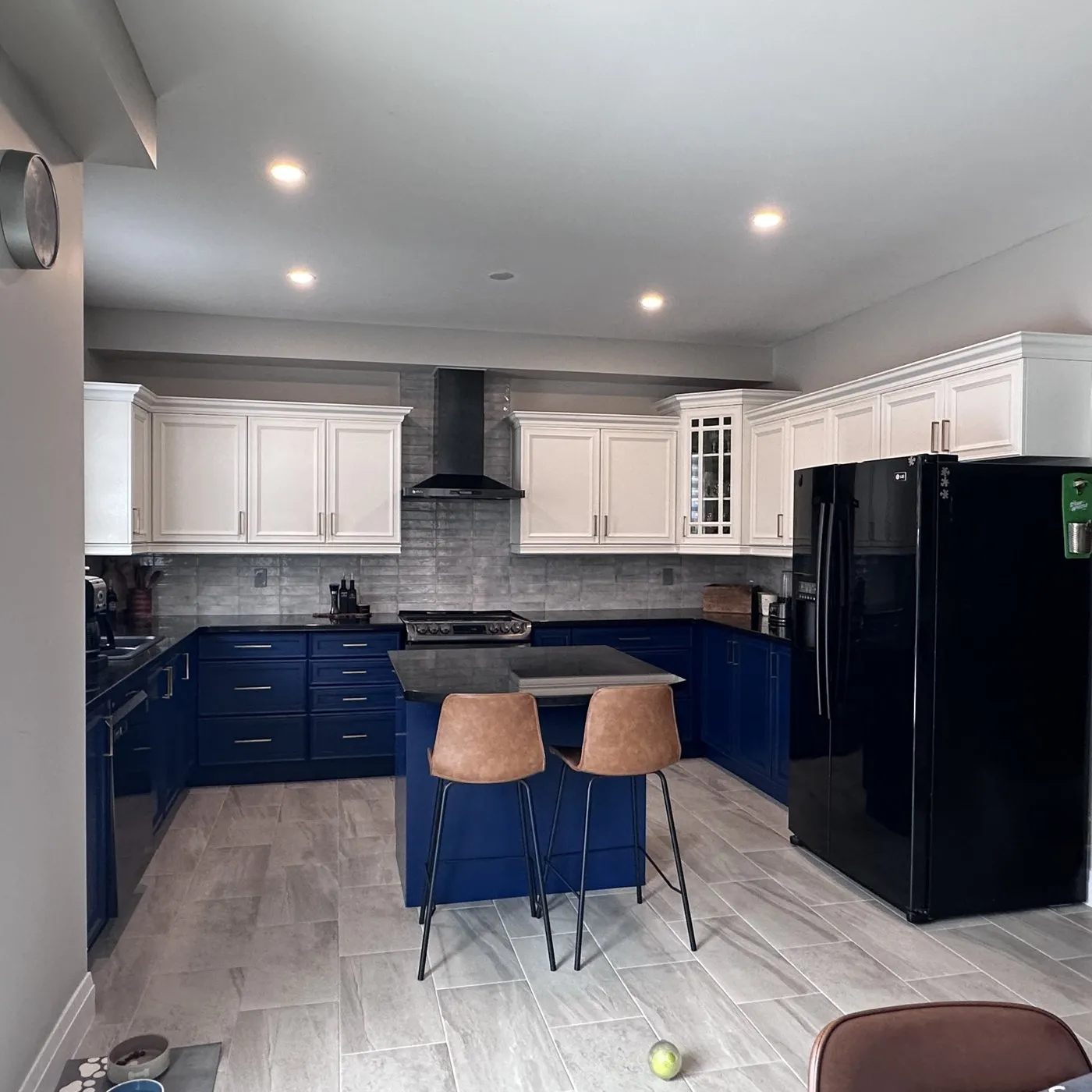 After
After 2K
Catalysed, not air-dried enamel
100+
Kitchens completed
25 years
In the trade, and here since 2013
5.0
Rated on Google
The half that moves and the half that does not
A kitchen splits into two kinds of surface, and the split decides everything about how it should be finished.
What comes off
Doors, drawer fronts and any panel held on with screws come off, get labelled, and travel to the spray booth.
That room exists to remove variables. Temperature and humidity are held steady, the exhaust pulls overspray away from the work, and the filtration keeps the air clean enough that nothing lands on a wet panel. A finish sprayed there in February comes out the same as one sprayed in July, which is not true of a finish sprayed in a kitchen with the patio door open.
What stays on the wall
The cabinet boxes cannot come off the wall. So they are sprayed where they stand, behind zipper walls and plastic sheeting that seal the kitchen off from the rest of the house, with masking over the counters and appliances and filtration running throughout. That is the same 2K polyurethane going onto the boxes as onto the doors, in the same colour, so the finished kitchen reads as one surface rather than two that nearly match.
Doing both is the point. A painter with no booth sprays everything in your house and accepts whatever the day's dust and humidity do to the doors. A refacing company with no spray equipment wraps the boxes in stick-on veneer because finishing them properly is a different trade. Each is solving half the problem with the half of the kit they own.
The finish itself
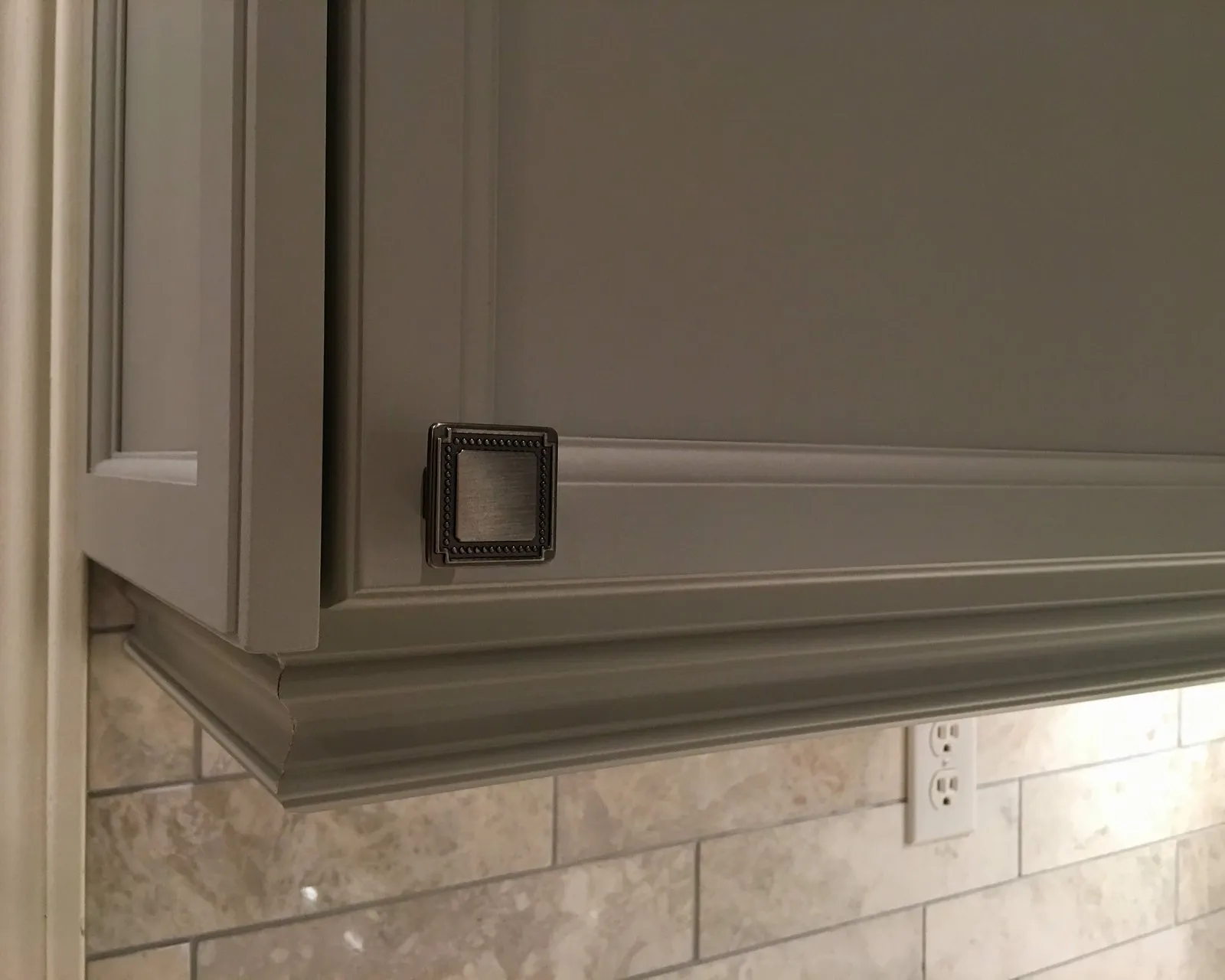
What goes on is 2K polyurethane — two-component, solvent-based, catalysed. The two parts are mixed immediately before spraying and a chemical reaction starts that continues for hours afterwards. The coating does not dry by evaporation the way a water-based product does; it cross-links into something considerably harder than what went into the gun.
That matters in a kitchen more than almost anywhere else in a house. Cabinet doors get knocked with pans, scraped by rings and cleaned with whatever is under the sink. A cross-linked film:
- Resists scratching and chipping rather than marking
- Shrugs off the degreasers and cooking oils that soften a softer coating over time
- Does not yellow as it ages, which is what eventually dates a white kitchen
It is the same class of system that high-end furniture manufacturers and automotive refinishers use, for the same reasons.
It costs more. Considerably more per litre than cabinet enamel, and once catalysed the leftovers cannot be saved for the next job. We think the trade is worth making, and the argument is not really about the first year. It is about the fifth, when the difference between a hard finish and a soft one is obvious on every door around the bin and the dishwasher.
Preparation, which is most of the work
A smooth finish amplifies whatever is underneath it rather than hiding it. Every dent, every ridge of old paint, every filled screw hole that was not sanded flat will be more visible after spraying, not less. So preparation is where the hours actually go.
The first step is degreasing, and it is where we differ from most of the trade. The standard product is TSP, which is water-based, and it has two problems:
- It cannot dissolve wax. Years of furniture polish sit there invisibly, and the primer goes down onto a barrier instead of onto wood.
- Being water-based, it swells the timber, raising the grain and creating sanding work that did not need to exist.
We use our own modified solvent degreaser instead. It lifts the waxes and polishes TSP leaves behind, it does not swell the substrate, and it does in one pass what usually takes two or three.
Filling, sanding and the light it is checked under
Then filling and sanding, then inspection under the booth lighting, which is set low across the surface rather than overhead and throws a shadow off any flaw a ceiling light washes out. It is the lighting doing the work, not a separate lamp. Anything it finds goes back a step. After sanding, the dust comes off with compressed air rather than a cloth, because a tack rag drags fine dust into corners and leaves it there.
The primer is tinted to match your topcoat rather than left white. It is a small thing that pays off years later: when a door eventually takes a knock deep enough to go through the colour, what shows underneath is the same shade rather than a bright white scar.
Coats, grit and cure
The standard schedule
Sanding between every coat, not just the first:
- One coat of tinted primer
- 180 grit — flattens the primer and gives the topcoat something to key into
- First topcoat
- 240 grit — fine enough to preserve the surface while still leaving the microscopic scratch pattern the next coat grips
- Second topcoat
When it needs more
Some jobs do. Going from a dark stain to a pale colour takes extra coverage, and reds and yellows are notoriously poor at hiding what is underneath them. Heavy open grain can take another coat before it stops reading through. That assessment happens when we quote, so the extra coats are in the price rather than a conversation halfway through the week.
Cure times, which are not flexible
- Eight hours between coats. A coat sprayed onto one that has not finished reacting traps solvent underneath and stores up an adhesion problem for later.
- Forty-eight hours in the shop before a door is handled for installation — the fortnight in the booth provides that several times over.
- Twenty-four hours on the sprayed boxes before you use the kitchen.
Those numbers are the reason the schedule looks the way it does, and shortening them is the most common way this kind of work goes wrong.
What the fortnight is actually like
The whole job runs about two and a half to three weeks, and only part of it is disruptive.
Day one the doors and drawer fronts come off and go to the shop, and you choose your colour from physical painted samples in your own kitchen, in your own light, rather than off a chip under a showroom lamp.
Then for roughly a fortnight nothing happens at your house at all. The kitchen works — you keep the boxes, the sink, the countertops and every appliance, and the only inconvenience is open shelving where the doors used to be.
Most people find it far less disruptive than they braced for, and some of them tell us they rather liked being able to see everything.
The five days in the house
The last stretch is the five days we are in the house: containment goes up, the boxes are degreased and sanded, then primed and sprayed, and finally the doors come back, get hung and adjusted, and we walk through every cabinet with you.
We ask you to be elsewhere for the two or three days of actual spraying. The containment keeps solvent out of the rest of the house, but it does not make the kitchen a pleasant place to sit while the work is going on, and the honest advice is to plan a short trip around it.
Then it is finished. Not finished-but-be-careful — the finish is cured, the cupboards can be loaded that evening, and the work carries a five-year warranty on the finish and the workmanship both.
Two halves of one kitchen
What travels to the booth, and what is sprayed where it stands
Every kitchen splits this way, and it is the split that decides how each half gets finished.
| Aspect | Doors, drawer fronts, panels | Cabinet boxes |
|---|---|---|
| Where they are finished | Off the hinges and into our spray booth. | Where they stand, in your kitchen. |
| Why | Anything held on with screws comes off and travels. | They are fixed to the wall and cannot come off it. |
| Conditions | Temperature and humidity held steady, air filtered. | Zipper walls, sheeting, masking and filtration running. |
| Dust | Nothing settles on a wet panel. | Controlled rather than eliminated — it is still a house. |
| Coating | 2K polyurethane, tinted primer and two topcoats. | The same 2K, the same colour, so the room reads as one surface. |
| How long | Away about a fortnight. | Five days on site, two or three of them spraying. |
| Do you need to be out | No. You keep a working, doorless kitchen throughout. | Yes, for the two or three days of actual spraying. |
Spraying is one part of a larger decision
Spraying is a method, not a diagnosis. It changes the colour and the surface, and it cannot change a door profile you dislike or a box that has swollen under the sink. Plenty of people arrive asking for a spray finish when what would actually solve the room is new doors on the boxes they already have, or nothing at all beyond new hardware. Setting out what a sprayed finish does and does not fix is the job of the cabinet painting pillar above this page, which puts the finish beside the alternatives rather than selling it on its own.
Spray Painting Cost in Oakville
Spraying is priced on the count, not the floor area of the room. Every door and drawer front is handled individually — taken off, degreased, sanded, primed, sprayed and hung again — so the number of fronts is what moves the price. A galley with twenty narrow doors can cost more than a larger kitchen with fourteen wide ones.
On top of the count sits a day rate against the days we are in your house spraying the boxes. That follows from how many boxes there are, what condition they are in, and how awkward the room is to contain and work around.
Two things routinely separate two similar-looking quotes. The first is the existing finish: where it has to come back further than a scuff-sand, the prep hours go up. The second is colour — a big jump from dark to pale takes additional topcoats for even coverage, and so do reds and yellows.
Hardware, soft-close hinges and any millwork are quoted as their own lines, so you can see what each part costs and leave any of them out. Send wide photographs and the written price comes back within 24 hours. That price is the one you pay.
Questions
Common questions about cabinet spray painting in Oakville
- Why spray instead of brushing or rolling cabinets?
- Because brush and roller leave texture, and on a cabinet door texture is what gives away a repaint. Spray atomises the coating into a fine mist that settles as one even layer, with no strokes, no stipple and no lap lines where wet met dry. On cabinets we do not offer brush or roller at all. Trim is the exception — a fixed baseboard or a stair rail is sometimes better finished by hand, and we will say so when it is.
- Where does the actual spraying happen?
- In two places, deliberately. Doors, drawer fronts and any panel that unscrews go to the booth at our booth, where temperature and humidity are held steady and nothing settles on a wet surface. The cabinet boxes cannot come off the wall, so those are sprayed in your kitchen behind zipper walls and sheeting with filtration running. Booth quality where it is possible, professional containment where it is not.
- How many coats, and how long between them?
- One coat of tinted primer and two topcoats as standard, sanded between every coat — 180 grit after the primer, 240 between the topcoats. Each coat gets at least eight hours to cure before the next. Some colours need more than two topcoats, particularly reds, yellows, and any big jump from dark to light, and that is worked out when we quote rather than discovered halfway through.
- Can I use the kitchen while the doors are away?
- Yes, and that is most of the project. For the fortnight your doors are in the booth you have a working doorless kitchen — boxes, sink and appliances all in use. It is the five days at the end, when the frames are sprayed in the house, that you lose it, and we ask you out for the two or three of those we are actually spraying, because the finish is solvent-based.
- How soon can I use the cabinets after they go back on?
- Straight away. The doors have had a fortnight in the shop and the boxes get at least 24 hours from the final coat before handover, so the finish is cured rather than merely dry by the time we walk through it with you. Load the cupboards the same evening. There is no week of being gentle with it.
- What does spraying cost compared with a cheaper quote?
- More, and the material is most of the reason. A catalysed two-component system costs several times what a tin of cabinet enamel costs, and once it is mixed it cannot be kept. What you get back is a finish that does not chip to bare wood at the first knock and does not yellow as it ages. We are not the cheapest quote in Oakville and we do not try to be.
Want to know what spraying your kitchen would cost?
Send wide photographs of each run of cabinet and the written quote comes back inside 24 hours, unrevised afterwards. If a sprayed finish is the wrong answer for your kitchen we will say so before quoting rather than after.
Free in-home consultation · no obligation
Refaced. Repainted. Refinished.