
Color Consultation in Oakville — Samples Seen in Your Own Light
A colour is a different colour in your kitchen than it is in a shop. That is not a figure of speech — it is how light works, and it is why we bring the samples to you.
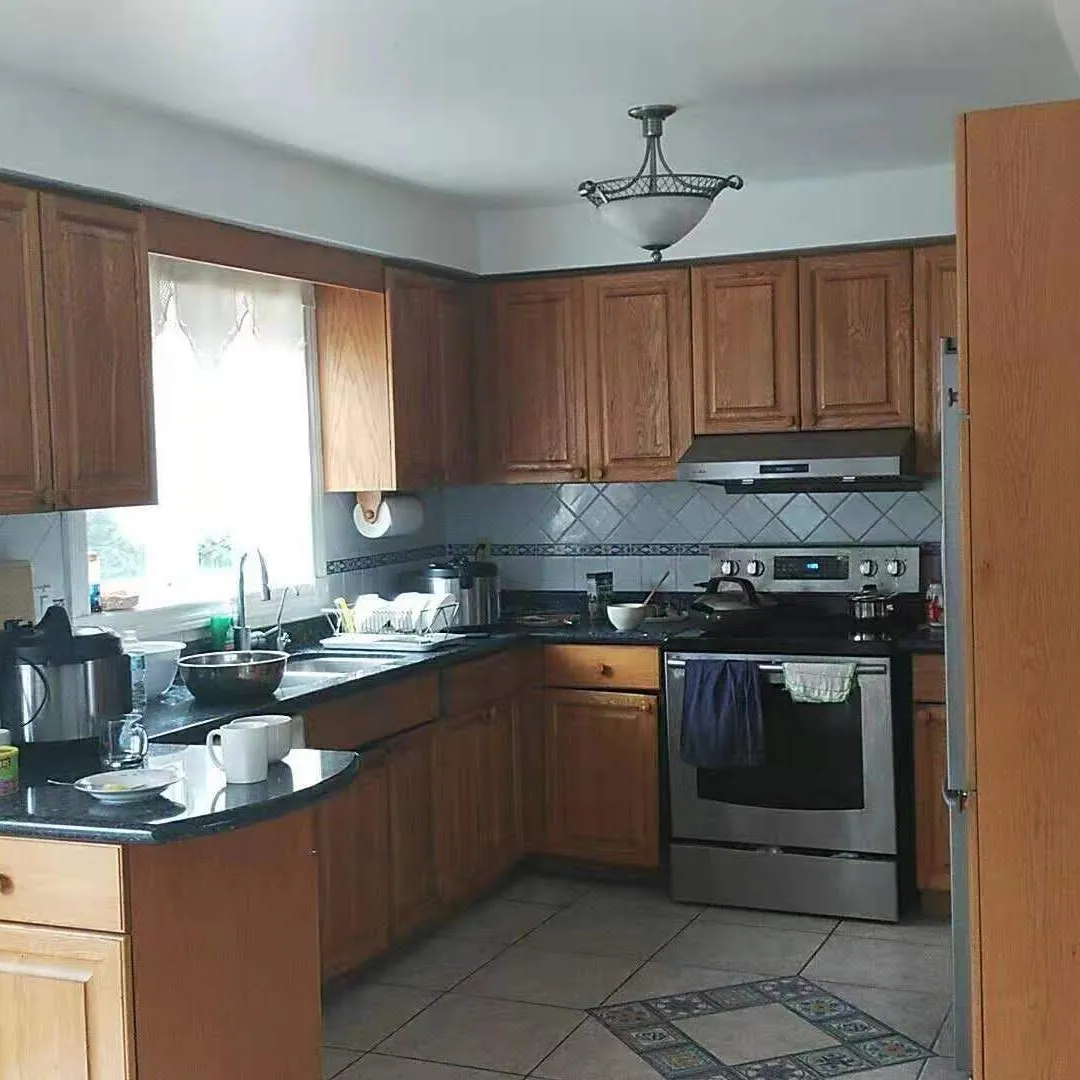 Before
 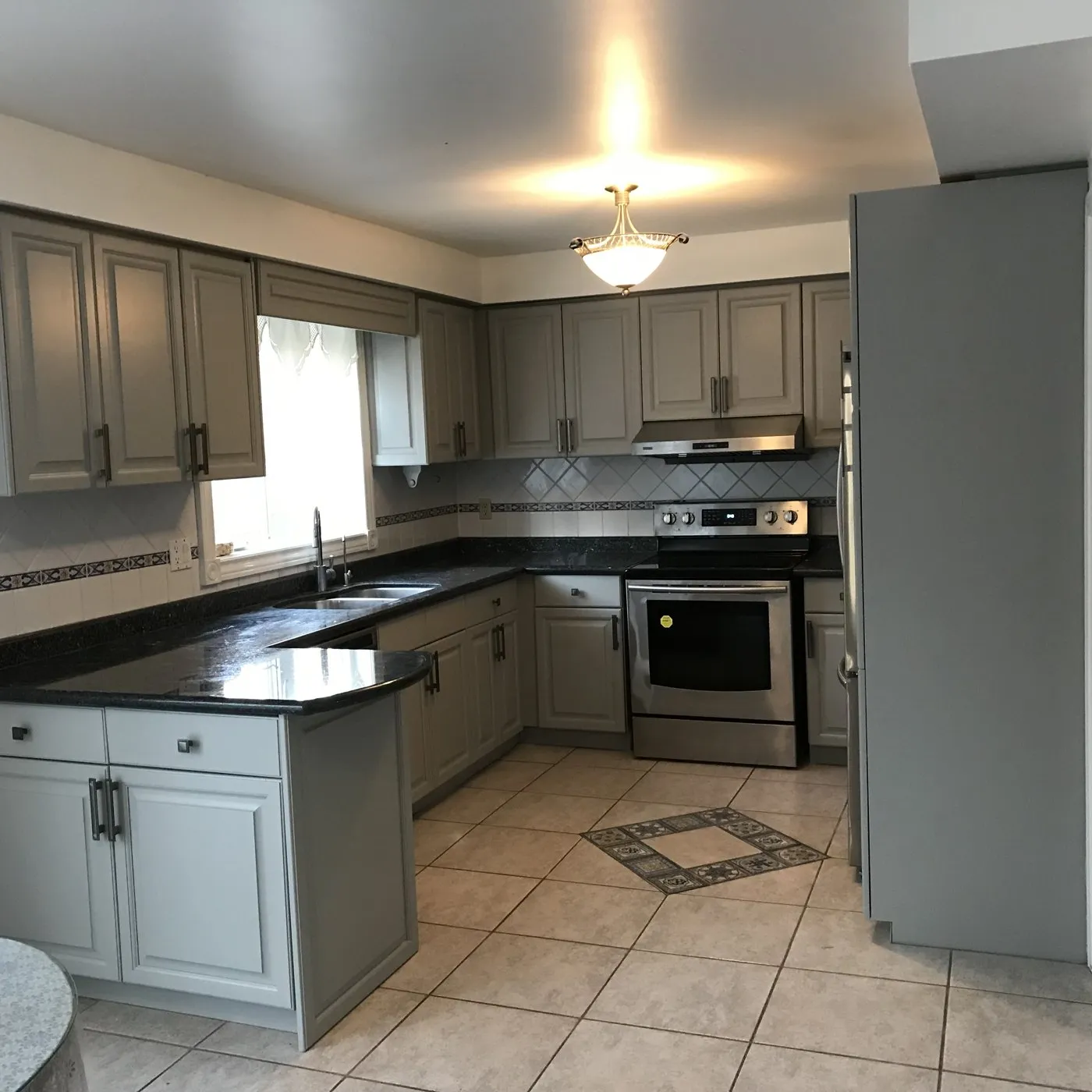 After
After Your light
Samples on your doors, in your light
100+
Kitchens completed
25 years
In the trade, and here since 2013
5.0
Rated on Google
Why a colour changes when it gets home
A paint chip under the fluorescent lighting of a shop, a photograph on a phone screen, and a sprayed door in your kitchen at seven in the evening are three genuinely different colours. This is not fussiness — it is how light and pigment interact.
Three different lights
- Shop lighting is fluorescent or bright LED with a cool cast, chosen so everything under it looks clean and bright
- A phone screen is backlit and adjusts automatically, and makes a colour emit light rather than reflect it
- Your kitchen is lit by whatever daylight the window gives, filtered through the direction the room faces, plus fittings usually warmer than anything in a shop
Then the room joins in
A colour picks up bounce from your floor, your countertop and your walls. A soft grey in a kitchen with warm oak flooring goes noticeably warmer. The same grey beside a cool white quartz countertop stays cool and can read almost blue. Nothing has changed except what is reflecting onto it.
Which way your room faces
North-facing rooms in Oakville get consistently cool light all day and can make a greige look distinctly grey. South-facing rooms get warm afternoon light that pushes the same colour the other way. This is the single most common reason somebody dislikes a colour they were sure about.
What actually gets brought to your kitchen
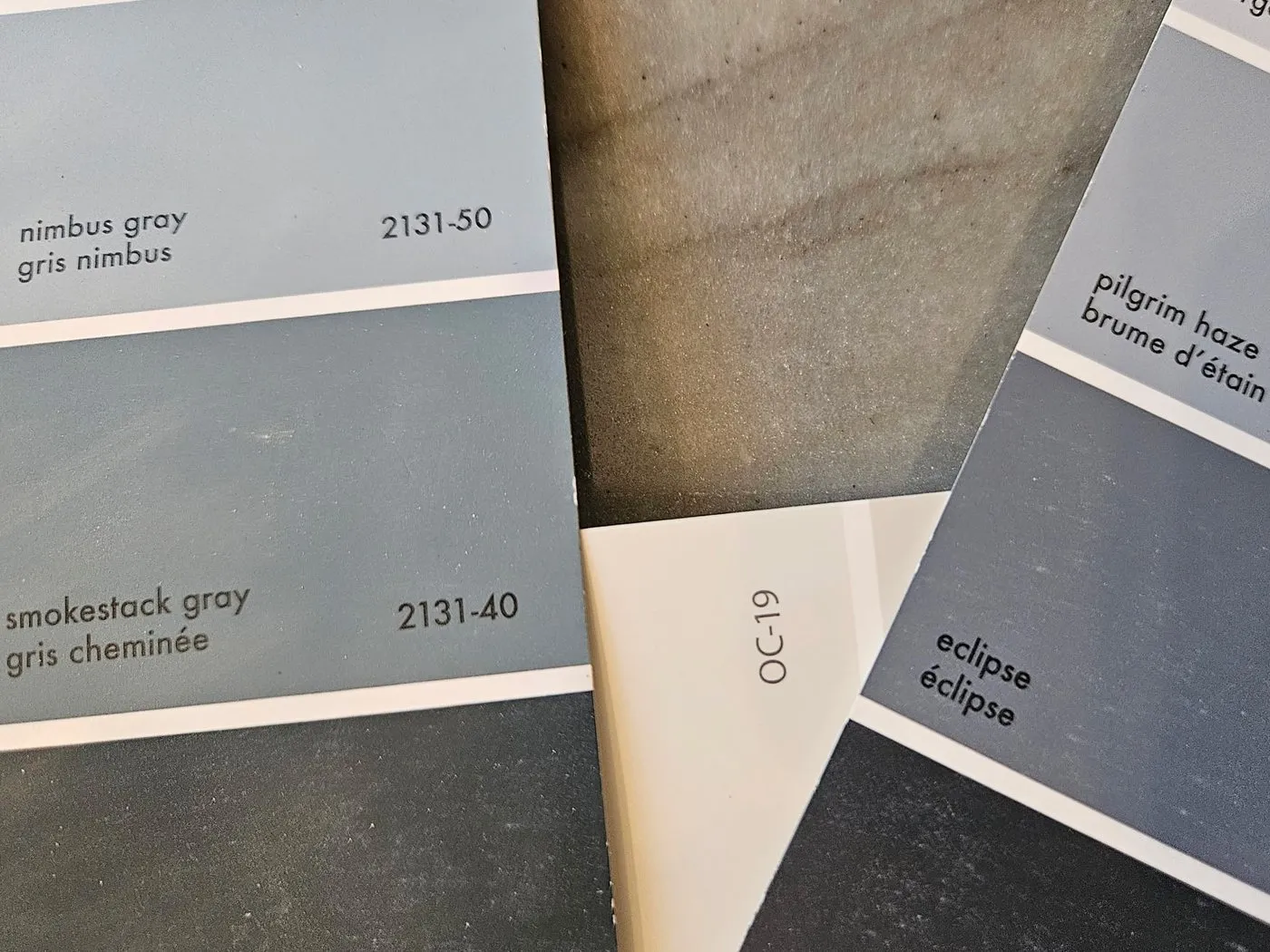
Physical painted samples, sprayed with the real finish on real substrate. Not printed cards.
A printed chip is ink on paper, and it cannot reproduce two things that matter. It cannot show sheen, and sheen changes the apparent colour considerably — the same pigment in matt and in semi-gloss reads as two different shades, because gloss reflects the light source while matt scatters it. And it cannot show you how the finish looks over the substrate, which matters more on wood with visible grain than on a flat panel.
We bring the shortlist and hold it against your actual doors, in the actual room, and then leave the contenders with you. That last part does most of the work. A colour seen once, for a minute, in one lighting condition tells you very little. The same sample propped against a cabinet where you see it at breakfast, in the afternoon and under the lights at night tells you everything, and it is where people change their minds.
When the decision happens, and why it is late
For painting, colour is chosen on the day the doors come off. That sequence surprises people who expect to have decided everything before work starts.
It works because the shop period is two weeks and the actual spraying takes a fraction of that. There is no schedule pressure created by deciding on day one, so nothing is gained by forcing the decision a month earlier — and something is lost, because deciding in the abstract is exactly the condition under which people choose badly.
Refacing is different, and the difference is worth understanding. There, colour and door style are settled at the start, because doors are manufactured to that specification and a four-week manufacturing period cannot begin without it. You cannot change a door style or a colour once production has started. So on a refacing job the decision comes early by necessity, and we spend correspondingly longer on it.
If you already know exactly what you want, that is fine and it saves a step. We will still put the sample against the kitchen before spraying it, because it costs nothing and occasionally saves somebody from a colour they had loved in a photograph.
What we will and will not advise on
We are finishers. What we can tell you with genuine authority is how a colour will behave on the surfaces we are finishing, how it will sit against the countertop and floor you already have, how it will age, and how it will look in the specific light of your room.
Practical guidance we do give: darker colours show dust and fingerprints more on a flat door than on a profiled one; very dark and very saturated colours sometimes need extra topcoats, which is worked out at quoting rather than discovered later; a colour taken from dark to light needs more coverage than the reverse; and the primer is tinted to your topcoat, so a future chip does not flash white whatever you choose.
What we do not do is design your room. We will not specify wall colours, tile, flooring or countertops, and we will not pretend to an eye we do not sell. If you are working with a designer, we are happy to match to what they have specified and to say honestly whether it will behave the way they expect on a sprayed cabinet door.
Trim, walls and the things around the cabinets
Cabinets are rarely the only painted surface in view, and the relationships matter.
A very common decision is whether trim should match the cabinets, match the walls, or sit apart from both. There is no single right answer, but there is a reliable observation: where cabinets and adjacent trim are close but not identical, the near-miss is more noticeable than a deliberate contrast would be. If they are going to be different, make them clearly different.
Where trim is being finished at the same time as the cabinets, matching is exact rather than approximate, because both can be sprayed in the same product and the same batch. Where the trim is being brushed instead, which is often the sensible choice on fixed casings and baseboards, the product is different and we will show you both together so you can see how they sit side by side before committing to either.
We keep a record of the colours and products used on every project. If you come back in three years wanting a matching built-in, or a door replaced after damage, the specification is on file rather than being matched by eye.
The colour decision sits inside a bigger one
Colour is the last decision, not the first, because what is possible depends on what is being done. A sprayed finish can be any colour at all; a stained finish is bounded by what the timber will take; and if the doors are being replaced rather than painted, the profile changes what a colour will look like on them. So choosing a colour once the method is settled is the sensible order, and the pillar above this page covers the methods it depends on. Nobody should pick a shade before knowing which of those they are buying.
Color Consultation Cost in Oakville
There is no charge for it. The consultation is part of any finishing job we take on, and nothing is asked for on the day — no fee and no deposit. We are not a design studio selling advice by the hour.
It exists because of what it prevents. Once a colour is sprayed, changing your mind means stripping the finish back and running the whole process again, and that is a real cost rather than a touch-up. Half an hour with sample doors in your own kitchen is the cheapest insurance on the entire job, for you and for us both.
What it costs you is time. An hour or so, ideally looked at twice — once in morning light and once late in the afternoon — because a colour that reads warm under a showroom lamp can turn grey against your own floor.
If you arrive already certain of a colour code, we will spray it. We will still put the sample in front of you first, because that costs nothing and it occasionally changes somebody's mind at the only point where changing it is still free.
Questions
Common questions about colour consultation in Oakville
- Is the colour consultation a separate paid service?
- No. It is part of any finishing job we do, and there is no charge and no deposit taken on the day. We are not a design studio selling advice by the hour — this exists because getting the colour wrong is expensive for us as well as disappointing for you, and half an hour with real samples in the room prevents most of that.
- When does it happen?
- On the day the doors come off, for painting work. That timing surprises people, and it is deliberate — the two-week shop period gives us far more time than we need to spray in whatever colour you choose, so nothing is delayed by deciding then. It also means you are choosing with the doors off, seeing the room as it will actually be. For refacing it happens earlier, because a door has to be manufactured in the chosen finish.
- What do you actually bring?
- Physical painted samples — real finish sprayed on real substrate, not printed chips. A printed card cannot show you sheen, and sheen changes a colour more than most people expect. We leave the contenders with you against the doors so you can look at them at different times of day rather than deciding in one moment under one light.
- Can I just tell you a colour code I have already chosen?
- Yes, and some people do. If you know exactly what you want we will spray it. We will still show you the sample against your kitchen first, because it costs nothing and it occasionally changes somebody's mind — and the point at which to discover that is before four litres of catalysed finish have been mixed.
- Do you help with the whole scheme, or only the cabinets?
- We advise on what we are finishing — cabinets, trim, millwork, doors — and how those sit against what is already in the room. We are finishers rather than interior designers, so we are not going to specify your wall colour, your tile or your countertop. What we can tell you is how a given cabinet colour will behave beside the countertop and floor you already have.
- What if I hate it once it is done?
- This is precisely what the sample process is designed to prevent, which is why we insist on it even when someone arrives certain. Once a colour is sprayed, changing it means stripping back and starting again, and that is a real cost rather than a touch-up. Half an hour of looking properly at the front end is the cheapest insurance in the project.
- Is there anything I can try before booking a consultation?
There is, and it costs nothing. Our colour visualiser gives you a free preview of your kitchen in a different colour, which is usually enough to cut a longlist down to two or three worth seeing as real samples. It does not replace this consultation — a screen cannot show you how a colour shifts between morning and evening in your own kitchen — but it is a sensible place to start.
Refaced. Repainted. Refinished.