
Drawer Box Replacement in Oakville — When the Box Is the Problem, Not the Front
A drawer that sags, sticks or drops its bottom out is not a door problem, and no amount of work on the front will fix it. The box is a separate thing.
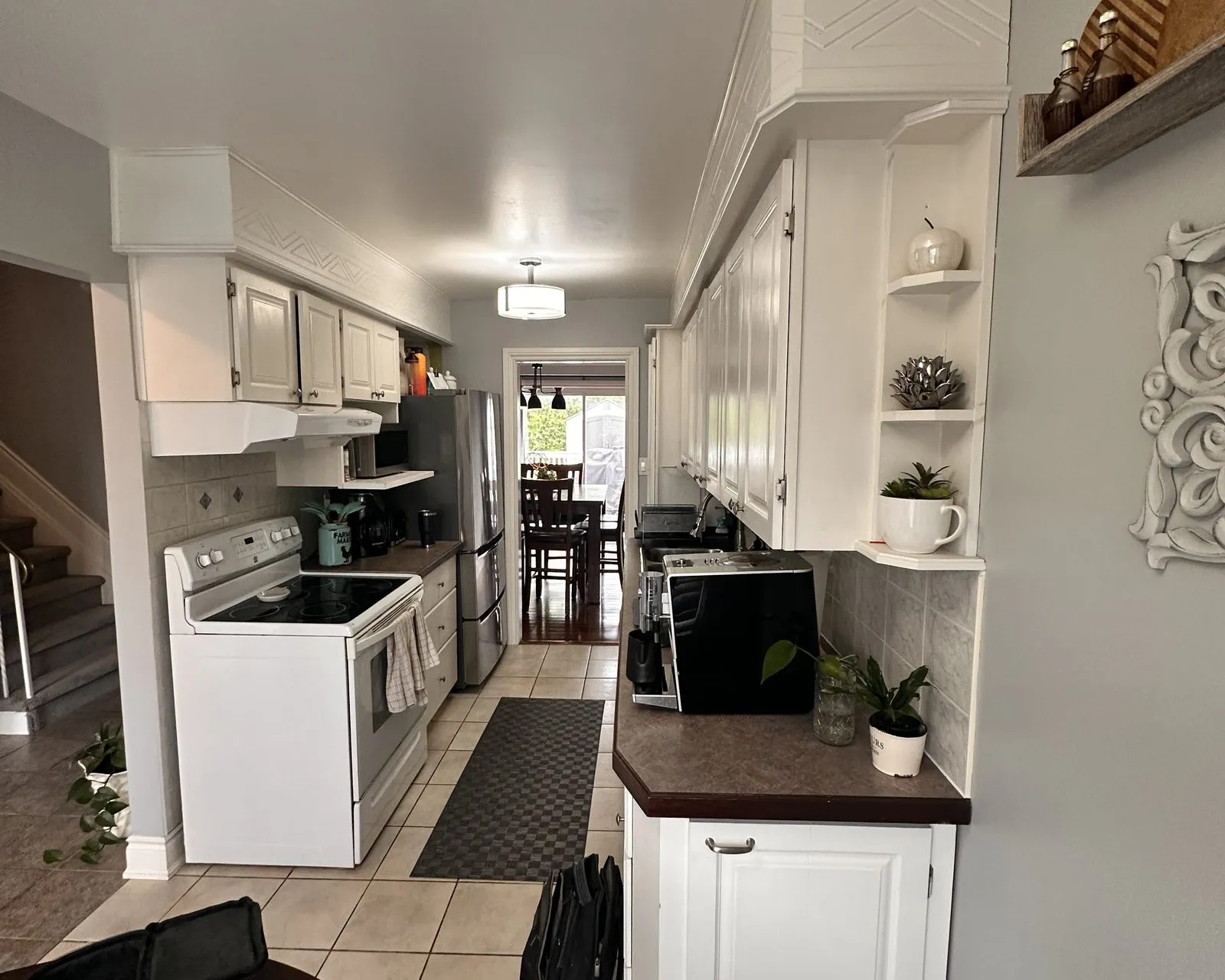 Before
 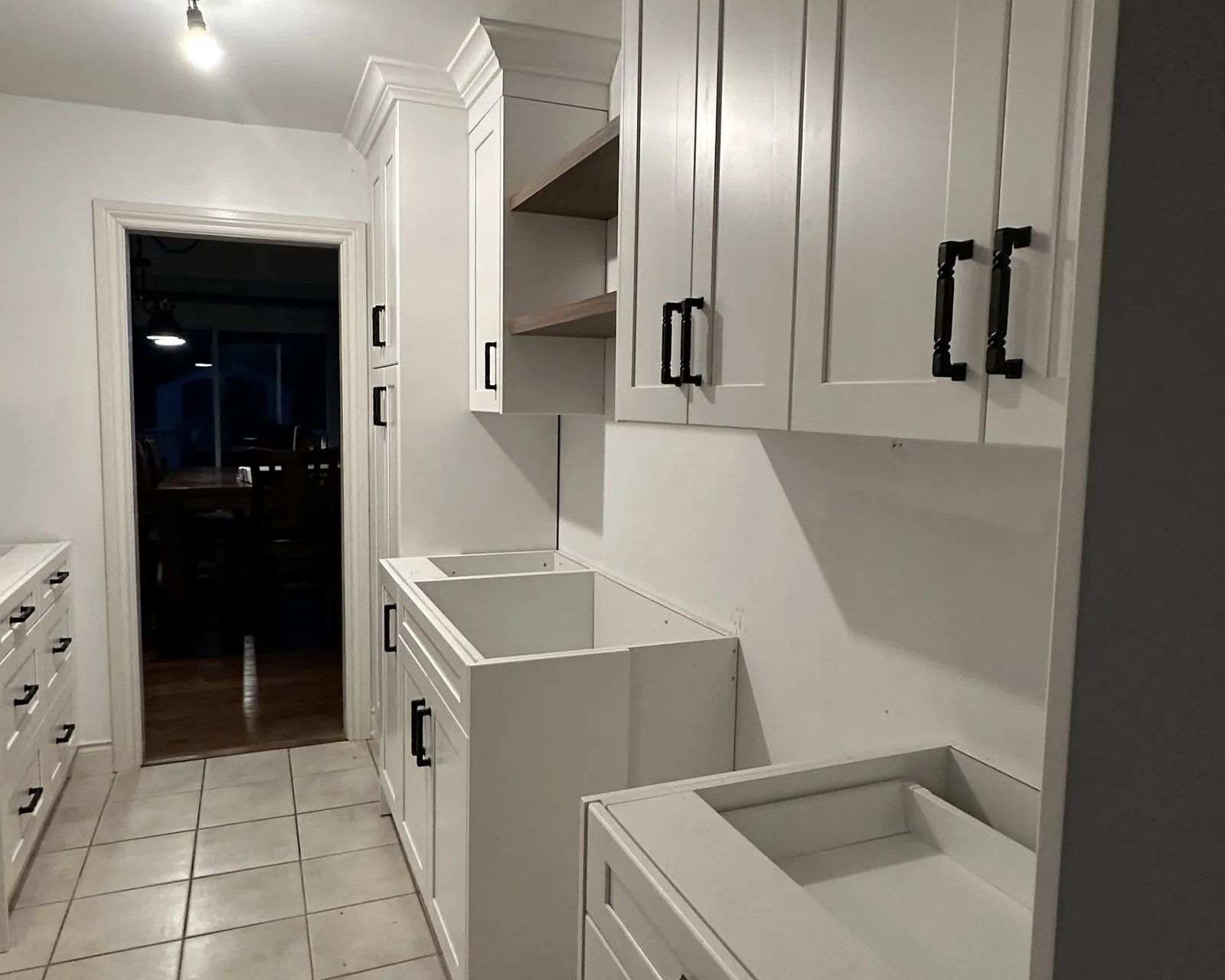 After
After The box
A sagging drawer is not a door problem
100+
Kitchens completed
25 years
In the trade, and here since 2013
5.0
Rated on Google
The box and the front are two different things
This distinction causes more confusion than anything else in cabinetry, and it decides what a kitchen actually needs.
The drawer box is the container. Four sides and a bottom, sliding on runners, holding whatever you put in it. Nobody sees it unless the drawer is open.
The drawer front is the panel screwed onto the face of that box. It is what lines up with the doors, it carries the handle, and it is the only part of the drawer visible when the kitchen is shut.
Why it matters that they come apart
A front unscrews from a box in about a minute. Which means either can be replaced without touching the other, and that matters because they fail for completely unrelated reasons.
Which one is failing
- Sags, sticks, rattles or has dropped its bottom onto the cutlery — that is the box or the runners. A beautiful new front changes nothing about any of that.
- Works perfectly and looks like 1998 — that is the front. Rebuilding the box behind it is money spent on the half that was working.
Most kitchens need one. Some need both. It is worth knowing which before anybody quotes.
Why builder drawers fail first
The drawers in a kitchen are the only moving parts that carry weight, and they are built to a price.
A typical builder-grade box is particleboard, stapled at the corners, with a thin bottom panel sitting in a shallow groove or pinned underneath. Side-mount runners with plastic rollers. It is adequate when the house is new and it is what almost every production kitchen gets.
Then it is loaded with pans and opened forty times a week for fifteen years.
The failures are predictable. The stapled corners work loose, because a staple relies on friction and friction is exactly what repeated loading destroys. The bottom drops out of its groove, usually the pan drawer, usually all at once. The rollers on the runners flatten and the drawer starts to drag. And if anything ever leaks under the sink, particleboard swells, loses all its structure and never recovers.
None of that is a reflection on the kitchen as a whole. The box beside it is frequently fine, the doors are frequently fine, and the drawers have simply reached the end of what they were built for.
What replaces them
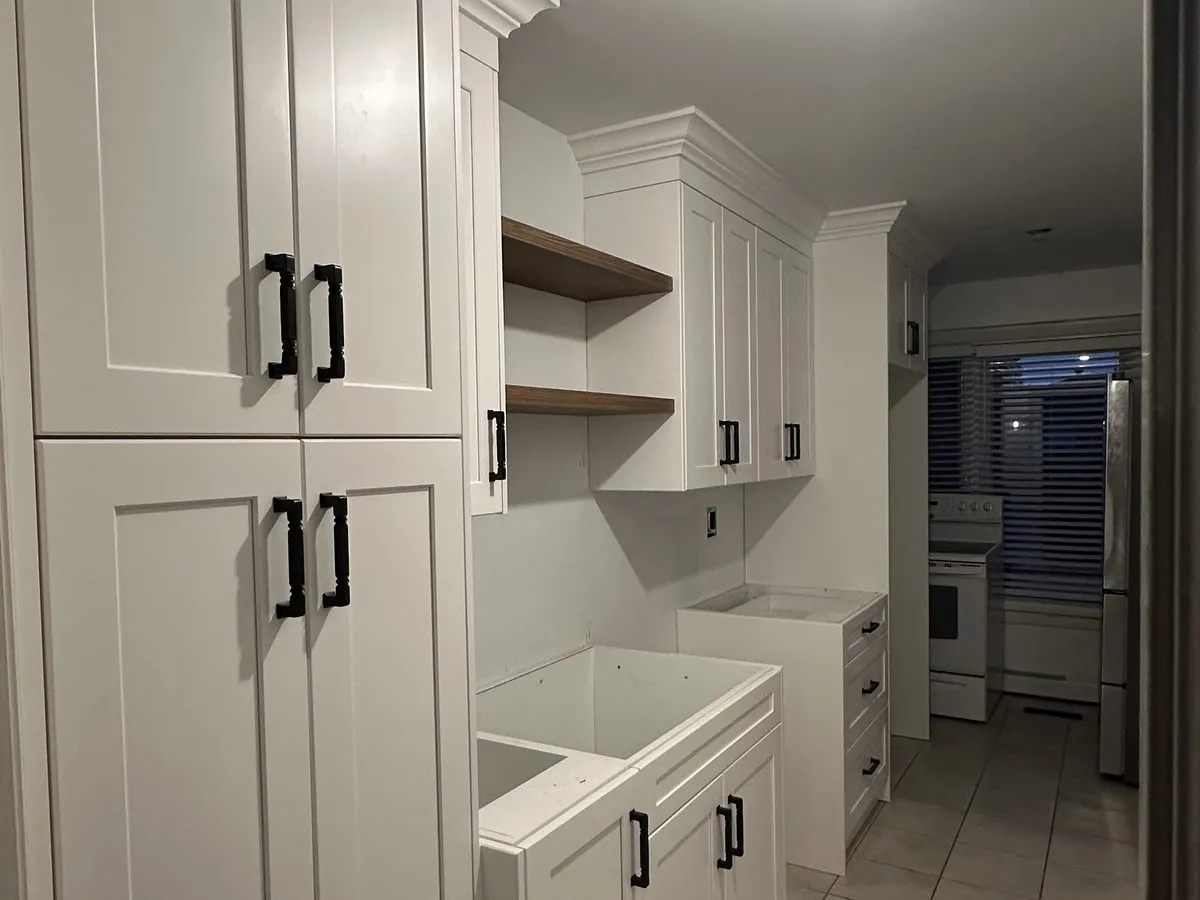
Plywood boxes with dovetailed corners, and a solid bottom set into a groove rather than fixed to the underside.
The dovetail is not decoration. Interlocking joints resist being pulled apart in the direction a drawer is actually loaded, so the joint tightens under load where a butt joint and a staple work loose. It is the single clearest indicator of how a box was built, and you can check your own in ten seconds by opening a drawer and looking at the corner. Interlocking fingers mean dovetail. A line of staples or a plastic bracket means the other thing.
Plywood matters for two reasons. It holds a screw properly, which is what the runners are fixed with. And it survives water. A plumbing leak that destroys a particleboard box will leave a plywood one serviceable, which in a run of base cabinets under a sink is not a hypothetical.
The bottom sits in a groove cut into the sides, so the weight of the contents is carried by the box rather than by whatever is holding the bottom on.
Runners, and why the box has to suit them
Undermount soft-close runners are what most people want once they have used them, and they impose a requirement on the box.
They sit underneath the drawer rather than at the sides. Nothing metal is visible when the drawer is open, you gain a little interior width, and the drawer closes itself over the last inch instead of being slammed. They are rated for real weight, which is what makes them suitable for pan drawers rather than only cutlery.
The catch is tolerance. An undermount runner grips the underside of the box and depends on the bottom being a consistent thickness and genuinely flat. A stapled box with a thin pinned-on bottom does not give it anything to hold, which is why retrofitting undermounts to old builder drawers usually does not work and why the runner upgrade and the box replacement tend to arrive together.
Side-mount runners are more forgiving and can sometimes be swapped on their own. If your existing boxes are sound and you only want the closing action, that is worth asking about before committing to new boxes.
When to repair instead
Not every failing drawer needs replacing, and some of these are a ten-minute job.
A runner that has jumped its bracket, a screw that has pulled out of the side, a bottom panel that has slipped out of its groove while the box itself is still square — all repairable, and none of them a reason to rebuild. A drawer that drags because the cabinet has shifted may just need the runners re-set rather than replaced.
What does not repair well is particleboard that has swollen. Once it has taken water it has lost its structure permanently and there is nothing to screw into. Corners that have opened up and been glued or screwed back together more than once are the same story. And a box that was too flimsy when it was new will not be improved by better runners.
The test we apply is simple enough to apply yourself. Take the drawer out, hold it by two opposite corners and try to rack it. If it flexes into a parallelogram, the joints are gone and the runners will keep failing no matter how good they are.
Drawers are one half of a two-part problem
The box carries the weight and the front carries the look, and they fail on completely different schedules. Plenty of kitchens need one and not the other, which is why they are quoted separately rather than bundled. Working out whether the fronts need doing as well as the boxes is the first thing to settle, because doing both at once costs less than doing them a year apart and doing the wrong one costs the whole amount. The page above sets the carpentry services against each other.
Drawer Box Replacement Cost in Oakville
Boxes are quoted per drawer, and the price turns on what is behind the front rather than on the front itself. A box that has simply loosened at the joints is a different job from one whose bottom panel has dropped out or whose sides have swollen, and the two do not cost the same.
The runners are the other half. A drawer that sticks or sags is often a runner problem as much as a box problem, and replacing a box on tired runners solves half the complaint. Soft-close runners are quoted as their own line — they are not the same upgrade as soft-close door hinges, which live in the hinge, and plenty of kitchens need one without the other.
Depth and width matter more than people expect. A deep pan drawer carries real weight and needs a heavier box and a heavier runner than a cutlery drawer, so a kitchen with several large drawers prices differently from one with the same number of small ones.
Questions
Common questions about drawer box replacement in Oakville
- What is the difference between a drawer box and a drawer front?
- The box is the container that holds your cutlery and slides in and out. The front is the panel screwed to the face of it, which is what you see when the drawer is shut. They are different pieces, they are replaced independently, and they fail for different reasons. A sagging drawer is a box problem. A dated-looking drawer is a front problem.
- Why do the drawers in a newer kitchen wear out faster than the doors?
- Because they are the only moving part carrying weight. A door swings and holds nothing. A drawer full of pans is loaded every time it is opened, and in a busy kitchen the same three drawers get opened dozens of times a day. Builder-grade boxes are usually stapled particleboard with a thin bottom captured in a shallow groove, and that construction gives up long before the cabinetry around it does.
- What are the new boxes made of?
- Plywood with dovetailed corners and a solid bottom set into a groove rather than stapled on. Dovetails interlock, so the joint gets stronger under load instead of working loose. Plywood holds a screw and survives a leak under the sink, which is where particleboard swells and crumbles.
- Do I need new runners as well?
- Usually, and it is normally the reason to do the job properly. Undermount soft-close runners sit beneath the box rather than at its sides, so nothing metal shows when the drawer is open and you gain a little width. They also need a box built to a tighter tolerance than a side-mount runner does, with a bottom of the right thickness. Fitting them to an old stapled box is not usually possible.
- Can you just fix the drawer I have?
- Sometimes, and we will say so. A runner that has come off its bracket, a screw that has pulled, a bottom that has dropped out of its groove but is otherwise sound — all repairable, and none of them worth replacing a box over. What is not worth repairing is particleboard that has swollen, corners that have opened up, or a box that has been screwed back together more than once.
- Will new boxes fit my existing cabinets?
- Yes. They are built to your openings, which is the whole point of doing it this way rather than buying stock sizes. Nothing about the cabinet box changes and the fronts you already have can go straight back on if you are keeping them.
- Does this add soft-close to the doors as well?
- No, those are two different upgrades. Soft-close on a drawer is in the runner underneath. Soft- close on a door is in the hinge. People often want both and they are quoted as separate lines, because plenty of kitchens need one without the other.
Refaced. Repainted. Refinished.