
Custom Millwork and Trim in Oakville — Fitted, Not Just Installed
Cabinets are built square and houses are not. Millwork is everything that closes the gap between the two, and it is what decides whether a kitchen looks fitted or installed.
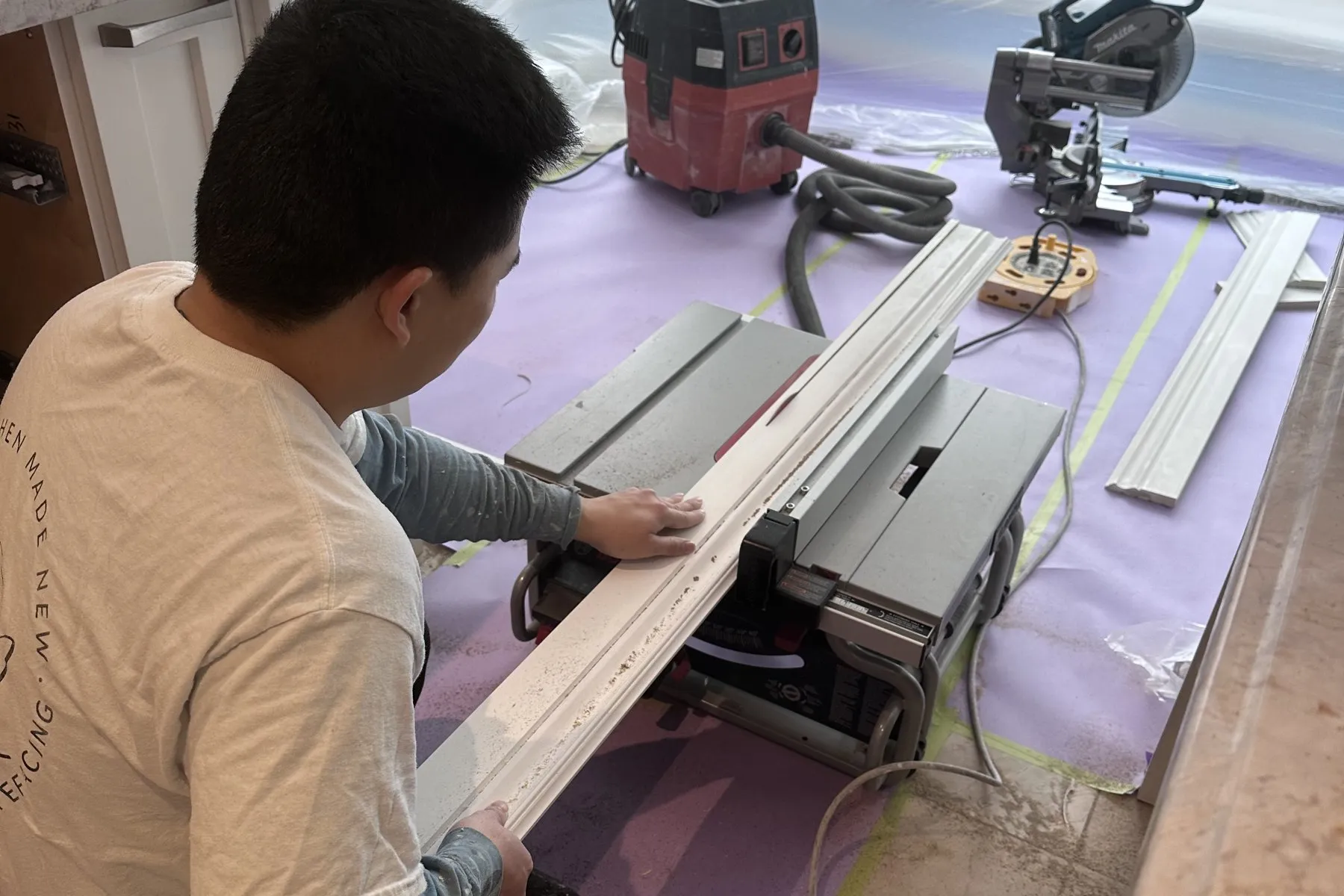
Scribed
Cut to the wall you actually have
100+
Kitchens completed
25 years
In the trade, and here since 2013
5.0
Rated on Google
What millwork covers
Everything in a kitchen that is not a door, a drawer or a box.
- Crown moulding across the tops of the wall units
- Light valance underneath them, hiding the strip lighting
- Filler strips where a run of cabinetry meets a wall and the two do not quite agree
- Scribes — the pieces cut to follow a wall's actual shape
- Exposed end panels finishing the visible side of a run
- Toe kicks along the floor
- Panelling that dresses the back or side of an island, so it does not look like the back of a cupboard from the dining table
None of it is what anyone rings up about. All of it is what separates a kitchen that looks built into the room from one that looks placed in it.
Why it matters more than it sounds
It is arithmetic. A cabinet is manufactured square to a tolerance of a millimetre or two. A wall in a house of any age is out by considerably more than that, and it is out by different amounts at different heights. Something has to absorb the difference. That something is millwork, and doing it well is mostly patience.
Why new doors make old trim look worse
This is the most common surprise on a door or refacing project, and it is worth knowing before it happens rather than after.
Nothing about the trim changes. What changes is the standard it is being judged against.
A filler strip that was cut a bit rough, a crown that steps where the ceiling sags, a gap at the end of a run that has been filled with caulk twice — all of that reads as normal wear against doors that are themselves tired. Put crisp new fronts in front of it, sprayed and level and consistent, and the eye goes straight to the one thing that has not been dealt with.
We raise it at quoting for that reason. Not to add a line to the bill, but because the alternative is a kitchen that is ninety percent transformed and one gap short, and that gap is what somebody will look at.
Sometimes the answer is that the existing trim is fine and should be left alone. Often it is a couple of pieces rather than all of it.
Scribing, and walls that are not straight
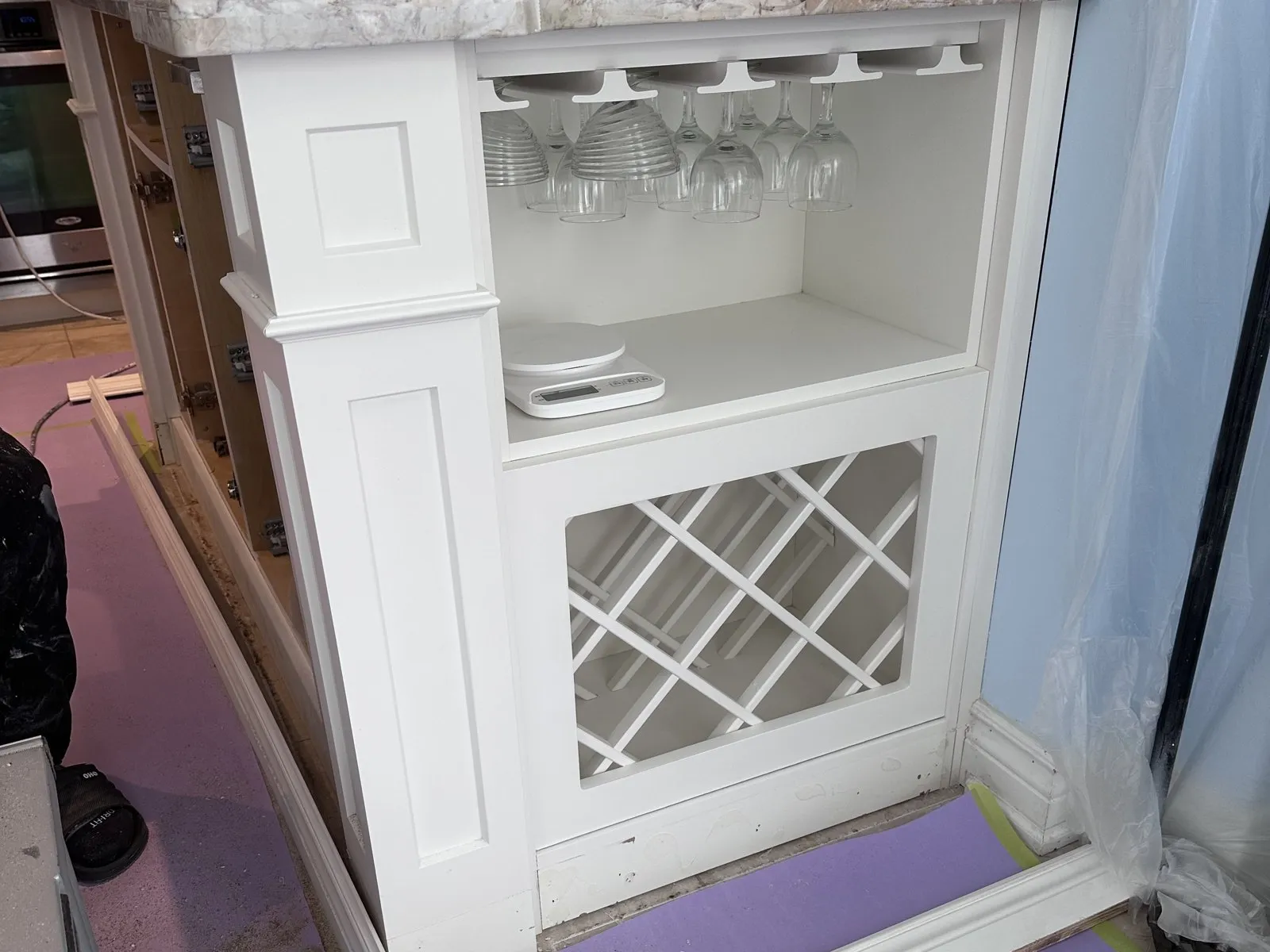
Scribing is the technique that makes cabinetry look fitted, and almost nobody outside the trade has heard of it.
How it is done
A filler strip is held in position against the wall. The wall's actual contour — the bow, the lump where a stud sits proud, the taper where the plaster thickens toward a corner — is transferred onto the face of the strip with a compass or a scribing block. The strip is then cut to that line rather than cut straight.
The result sits tight against the wall along its entire length. No shadow gap, no wedge of caulk, no place where the joint opens up as it runs.
What most kitchens have instead
A straight-cut filler pushed against a wall that is not straight, leaving a gap that varies along its length, filled with sealant and painted over. It works for a while and it always shows eventually, because caulk shrinks and the line it leaves is never quite parallel to anything.
This is where the time goes in millwork, and it is why it is carpentry rather than assembly. There is no way to order the right shape. It has to be cut to the room it is going into.
Panel-ready, end panels and the pieces that get overlooked
Three things that come up repeatedly and that painting-only or refacing-only companies tend to send elsewhere.
Panel-ready appliance fronts
A fridge or dishwasher designed to take a matching cabinet panel needs that panel built to the appliance's specification, finished to match the doors, and hung on the appliance's own hardware. It is three jobs across two trades. Most companies can do one of them, which is how you end up with a brushed panel sitting next to a sprayed door, not quite matching, in a kitchen that cost a great deal of money.
We build the panel, spray it in the booth alongside your doors in the same system and the same colour, and fit it. One trade, one finish.
Exposed end panels
The visible side of a run, particularly at the end of an island or where a tall unit stands proud. Builder kitchens frequently leave these as bare melamine because nobody was going to see them from the show-home camera angle. They are the first thing you see walking into the room.
Toe kicks and valance
Unglamorous, cheap while the crew is there, and both are noticeable when they have been left as they were.
Timing, and what it costs to wait
Millwork is dramatically cheaper as part of something else.
During a cabinetry or refacing project the crew is already in the house, the measurements are being taken anyway, and the sprayer is set up and loaded with your colour. Adding a set of scribes, a run of crown and a couple of end panels is materials and a modest amount of labour.
Doing it six months later is a separate visit, separate setup, and a colour match to a finish that has now had six months to settle. It will be close. It is not the same as having been sprayed in the same batch.
So the useful question at quoting is not whether you want millwork. It is which pieces you would regret not having done while everything was apart. We would rather list them and have you strike two off than have you find them afterwards.
Millwork is the last ten percent of a cabinetry job
It is rarely the reason anyone calls, and it is frequently the difference between a kitchen that looks finished and one that looks nearly finished. New fronts make every old gap more obvious, which is why the finishing work that follows new doors or boxes tends to get decided halfway through rather than at the start. Better to know it is coming. The page above sets out the cabinetry work it usually follows.
Custom Millwork and Trim Cost in Oakville
Millwork is quoted by the run and by the complexity of what it has to close. Cabinets are built square and houses are not, so the price reflects how much scribing, packing and fitting stands between a straight length of timber and a join that looks like it was always there.
Crown that follows a level ceiling is one price. Crown that follows a ceiling which drops fifteen millimetres across the room is another, because every length has to be cut to the gap in front of it. The same is true of light valances, end panels against out-of-plumb walls, and filler pieces around appliances.
It is far cheaper done at the same time as the cabinets. The crew is already in the house, the sprayer is already loaded with your colour, and the measurements are being taken anyway. Coming back for millwork afterwards means a separate mobilisation and a separate colour match, and neither of those is free.
Painting existing trim around a room is a different job on a different quote — that is finishing work, and it belongs to the painting side of the business.
Questions
Common questions about millwork and trim in Oakville
- What counts as millwork in a kitchen?
- The pieces that are not doors, drawers or boxes. Crown moulding across the tops, light valance under the wall units, filler strips where cabinetry meets a wall, scribes that take up the gap against an uneven surface, exposed end panels, toe kicks, and any panelling that dresses the side of an island or a run. All made to the kitchen rather than bought to length.
- Why does new cabinetry make the trim look worse?
- Because it raises the standard everything else is judged against. A gap at the end of a run, a filler that was cut roughly, a crown that steps where the ceiling drops — all of that was invisible against tired doors and becomes the thing you look at against new ones. It is the most common surprise on a refacing or door job.
- What is scribing?
- Cutting a piece to follow the actual shape of a wall rather than assuming the wall is straight. A filler strip is held against the wall, the wall's contour is transferred onto it, and it is cut to that line so it sits tight along its whole length. It is the difference between a joint you cannot see and one filled with caulk.
- Do you make the millwork or buy it?
- Make it. Crown and trim profiles are bought as stock lengths the way any joiner buys them, but fillers, scribes, end panels, valances and panel-ready fronts are cut, assembled and finished here. Then they go into the booth and are sprayed in the same 2K as the doors, so they match exactly rather than approximately.
- Can you match millwork to cabinets somebody else installed?
- Usually. If the finish is one we can colour-match we spray the new pieces to it, and the closer the existing finish is to a standard colour the better that goes. Where the existing cabinetry has aged unevenly, matching to how it looks now rather than to what it was originally is the honest approach, and we will say if we think the difference will show.
- Is this the same as the trim painting you do?
- No. This is making and fitting the woodwork. Painting existing trim around a room is finishing work and belongs to the painting side of the business. They often happen in the same house and they are different jobs with different quotes.
- Does it need doing at the same time as the cabinets?
- It is far cheaper if it is. The crew is already there, the sprayer is already set up in your colour, and the measurements are being taken anyway. Coming back for millwork afterwards means a separate visit and a separate colour match.
Refaced. Repainted. Refinished.