
Custom Cabinet Door Replacement in Oakville — The Only Part That Has to Change
The doors and drawer fronts are the part of a kitchen you touch. They are also the part that dates first, and the only part that has to change to make the room look new.
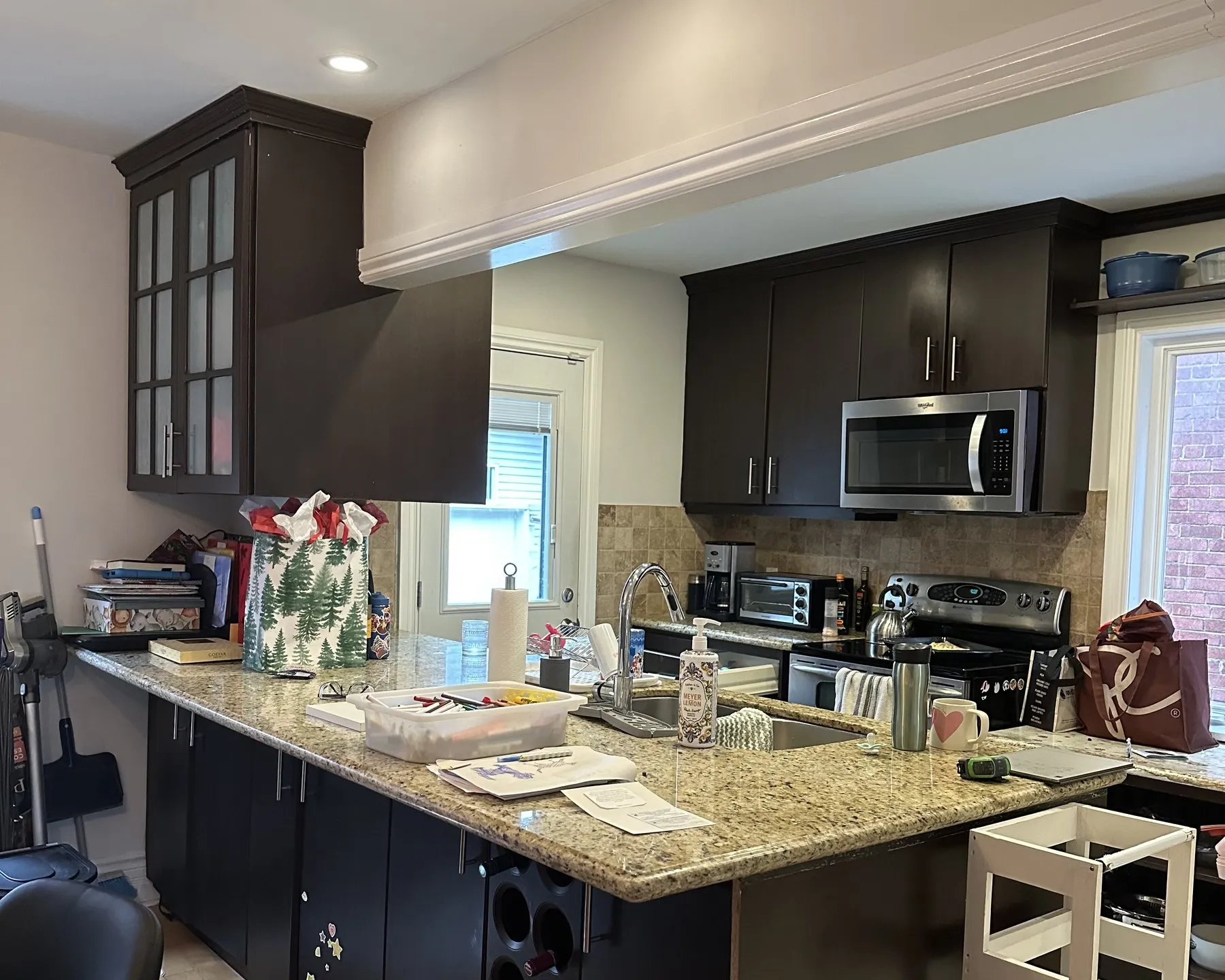 Before
 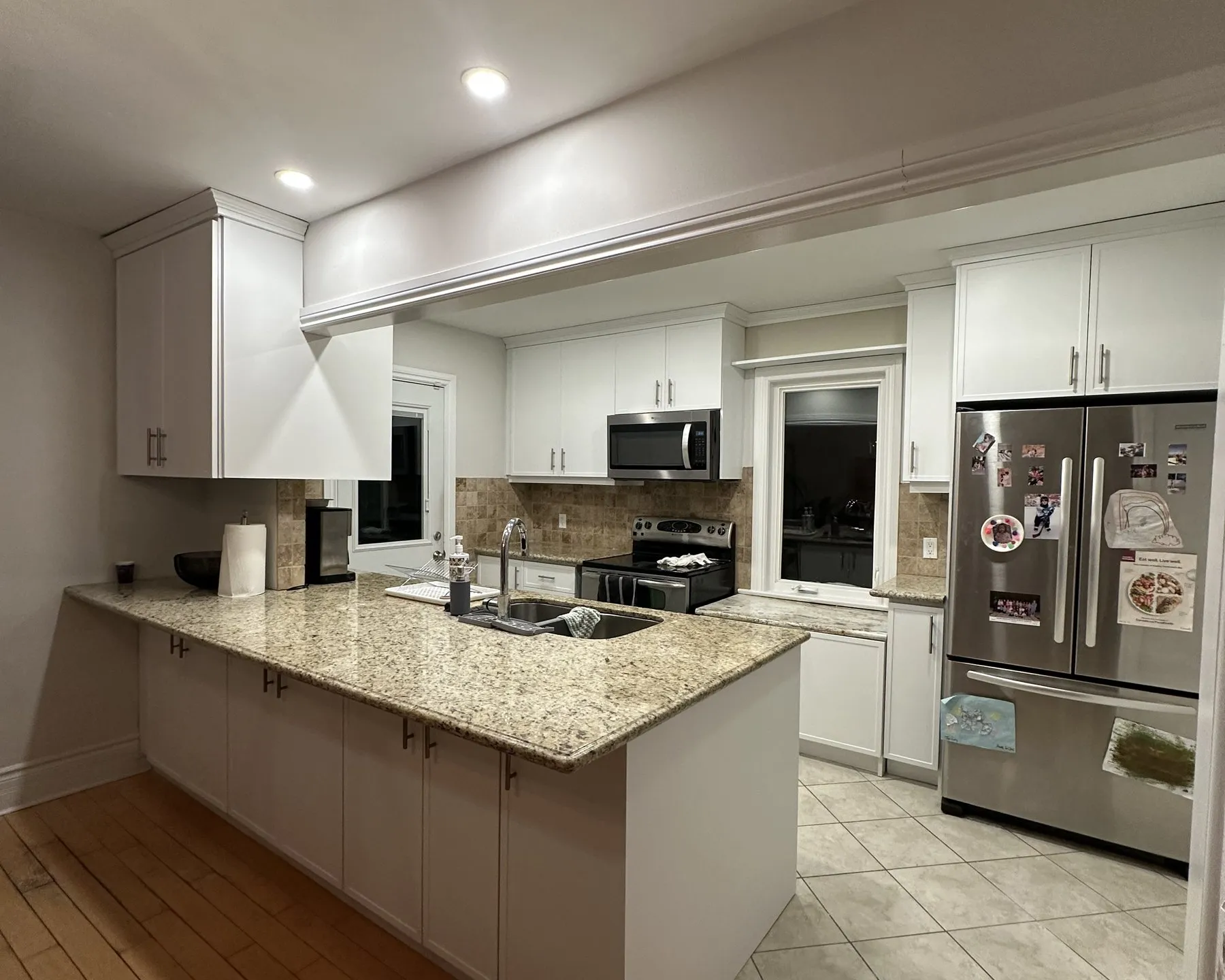 After
After Boxes stay
Only what you see is replaced
100+
Kitchens completed
25 years
In the trade, and here since 2013
5.0
Rated on Google
What changes and what does not
The boxes stay. Everything you see with the doors shut is replaced.
That is the whole proposition, and it works because of an asymmetry most people have never had cause to think about. The box of a kitchen is plywood or board, screwed to a wall, hidden behind a door. Nothing about it dates. It has no style. Provided it is square, dry and firmly fixed, a twenty-five-year-old box is functionally the same as a new one.
The doors are the opposite. They carry all of the style, they take all of the wear, and they are what makes a kitchen look like it belongs to a decade.
So the fronts come off and new ones go on, made to the openings you already have. The drawer fronts go with them. Hinges are replaced at the same time because new doors are drilled for new hardware. Handles either move across or get changed, depending on what you want.
What you end up with is a kitchen that looks rebuilt, on a box that never needed rebuilding.
Where the doors come from
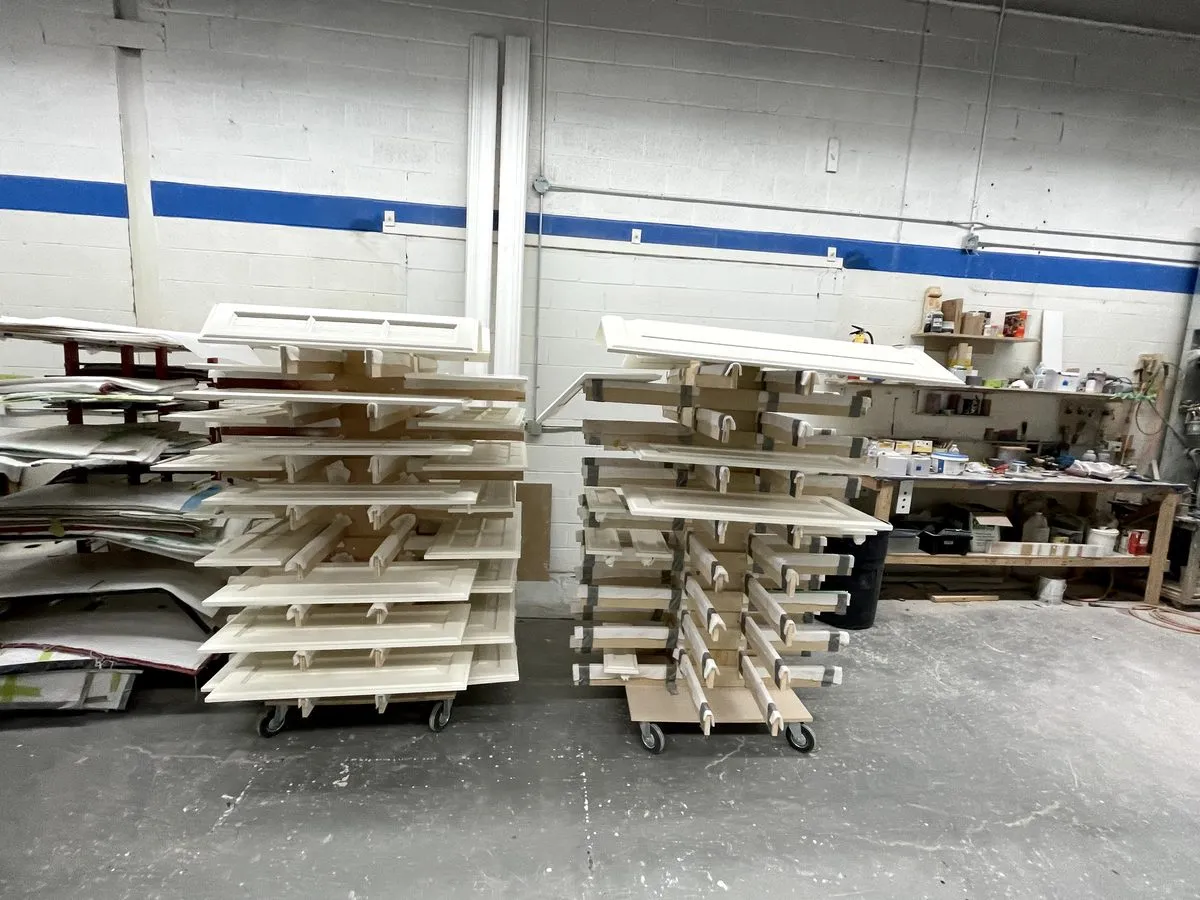
Worth being straight about this, because plenty of companies are vague on it.
We do not manufacture doors. They are made to our measurements by manufacturers we have worked with for years, ordered to each opening, and they arrive already sprayed.
Why the finish matches
The door maker sprays each door in 2K polyurethane in the colour you chose, and we spray the cabinet boxes on site in the same colour and the same system. We specify both, so you are not matching a catalogue colour to a frame somebody has tried to match on site.
The result is doors and boxes in one colour and one coating system, specified by us from start to finish.
The four weeks
A door order's four weeks is manufacturing time. It is why replacing doors runs four to five weeks end to end while painting the existing ones runs two and a half to three. During those four weeks nothing at all happens in your kitchen.
Material, and the fifteen-year term
Two choices, and the right one follows from whether you want colour or wood.
Waterproof MDF, for a painted finish
It is what most painted kitchens get. It is dimensionally stable in a way solid timber is not, so it does not swell in a humid July or shrink in a dry February, and a painted finish sitting on a panel that does not move is a finish that does not crack at the joints. The 2K bonds to it exceptionally well. That combination is why waterproof MDF doors carry a fifteen-year warranty here, on the paint and on the panel both, against a trade norm of one to three years.
Solid wood, for grain
For people who want the grain visible. It takes a stain and a clear coat rather than a colour, and it moves seasonally the way timber does, which is fine under a clear finish and less forgiving under paint.
Thermofoil, which we rarely recommend
Thermofoil doors arrive pre-finished, cost less, and cannot be repaired if they are damaged or if the film starts lifting at an edge. Sprayed wood or MDF can be touched up. We will quote thermofoil if budget makes it the difference between doing the job and not, but it is not what we would put in our own kitchen.
Measuring, which is where this goes wrong
Kitchens are not built to a consistent tolerance. Not older ones, and not new ones either.
Two openings that look identical along a run are routinely a few millimetres apart. A box that was fitted to a wall out of plumb has been quietly out of square ever since. Somebody has adjusted a hinge over the years to hide a gap that was actually a box problem.
Doors ordered to a nominal size will show every bit of that. The gaps down a run go uneven, and once there are new fronts on the kitchen the eye goes straight to them, because everything else looks sharp.
So every opening is measured on its own before anything is ordered, and the doors are made to those measurements rather than to a size chart. It is unglamorous work and it is most of the reason a replaced kitchen either looks factory-fitted or looks like new doors on an old kitchen.
This is also why measuring happens after you have decided to go ahead rather than before you have a price. Photographs are enough to quote from. They are not enough to order from.
When new doors are the wrong answer
Two cases, and both come up weekly.
The doors are sound and you dislike the colour. Then this is the expensive way to solve a cheap problem. Painting the doors you have costs considerably less, takes weeks less, and on a well-made door produces a finish indistinguishable from a new one, because it is the same finish. What you give up is the ability to change the profile. If a raised panel is what you dislike, painting it leaves you a raised panel in a different colour.
The boxes have failed. New fronts on a box that is swollen at the base, flexing when pushed, or pulling off the wall will look excellent for a few months and then stop. That kitchen needs cabinetry work rather than doors, and we would rather say so before quoting than discover it on the day the fronts arrive.
The distinction is worth getting right because it decides the whole budget. It is also why we ask for photographs of the insides of the boxes and not just the fronts.
Doors are one of several things that get replaced
Almost nobody replaces doors and nothing else. The hinges are off anyway, the drawer boxes are exposed for the first time in twenty years, and the gaps where cabinetry meets wall look worse against new fronts than they did against old ones. Knowing what else gets changed while the doors are off is worth having before the order goes in, because most of it is cheaper to do while everything is apart. The page above this one covers the rest of what the carpentry side makes.
Custom Cabinet Door Replacement Cost in Oakville
Doors are priced per door and per drawer front, which is the only method that reflects the work. Each one is measured, made, finished and hung individually, so the count is what the quote is built on — not the square footage of the kitchen and not the length of the runs.
Three things move the price beyond the count. The door style, because a shaker with a flat centre panel is less work than a raised or routed profile. The material, with painted MDF at one end and rift-cut hardwood with a custom stain at the other. And the openings themselves, since frames that have moved out of square need each door sized to its own opening rather than to a standard.
Hinges are a separate line. Your existing ones can stay if they are sound and working, because they are hidden and there is little sense replacing what is not worn — but most people take the soft-close upgrade once they have felt the difference, and doing it while the doors are already off costs less than returning for it.
Questions
Common questions about cabinet door replacement in Oakville
- Do you make the doors yourselves?
- No. Doors are made to our measurements by manufacturers we have used for years, and they arrive already sprayed in 2K polyurethane, in the colour you chose. We then spray your boxes on site in the same colour and system, so the doors and the boxes match exactly rather than approximately.
- How long does it take?
- Four to five weeks, and four of those are the doors being made. Nothing happens in your kitchen during that time and it carries on working normally. The week we are in the house is five days, at the end.
- Solid wood or MDF?
- Waterproof MDF if the doors are being painted, which is most of them. It does not move with the seasons, it takes a sprayed finish exceptionally well, and it carries a fifteen-year warranty on both the paint and the panel. Solid wood if you want the grain to show through a stain rather than a colour over the top. We will say which suits what you are describing.
- Can I change the door style, or does it have to match what is there?
- Change it. That is most of the reason to replace doors rather than paint them. Shaker, slab, raised panel, any of them, because the doors are made to your openings rather than picked off a shelf. The boxes behind do not care what shape the front is.
- What happens to the hinges?
- They come off with the old doors and they are usually replaced at the same time, because new doors are drilled for new hinges and there is no sense fitting worn hardware to them. Soft-close is the normal choice at that point. It adds no time to the installation.
- How do you know the doors will fit?
- Every opening is measured individually, before anything is ordered. Kitchens are not built to a consistent tolerance, and two openings that look identical across a run are frequently a few millimetres apart. Doors made to a nominal size would show that as uneven gaps down the whole kitchen. Doors made to each opening do not.
- What warranty covers them?
- Fifteen years on waterproof MDF doors and drawer fronts, covering the painted finish and the panel itself. Five years on the hinges, the installation and the workmanship, and on the finish where the boxes have been sprayed. Most companies in this trade offer one to three.
Want new fronts on the boxes you already have?
Send wide photographs of every run of cabinet and the written quote comes back inside 24 hours, unrevised afterwards. Openings get measured properly once you decide to go ahead, because doors are made to what is actually there.
Free in-home consultation · no obligation
Refaced. Repainted. Refinished.