
Wood Staining in Toronto — Colour That Lives in the Wood
A tinted varnish puts colour in the film. Stain puts it in the timber. That sounds like a detail until something gets damaged — then it is everything.
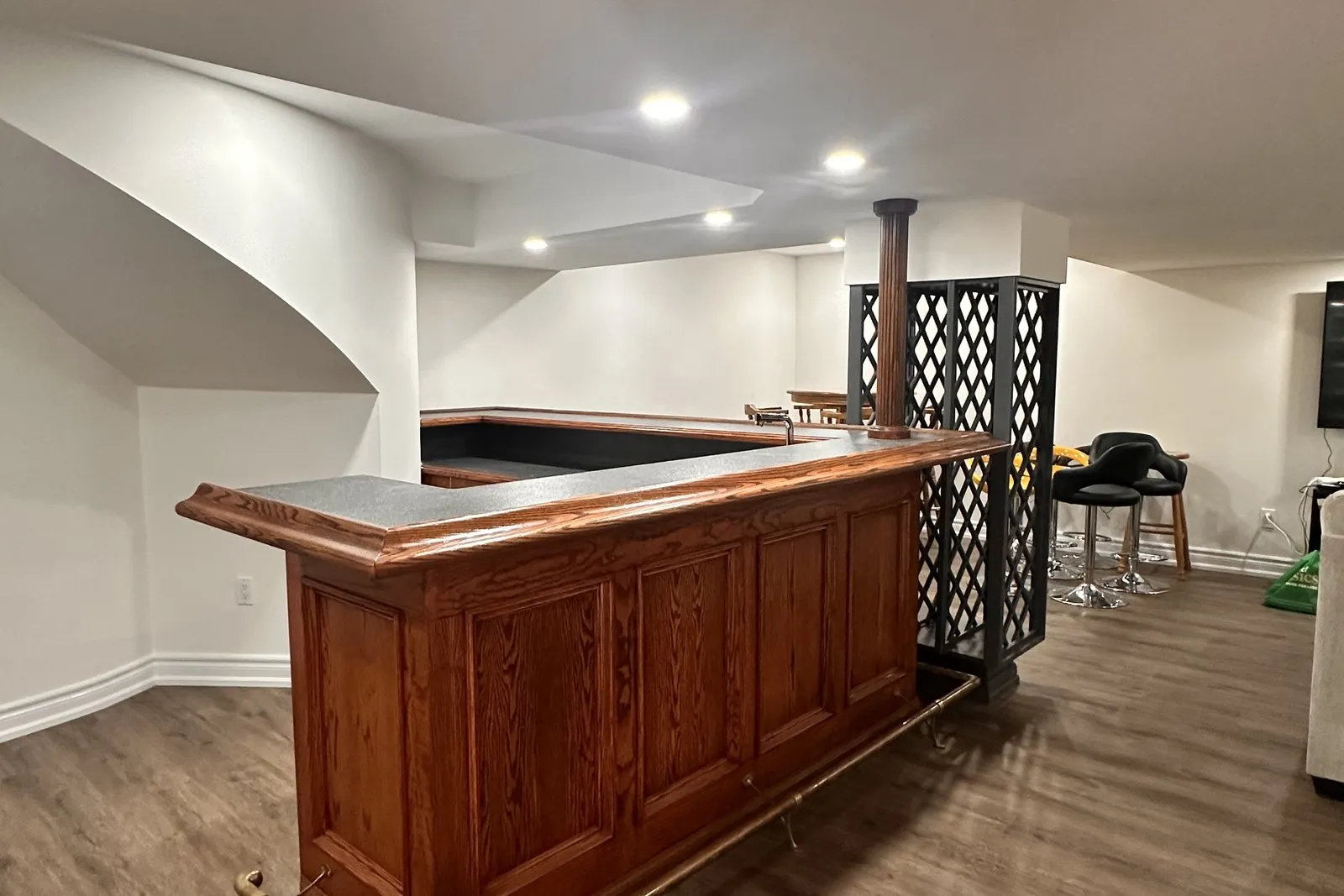
In the timber
Not in the film over it
Repairable
Locally, without recoating a whole panel
Non-yellowing
Which matters most under a clear coat
5.0
Rated on Google
Where colour lives, and why it decides everything else
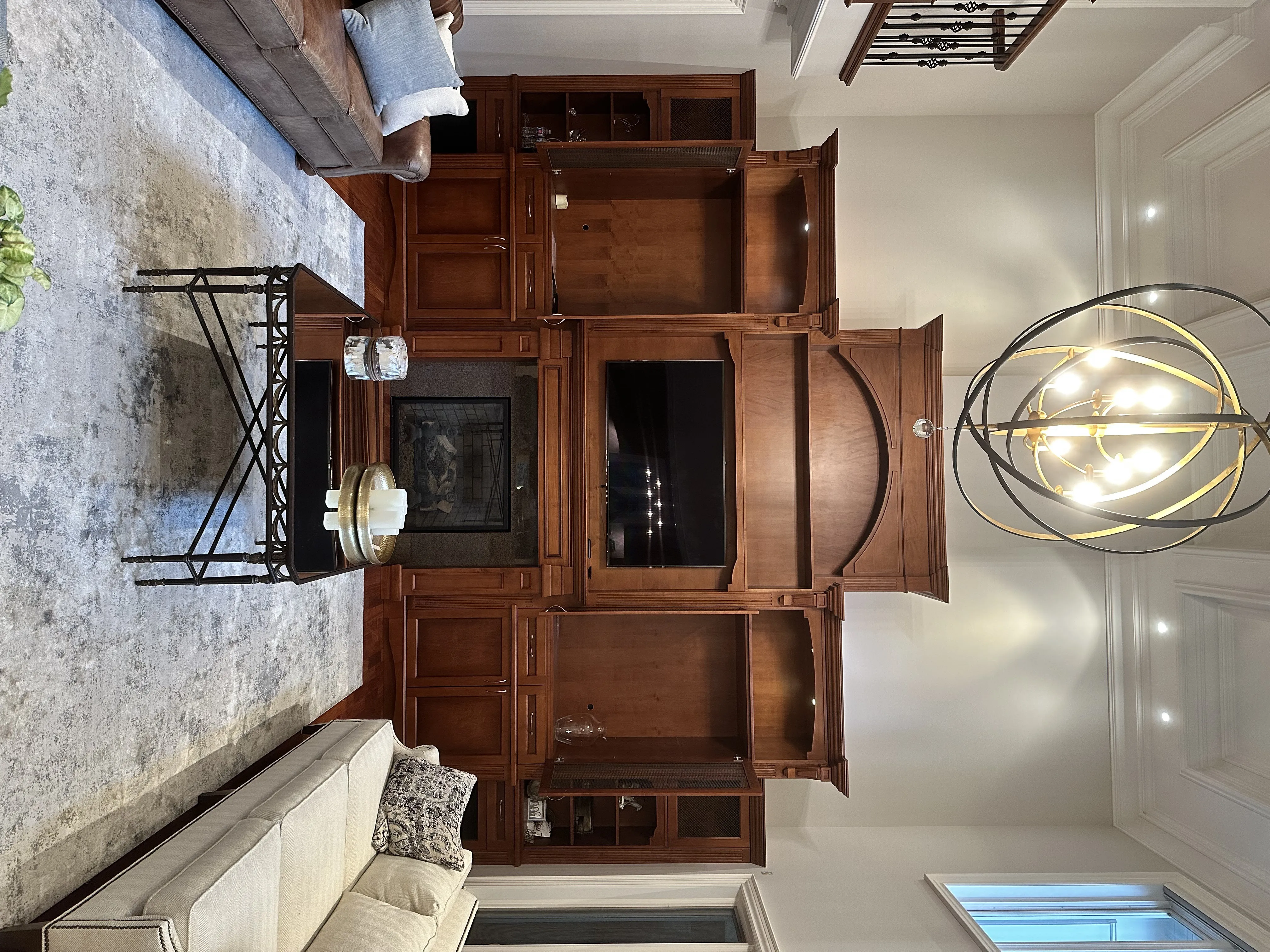
There are two ways to make wood a different colour and keep the grain showing, and they are not variations on a theme.
The first is a tinted topcoat: pigment suspended in the varnish, so one product colours and protects at once. It is quick, it is what most one-coat products on a shelf are, and the colour lives in the film sitting on top of the wood.
The second is what we do: stain the bare timber, let it dry, then seal it under a clear finish. The colour lives in the wood and the film over it is transparent.
Everything that matters downstream follows from that choice. When a chair back scuffs a stained-and-clear-coated panel, it removes finish and the colour underneath is untouched — the repair is local, a scuff sanded and reclear-coated, and it disappears. When the same thing happens to a tinted topcoat, the scuff takes colour with it and leaves a pale mark that cannot be spot-repaired, because any new tinted coat over it will be darker than its surroundings. The only fix is recoating the whole panel to a break.
Ten years in, that difference is the whole value of doing it properly.
The hard limit, and the one exception to it
Stain goes darker. It never goes lighter. Pigment and dye are added to timber; neither can be subtracted from it.
Honey oak becomes walnut. Walnut does not become honey oak. Maple becomes almost anything. Anything dark stays at least that dark. There is no product that reverses this and no technique — bleaching exists, it is aggressive, it raises grain badly and it does not produce a result anyone wants on cabinetry.
The exception, and it is worth knowing because it changes people's minds: a great deal of what reads as orange in a seventies or eighties Toronto kitchen is not the oak. It is the lacquer. Air-drying nitrocellulose and early oil-based finishes yellow steadily, and after forty years the amber is largely in the film rather than in the timber.
Strip it and the wood beneath is frequently several shades cooler and lighter than anyone in the house expected. That is not bleaching, it is removal, and it is occasionally the entire change somebody wanted — a natural clear coat over the stripped oak, no stain at all.
We find that out by stripping a small test area before anything is quoted as a recolour. It costs an hour and it has redirected a lot of projects.
Species, and why the same stain gives different answers
Stain is absorbed, and every species absorbs differently. This is the part that makes colour matching an experiment rather than a selection.
Oak is open-grained and takes stain readily and evenly. The pores accept more pigment than the surrounding wood, which is why stained oak reads with strong figure — the grain gets darker relative to everything else. It is the most forgiving species we work with and by far the most common in this part of the city.
Maple and birch are the opposite. Tight, closed grain, and they absorb erratically — dense areas take almost nothing while softer patches drink it in, producing blotching that is impossible to fix once it happens. Both need a conditioner or a wash coat applied first to even out absorption, and even then they will not look like oak.
Pine blotches worse than either and also has resinous knots that resist stain entirely, so a stained pine surface has pale rings wherever a knot is.
Cherry darkens on its own with light exposure regardless of what is put on it, which means a cherry piece stained to match something today will not match it in three years.
None of that is a reason to avoid any species. It is a reason we make sample boards from your actual timber rather than showing you a chart.
What goes over the top
Clear catalysed 2K polyurethane, in satin, applied over the cured stain.
Non-yellowing is the property that matters most here, more than hardness. An air-drying clear over a cool grey-brown stain drifts steadily warmer, and within three or four years the colour you carefully chose has become a colour you did not. Under an opaque white that same drift is a problem; under a clear coat over stain it undoes the entire point of the exercise.
Hardness still matters on anything handled. A stained handrail or a stained cabinet door is touched constantly, and a soft film burnishes to a shine where hands go.
Grain raise gets dealt with before the clear coats. Water-based stain and any water-based product lifts the wood fibres, so the first sealer coat is cut back before the build coats go on. Skipping that leaves a surface that feels faintly rough in a way people notice with their hands long before their eyes.
Two build coats over the sealer for most work, three on anything horizontal or heavily used.
Where staining is the wrong answer
Three cases, and between them they account for most enquiries we turn down.
Veneer. A face sheet a fraction of a millimetre thick will be sanded through somewhere during stripping, and a veneer sanded through cannot be repaired — the substrate underneath is a different material and takes stain differently, so the patch is permanent and obvious.
Timber with nothing to show. Ordinary construction-grade pine, poplar, or MDF have no figure worth uncovering. Staining them produces a brown surface rather than a wood surface, and paint would look better and cost less. Poplar in particular is a paint-grade timber and is frequently mistaken for something worth staining.
Anywhere the desired direction is lighter. Covered above, and it is worth saying twice because it is the most common disappointment in this service. If the goal is a pale kitchen and the timber is dark, the answer is paint and we will say so.
The one service here that adds colour without hiding anything
Everything else through this booth puts an opaque film over the wood. Staining is the exception, and choosing it is choosing to keep something visible that paint would end. It only works on solid timber and it only travels darker, which rules it out more often than it rules it in. Reading choosing between covering the grain and keeping it is the fastest way to know which side of that line your woodwork falls on.
Wood Staining Cost in Toronto
Priced on the stripping hours first, the colour work second, and the clear coats third — in roughly that order of cost.
Stripping dominates and it is driven by the profile rather than the area. A flat panel strips quickly. A raised panel with a moulded edge has corners where the old finish sat thickest and where nothing but a hook and a hand will reach. Two pieces of identical size can differ by a factor of three on this line alone.
Colour work includes the sample boards, which are made from your own timber and are not an extra. Where a match to an existing floor or piece is wanted, expect more than one round of samples, and that is time rather than material.
There is a test we would rather do before quoting a recolour at all: strip a small hidden area to see what the timber under the old finish actually looks like. It has changed enough projects that we now treat it as standard on anything older than about thirty years.
Written price inside 24 to 48 hours from photographs, with stripping and colour work on separate lines. Cash, debit, credit and Visa.
Questions
Common questions about wood staining in Toronto
- Can you match a stain to my existing floor?
- Close, and honestly not exact, and anyone promising exact is guessing. Different species take colour differently — the same stain on oak and on maple produces two noticeably different results. We make sample boards on your actual timber and put them next to the floor in your light before committing.
- How is this different from a tinted varnish?
- A tinted varnish is one product doing two jobs, with the colour suspended in the film. Wear takes colour with it and a repair means recoating the whole panel. Staining colours the wood and a separate clear coat protects it, so wear removes finish and leaves the colour.
- Will it look blotchy?
- Not on the species that stain evenly. It genuinely can on pine, birch, maple and some cherry, which absorb unevenly and go patchy without a conditioner first. We know which species need it, we test on an offcut, and if a piece is going to blotch we tell you before rather than after.
- Can you stain over an existing stain?
- Only darker, and only after the old finish is off. There is no sealed surface a stain can penetrate — it has to reach open timber, which means the varnish or lacquer over the old colour has to be stripped and sanded first. That stripping is most of what you are paying for.
- What sheen should I choose?
- Satin for almost everything, and there is a reason beyond taste. A higher sheen on a stained surface reflects hard enough to obscure the grain you paid to keep visible, and it reports every fingerprint. Matte can look flat and lifeless over a dark stain. Satin sits where the figure reads best.
Timber worth keeping visible?
Photograph the piece, plus a close shot of an edge and the back, so we can confirm it is solid rather than veneered. The written price comes back inside 24 hours with stripping and colour work on separate lines.
Free in-home consultation · no obligation
Refaced. Repainted. Refinished.