
Spray Painting in Toronto — Half in a Booth, Half in Your House
Every spray job splits in two, because face frames cannot be unscrewed from a wall. How the two halves are made to match is the whole craft.
Two halves
Booth for the fronts, containment for the frames
One batch
So the two halves are the same colour
2–3 days
Out of the house while frames are sprayed
5.0
Rated on Google
Two halves, one colour
A kitchen has parts that unscrew and parts that do not, and that single fact dictates how every spray job is organised.
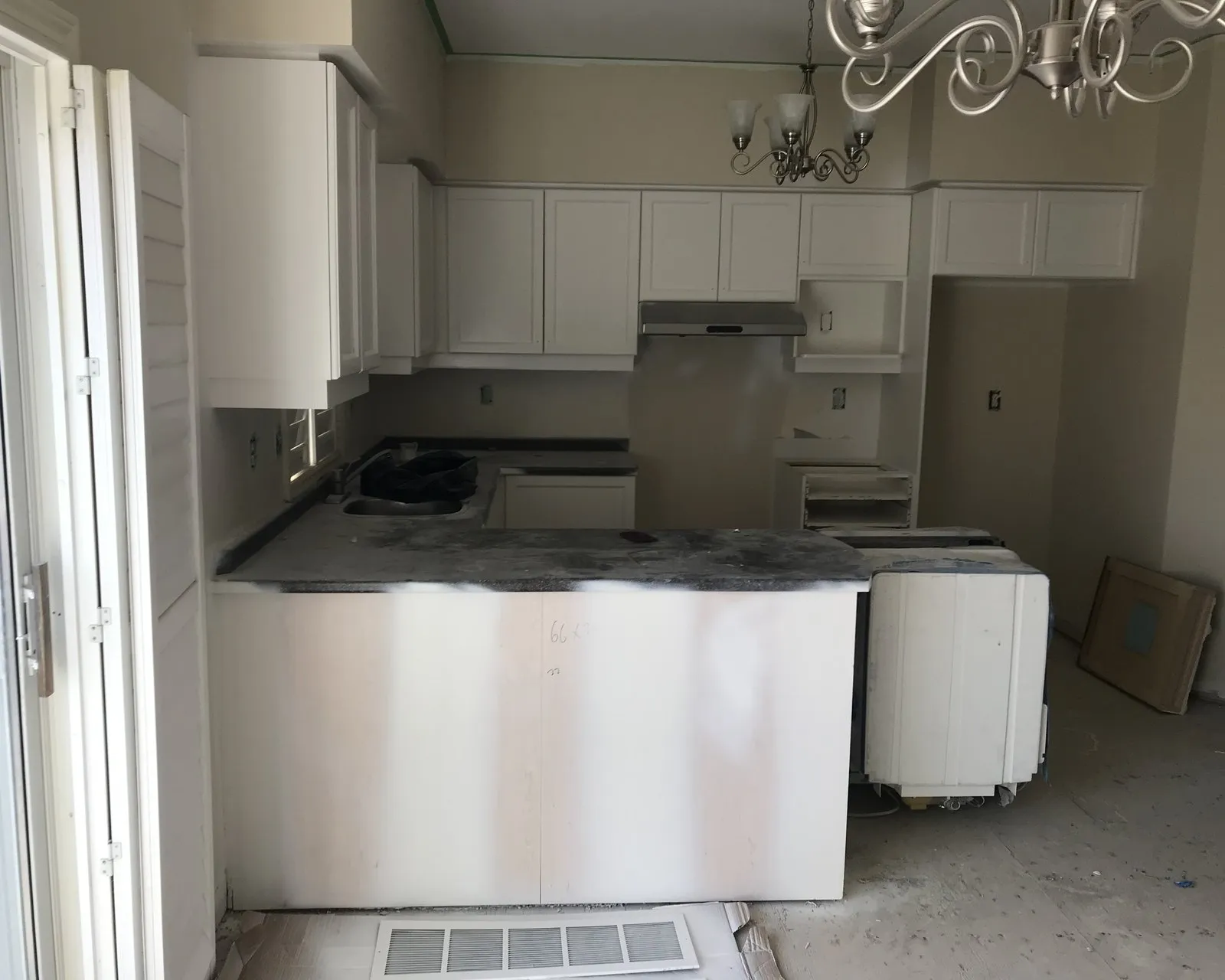
Doors, drawer fronts, shelves, valances and any loose panel come off, get labelled, and travel to the booth on Barmac Drive. Face frames, exposed end panels, tall cabinet sides and anything built into the wall stay where they are and get sprayed in your house.
The obvious risk is that the two halves do not match. Two batches of the same colour code can differ slightly. Two application conditions certainly do — the booth is at a controlled temperature and your kitchen is at whatever the day is doing, and temperature affects how a coating flows and therefore how a sheen reads.
So the halves are tied together deliberately. Same product, same colour, mixed as one batch and split, with the frames sprayed inside a short window of the doors rather than weeks apart. The sheen is checked against a door before the frames are committed to. It is a matching problem before it is a painting problem, and treating it that way is the difference between a kitchen that reads as one object and one where the boxes are subtly greyer than the fronts.
What atomisation actually does
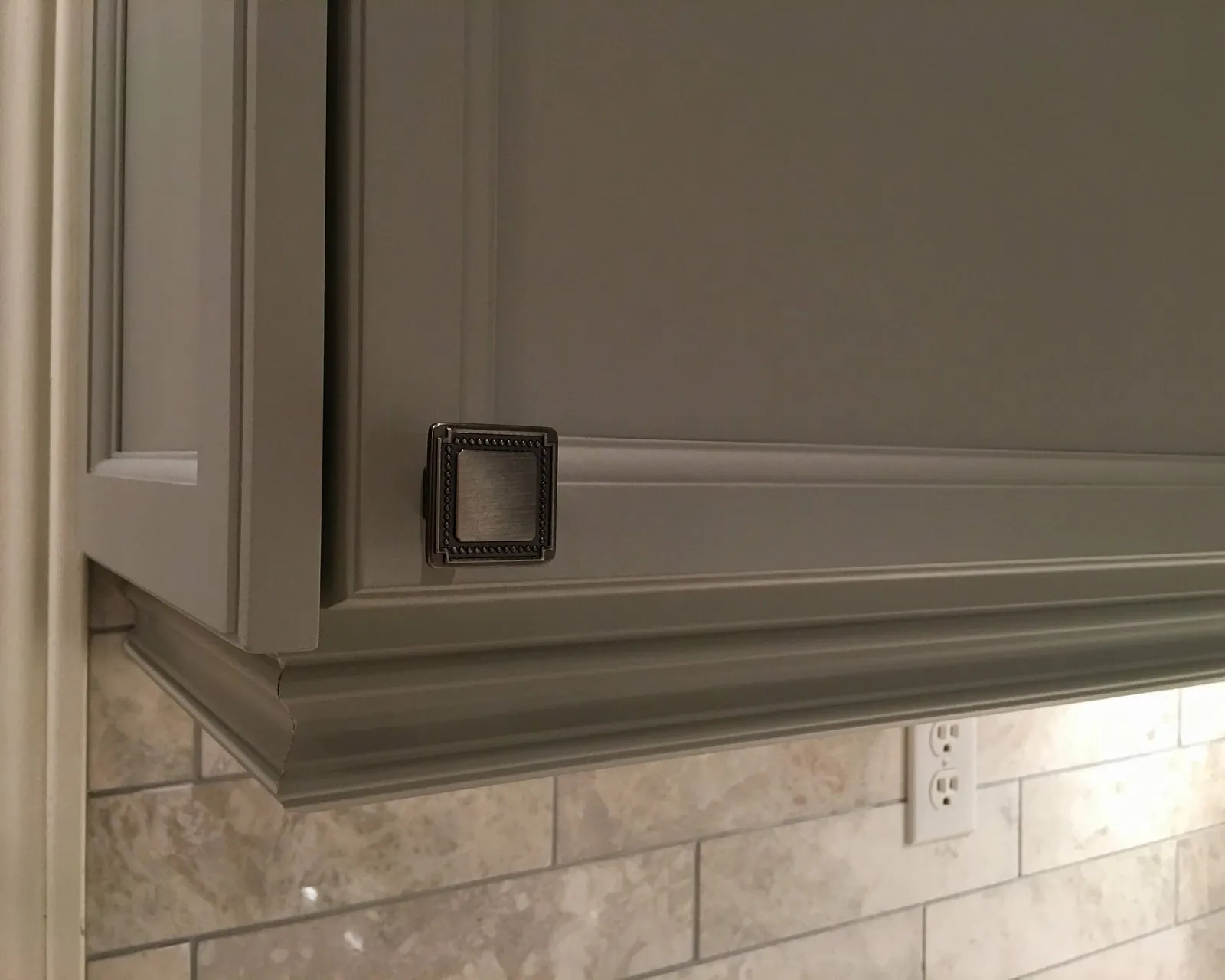
A gun does not apply paint. It breaks paint into droplets small enough that they arrive as a mist and merge on landing.
The consequence is that the coating has no direction. A brush lays material in the direction it moves and leaves ridges that flatten out only partly. A roller leaves a stipple. A sprayed film arrives everywhere at once at the same thickness, and when it flows out there is no stroke to flow out of.
There is also no join. A brushed panel has to be finished before the leading edge starts to set, or the next stroke lands on partly-dry material and leaves a lap line. On a large door in a warm room that window is short, and lap lines are the single most common visible defect on brushed cabinetry.
The trade-off is that spraying puts material in the air, which is why it can only be done in a booth or behind containment — and why the equipment, the preparation and the protection cost more than a brush and a tin.
Containment, in a house people live in
This is the half of the job nobody photographs and it is where most of the day one labour goes.
Plastic sheeting goes floor to ceiling across every opening out of the kitchen, and where a Toronto bungalow has an open plan that means sealing a doorway that has never had a door. Floors get covered and taped at the edges. Appliances are wrapped rather than just draped. Anything on a wall within reach of the mist comes off or gets covered.
Then extraction. A fan and ducting run out of a window, pulling air out of the contained space so it is at slightly lower pressure than the rest of the house. That is the part that matters most: it means air flows into the sealed area and not out of it, so overspray cannot drift down a hallway and settle on somebody's bedroom furniture.
It takes the best part of a day to build and about two hours to take down. It is on your quote as its own line, and if a quote you are comparing does not have something like it, the question worth asking is where the overspray is going.
The order of the coats
The schedule is dull and it is most of what a good finish is.
Degrease first, with a solvent formula, on every surface. Then abrade — not sand back, just enough to give the primer a mechanical key everywhere. Then vacuum and tack, because everything just loosened is now sitting on the work.
Primer next, chosen for the substrate rather than one primer for everything. Timber with any chance of tannin bleed gets a blocking primer, and oak and knotty pine both need it — a bare-timber primer under white on old oak lets brown come through at the grain within weeks.
Sand the primer flat. This is the coat that decides the outcome. Every raised fibre and every speck is dealt with here, because a topcoat magnifies what is under it rather than filling it.
Then two coats of 2K with a light denib between them. On a door, applied horizontal. On a frame, applied in place with the wet edge kept moving.
Nothing in that list can be skipped without it showing, and every step of it is in the price whether or not it is itemised.
What we spray and what we do not
Kitchen cabinetry is the bulk of it, and everything above applies to it directly.
Beyond the kitchen: interior and front doors, bathroom vanities, built-in bookcases, window seats, banisters and newel posts, radiator covers, and freestanding furniture. Anything that can come to the booth generally should.
What we deliberately do not spray is trim attached to walls in an occupied house where masking the entire room would cost more than the improvement. Skirting, architrave and casings in a lived-in Toronto semi are usually brushed in a waterborne alkyd, which lays down far better than people expect and does not require sealing off a family's living room for three days.
We also do not spray over failed substrates. A delaminating thermofoil door, a swollen particleboard end panel, a water-damaged sink base — those are replacement work, and putting an excellent finish on one is spending good money to make a failing part look expensive.
Spraying is the method, not the service
Nobody buys spray painting on its own — they buy a kitchen, a set of doors, a staircase or a run of built-ins, and spraying is how it gets done. This page is about the method because the method is what separates two quotes that use the same words. Reading what the spray equipment gets used on across a house shows what it gets applied to, and where we deliberately reach for a brush instead.
Spray Painting Cost in Toronto
Spray work is priced on two things: the surface area being coated, and the number of days containment has to stand in your house.
Surface area is not the same as door count. Interiors and shelving roughly double the area of a kitchen, which is why they are always their own line and why most people decline them. A run with a lot of exposed end panels has more frame area than its door count suggests.
Containment days are the other lever, and they are why doing all your spray work in one visit costs less than splitting it. The sheeting and extraction go up once. If the stair banister and the bathroom vanity are going to be done eventually, doing them alongside the kitchen costs a fraction of doing them as their own job later.
The quote separates booth work from in-place work so you can see both. The written price comes from photographs inside 24 to 48 hours and does not move afterwards. Cash, debit, credit and Visa, staged through the project.
Questions
Common questions about spray painting in Toronto
- Why can the whole kitchen not be sprayed at the shop?
- Because the face frames are screwed to your wall and the exposed end panels are part of the run. Only the parts that unscrew can travel. Everything fixed gets sprayed in place behind containment in the same product from the same batch, which is how the finished kitchen reads as one colour rather than two.
- What does containment actually involve?
- Plastic sheeting floor to ceiling across every opening, the floor protected, appliances covered, and negative-pressure extraction ducted out of a window so overspray leaves the house rather than settling in it. It takes most of a day to build and it is the reason nothing else in your house ends up with a fine mist on it.
- Why do we have to leave for two or three days?
- Because 2K is solvent-based. During spraying and for a period afterwards the air in that part of the house is not something to sleep next to, whatever the extraction is doing. We would rather say this plainly than describe it as low-odour and have you find out.
- Can you spray a water-based product so we can stay?
- We can, and we will if somebody needs it — but you should know what is being traded. A water-based enamel never reaches the hardness of a catalysed finish, and on cabinet doors that difference shows up as marking around the handles within a couple of years. It is your call, made with the trade-off stated.
- How do you stop dust landing on a wet frame?
- Filtered incoming air where we can, extraction pulling air one direction, and sequencing — the sanding is finished and the space is cleaned down well before anything is sprayed. It is not a booth and we do not pretend it is. It is as close as an occupied house gets.
Comparing a sprayed quote with a brushed one?
Send wide photographs of every run and the written price comes back inside 24 hours, with the booth work and the in-place work itemised separately so you can see exactly what each half of the job costs.
Free in-home consultation · no obligation
Refaced. Repainted. Refinished.