
Kitchen Design in Toronto — Decisions Made in the Room They Affect
Every colour decision made in a showroom is made under the wrong light. A tone that reads warm at the shop turns orange under a north-facing window.
No charge
And no deposit taken on the day
In your kitchen
Samples on your own counter, your own light
Quote first
The price is agreed before design starts
5.0
Rated on Google
What this actually is, and what it is not
A kitchen design service in this trade usually means one of two things. Either it is a full renovation design — walls, services, appliances, the lot — or it is a sales visit with a sample case.
This is neither. It is the set of decisions that remain once the boxes are staying put and the price has been agreed: which door profile, which colour, which hardware, which storage changes are worth making, and the handful of layout moves that are possible without opening a wall.
That is a narrower service than an architect's and a much more useful one for the kitchen most people actually have. In a North York bungalow with a working layout and forty-year-old fronts, almost nothing that needs deciding involves a wall. Everything that needs deciding involves the surface you look at.
What we do not do is walls, floors, plumbing and electrical. We say so early, because the alternative — saying yes and subcontracting it — is how a project gets a project manager and a markup and nobody accountable.
Why the light in your kitchen is the whole point
This is the single most consequential thing on the page and it is about physics rather than taste.
Colour is a property of light reflecting off a surface, not a property of the surface. A showroom is lit to make product look good: warm-white LED at high output, usually from several directions, usually with no window. Your kitchen has one or two windows facing one direction, a light fitting chosen by a previous owner, and under-cabinet strips that may be a completely different colour temperature from the ceiling.
Take a warm off-white chosen under showroom light into a north-facing Toronto kitchen and it reads yellow — properly, visibly yellow, in a way that cannot be unseen. Take a cool grey into a west-facing room and at five in the afternoon it turns lilac for an hour every day.
So the samples come to you, they sit on your own counter, and we look at them in the morning light and again with the room lights on. It is the cheapest step in the whole project, and it prevents the most expensive regret in it.
We leave samples behind for a few days on any colour anyone is uncertain about. There is no rush from our side because the price is already fixed.
Profile, and the thing people get backwards
Most people arrive having chosen a colour and not having thought about the door profile. It is the wrong way round.
Colour is changeable — not cheaply, but a kitchen can be repainted in a few years. The door profile is the kitchen. A shaker door and a slab door in identical white produce rooms that feel nothing alike, and a raised-panel door with an ogee edge reads traditional no matter what colour goes on it.
The profile also has to answer to the house. A 1958 side-split with original trim and a 2004 open-plan build are not asking the same question, and a profile borrowed from a magazine shot of a house nothing like yours is the most common way a good budget produces a room that feels off.
What we say most often: match the door to the age and character of the house rather than to the year you are renovating in. A kitchen that is legible with the house it sits in still looks right in fifteen years. A kitchen that is legible with this year does not.
Storage, which is where most of the improvement actually hides
If there is one part of this visit that returns more than people expect, it is the inside of the cabinets rather than the outside.
Almost every kitchen we open has the same problems. A deep corner cupboard nobody can reach the back of. A cutlery drawer on the wrong side of the room from the dishwasher. Shelves at a spacing set in 1962 for tins that are no longer the size tins are. Under-sink space full of pipework and nothing else.
Most of that is solvable while the doors are off anyway, and it is dramatically cheaper then than at any other moment. Pull-outs into a blind corner. Shelves re-spaced or replaced. A drawer bank where a door and a fixed shelf currently are. Soft-close on everything, which is a small thing that people report noticing daily for years.
None of it is compulsory and every item is its own line in the quote, so you can take the ones that matter and leave the rest.
Layout, and how far it can go without a wall
There is real layout work available inside a kitchen whose walls are staying, and it is worth knowing the boundary.
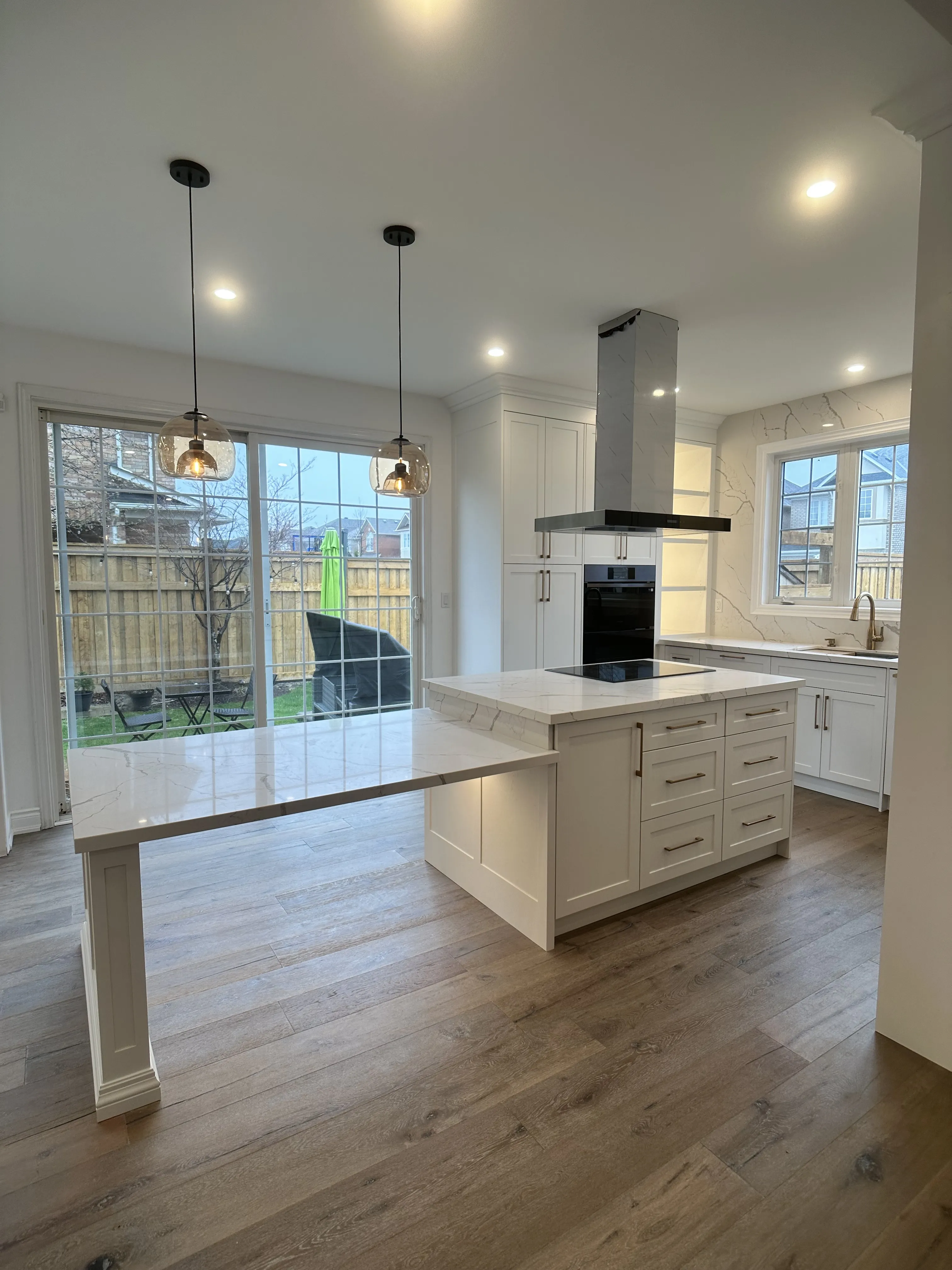
Movable without touching services: any cabinet that is not carrying a sink, a hob or a built-in appliance. Door swings. Where the tall storage is. Whether an island is resurfaced, extended, or given a new overhang for seating. Whether an upper run comes out entirely to open a wall visually, which is frequently the change that makes the biggest difference in a small Toronto kitchen and costs the least.
Not movable without other trades: the sink, because it is plumbing; the hob and oven, because they are gas or a dedicated circuit; and anything that requires a wall to be opened. Those are not ours and we will tell you who to ask.
The honest summary is that most of what people dislike about their kitchen can be fixed without moving a single service. The remaining twenty percent is a different project with a different budget, and if that is what you need, hearing it at the design visit is better than hearing it three weeks in.
Design is the last step, not the first
In most of this trade a designer visits, produces drawings, and a price appears at the end — by which point you have invested time and it is awkward to walk away. We invert it. The written price comes from photographs first and does not move, so the design visit is somebody helping you choose rather than somebody closing you. Reading why the price comes before the design visit rather than after it explains why that order changes the conversation entirely.
Kitchen Design Cost in Toronto
There is no charge for the design visit and no deposit is taken on the day.
That is possible because of the order things happen in. The written price is produced from photographs and reaches you inside 24 to 48 hours, itemised, before anyone visits. So by the time somebody is standing in your kitchen with samples, the commercial part is settled and the visit is doing one job: helping you choose well.
The alternative arrangement — design first, price at the end — is common and it puts a thumb on the scale. Once somebody has spent two hours drawing your kitchen, walking away feels rude, and that feeling is worth money to whoever engineered it.
Where design decisions do change the price, they change it visibly and by their own line: a different door profile, a premium colour, upgraded hardware, storage internals, interiors sprayed. You see each one and can decline any of them, and the revised number is written down rather than agreed verbally at your counter.
Cash, debit, credit and Visa, staged through the project, with nothing due until work starts.
Questions
Common questions about kitchen design in Toronto
- Is this a full architectural design service?
- No, and it is better to be clear than flattering. We hold two trades, cabinetmaking and spray finishing — we are not architects, we do not move walls, and plumbing and electrical are not ours. What this covers is everything about the cabinetry — profile, colour, hardware, storage and the layout changes possible without opening a wall.
- What does it cost?
- Nothing, and there is no deposit taken on the day. That is only possible because the price was already produced from photographs, so the visit is not doing the selling. A design visit that ends with a contract in front of you is a sales call with samples in it.
- Can you work with a designer I already have?
- Yes, and it is straightforward. We build and finish to a specification; if somebody else has written it, we quote against it. Where we will push back is on a spec that asks for something the substrate cannot do — a stain on veneer, for instance — and we would rather have that conversation early.
- What do you bring?
- Door profile samples in the real material, colour chips, hardware, and finished door samples in the actual 2K rather than printed swatches. The point is to see the real finish in your own light, because a photograph of a colour is not a colour.
- What order does a kitchen project actually go in?
The order is not a preference — stone is templated off cabinets that have to be installed and level first, so several steps depend on the physical existence of the one before. Reading the steps that physically cannot happen early explains the spine of it, and why almost every delay traces to a decision rather than a trade.
- Where does most of a kitchen budget go?
Cabinetry, by a wide margin, and it is also the least itemised line — which is why people misjudge it. Reading the largest line on almost every kitchen quote sets out the proportions and where the money is most often wasted, which is usually on replacing boxes that were doing their job perfectly well.
- How long does the visit take?
- An hour or so for most kitchens, sometimes two where there is genuine layout work to think about. It is not a presentation and there is no slide deck. It is somebody who has done this for twenty-five years standing in your kitchen with samples, saying what they would do.
Want the samples in your own kitchen before deciding?
Send wide photographs first — the written price comes back inside 24 hours and does not change. The design visit follows with the number already settled, which is the only way to choose a colour without a clock running.
Free in-home consultation · no obligation
Refaced. Repainted. Refinished.