
Cabinet Refinishing in Vaughan — Keep the Doors, Change What Is On Them
The opposite decision from refacing. You keep the doors you have and change the surface, which only works when there is real timber underneath.
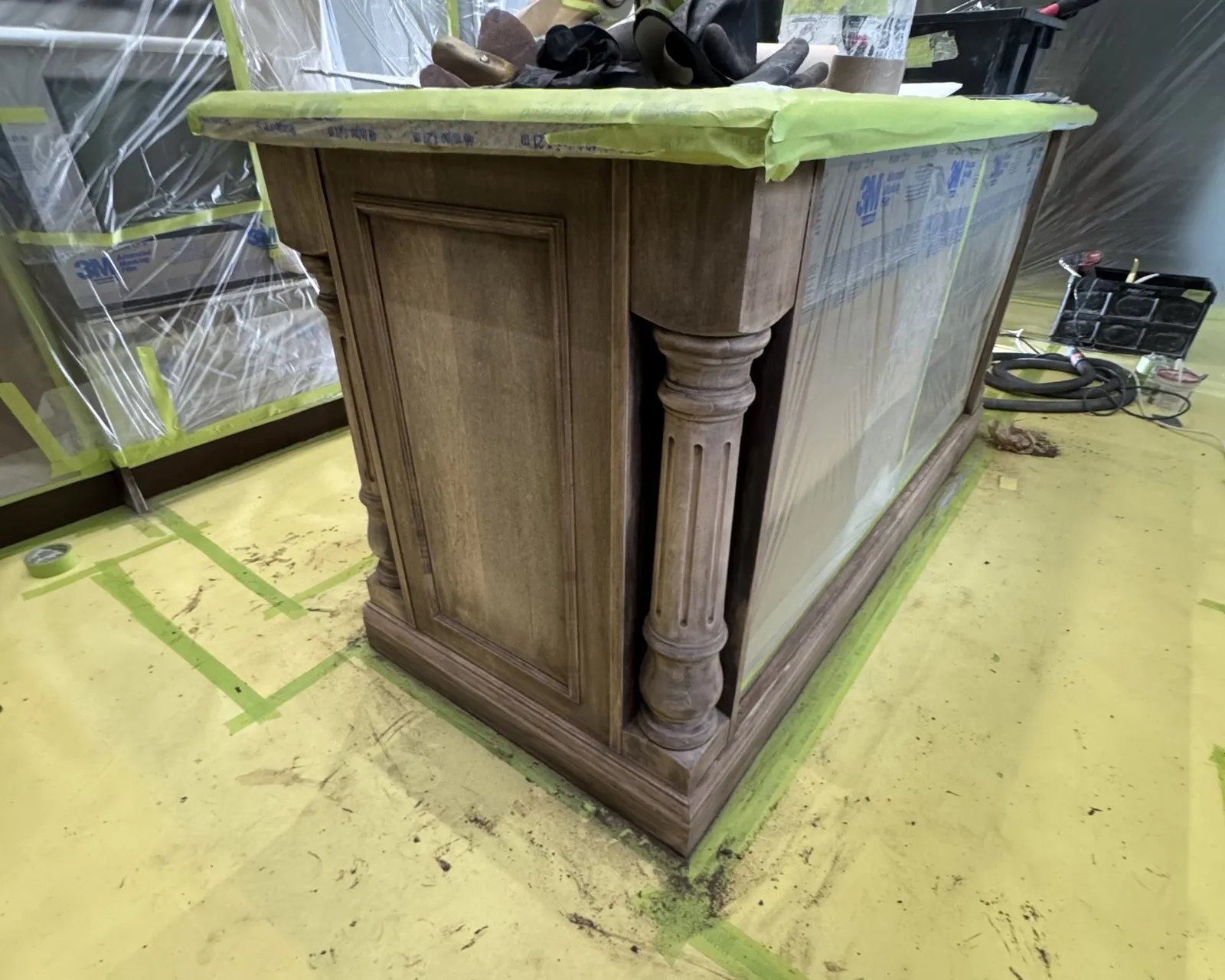 Before
 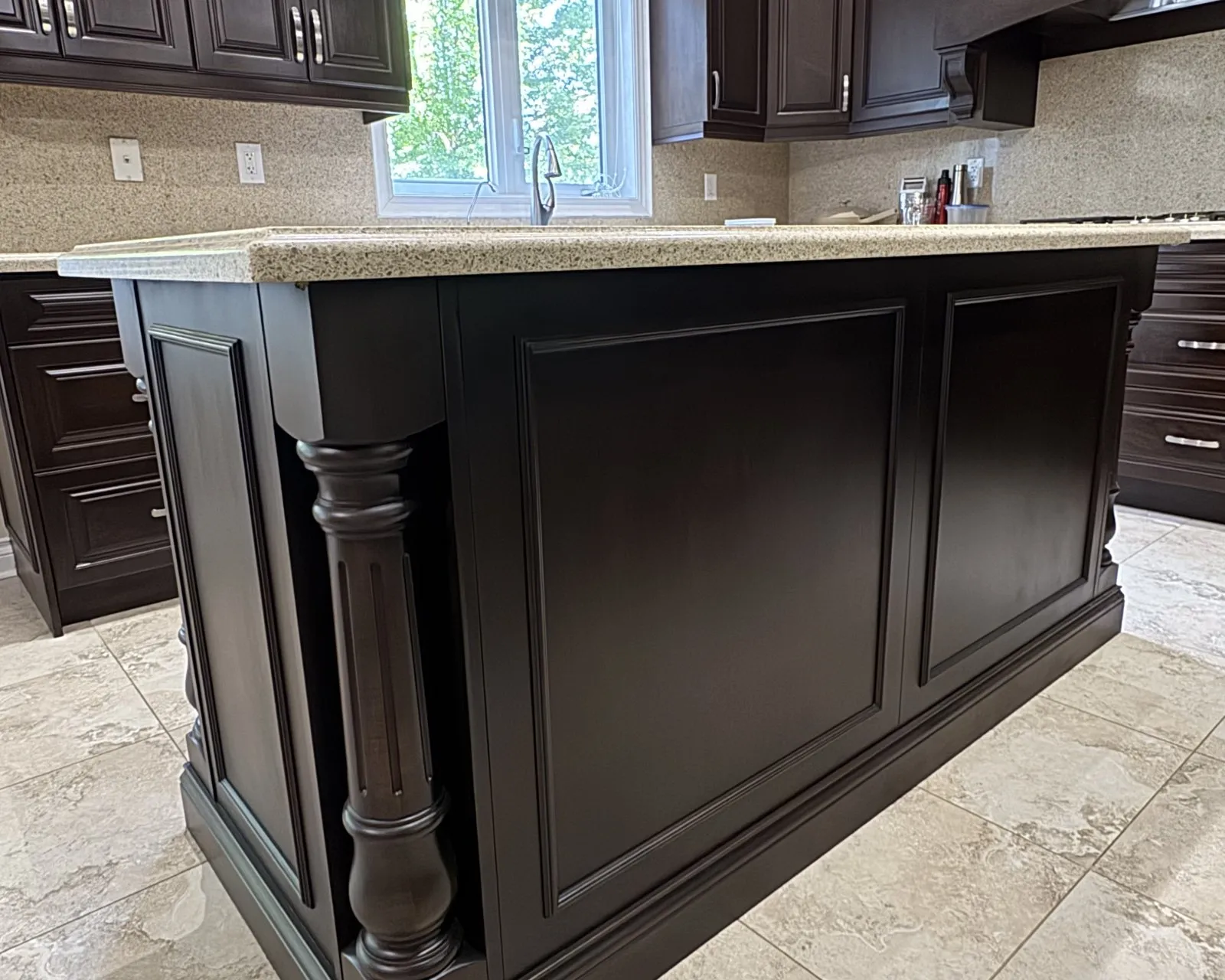 After
After Solid wood
The only substrate this works on
2–3 weeks
Most of it with a working kitchen
5 years
On the finish and the workmanship
4.9
Rated on Google
What refinishing actually means
Stripped to bare timber, stained, sealed. Not sanded and recoated — stripped, which is a different operation and most of the cost. Every layer of old lacquer, varnish or oil comes off until what is left is the wood the doors were made from, and only then does anything go back on.
What you get at the end is the same doors in a different colour of wood, with the grain visible through it. That is the whole proposition, and it is why the service exists alongside painting rather than instead of it: painting covers the timber, refinishing uncovers it.
The stain goes on to the tone you have chosen and the whole thing is sealed under clear 2K polyurethane — the same catalysed finish that goes onto a refaced kitchen, without pigment. Hard, non-yellowing, and repairable.
The one condition, and why it rules kitchens out
It only works on solid wood. Not veneer, not thermofoil, not MDF.
Veneered doors carry a face sheet a fraction of a millimetre thick. Stripping is chemical and mechanical and it goes straight through — and a veneer sanded through at one corner cannot be put back. Thermofoil is a vinyl film heat-wrapped onto a core; there is no timber under it at any point. MDF is engineered board, and while it takes a sprayed colour beautifully it has no grain to reveal.
This is not a preference or an upsell. A kitchen whose doors are not solid timber cannot be refinished by anyone, and a company that quotes to refinish them is going to paint them and describe it differently. We check before quoting, which occasionally means telling somebody that the service they called about is not available to them.
The other condition is the profile. Refinishing keeps the door you have in the shape you have. If the shape is what you dislike, no finish improves it.
Why stripping is the expensive part
Chemical stripper, dwell time, scraping, neutralising, sanding through the grits, and doing all of it again in the corners of a raised panel where the old finish is thickest and the access is worst. On a moulded door there is no machine for it — it is hands and time, and the time is the price.
That is also why refinishing is not simply the cheaper option people expect it to be. Refacing buys manufactured doors sprayed in a controlled booth; refinishing buys labour applied to what you own. On a kitchen with forty raised-panel doors, refinishing can cost more than refacing with flat MDF fronts and be worth every dollar of it, because the two produce different kitchens.
It is also the reason we will not quote refinishing from a bad photograph. How much finish is on there, and how sound it is underneath, changes the number materially.
The three weeks, and where they go
The doors, drawer fronts and any removable panels come off on day one, are labelled, and go to the shop. Everything else in your kitchen keeps working — the sink, the appliances, the countertops — with open shelving where the fronts used to be.
At the shop they are stripped, sanded, stained to the tone chosen on day one and sealed under clear 2K, with the sanding between coats that makes the difference between a finish that feels like glass and one that feels like paint. That is most of the two to three weeks.
The frames are done last and in place, behind sealed containment. On a solid-wood kitchen the frames get the same treatment as the doors — there is no version of this where restored fronts are hung on frames nobody touched. This is the disruptive part and it is the shortest.
Then the doors come back, get hung, and every one is adjusted so it sits square and closes properly.
What refinishing will not fix
Worth saying plainly, because the photographs people send are usually of the door faces and the problems are usually elsewhere.
A door that has taken on water at its bottom edge has swollen, and swelling does not reverse. Stripping it back reveals the damage rather than removing it. The same is true of a joint that has opened at a corner — a stripped door shows the gap more clearly than a painted one did, because there is no longer a film bridging it.
Hinges are a separate matter and usually a cheap one. A door that has dropped is almost always a hinge that has lost its adjustment rather than a door that has failed, and that is corrected on refit at no meaningful cost.
And the layout is the layout. Refinishing changes the surface of a kitchen and nothing about its shape — where the complaint is really that the island is in the wrong place or there is nowhere to put a bin, a better finish is the wrong purchase and we would rather say so at the quoting stage.
Refinishing is the narrowest of the three
It needs solid wood, it needs grain worth showing, and it needs doors whose shape you still like — three conditions, and a kitchen failing any of them wants something else. Veneered or MDF doors cannot be stripped at all. A profile you have gone off is not improved by a better finish on it. Working out which of the three a given kitchen actually wants is what the page above this one does, with all three set against one kitchen and the timings and costs side by side.
Cabinet Refinishing Cost in Vaughan
Refinishing is priced on the door and drawer count and on how much has to come off, and the second of those is why we ask for photographs of the doors themselves rather than of the room. Two identical kitchens can differ by a third depending on whether the existing finish is a thin lacquer or four decades of built-up varnish.
Profile drives it next. A flat or shaker door strips at a predictable rate; a raised panel with a moulded edge has corners that only hands can reach, and a kitchen full of them takes materially longer.
Frames are quoted with the fronts rather than separately, because on a solid-wood kitchen doing one without the other produces a result nobody wants. Where a customer wants only the doors done, we will say what that will look like before agreeing to it.
Against refacing, refinishing is not reliably cheaper and is sometimes dearer. What it is, is the only one of the three that keeps the timber visible — so the honest comparison is not on price but on which kitchen you actually want at the end.
Questions
Common questions about cabinet refinishing in Vaughan
- Can I see how a refinishing job runs before I book?
Yes. Our showcase shows how a refinishing job runs, start to finish, with real kitchens we have finished, what gets sprayed where, prices and warranties.
- How do I know if my doors are solid wood?
- Look at the edge of a door and at the back of it. Solid timber has grain that runs over the edge and continues on the reverse; veneer has a seam where the face sheet stops, and MDF has a uniform brown core with no grain at all. If you are not sure, photograph the top edge of one door and we will tell you. Getting this wrong is the most common reason a refinishing enquiry becomes a painting quote.
- Can you make oak look less orange?
- Usually, and it is the most common request we get. Stripping removes the old finish, and much of what reads as orange is the finish rather than the wood — an amber lacquer over honey oak yellows further with age. Stripped back and stained cooler, the same door can read very differently. It cannot be made white; that is painting.
- Is refinishing cheaper than refacing?
- Not necessarily, and often not. Stripping is slow, it cannot be rushed, and it is almost all labour — it is the most hands-on of the three services. Refacing buys new doors with a factory-sprayed finish; refinishing buys craft applied to the doors you own. Which is cheaper depends on the door count and on how much finish has to come off.
- Does the kitchen have to be out of use?
- Far less than for refacing. The doors and drawer fronts go to the shop for the stripping and finishing, which is most of the two to three weeks, and your kitchen works normally throughout with open shelving where the fronts were. The frames are done in place at the end, and that is the disruptive part.
- What about the cabinet frames — can they be refinished too?
- Yes, and on a solid-wood kitchen they should be, or you will have restored doors hung on tired frames. They are stripped and finished in place behind containment rather than removed. It is the slowest part of the job and it is why a full refinish is quoted on the frames as well as the fronts.
Not sure what your doors are made of?
Photograph the top edge of one door and the back of it, and we will tell you whether refinishing is even possible before quoting anything. If it is not, you will hear that rather than a price.
Free in-home consultation · no obligation
Refaced. Repainted. Refinished.